
MTF Tests of the Sony FE 24-105mm f/4 OSS
Or ‘My Last 24mm-105mm Lens Test Ever’
Obviously, I have angered the Lens Testing Gods, since for the second post in a row I’m testing 24-105mm f/4 lens; this time the Sony 24-105mm f/4 OSS lens. As I’ve mentioned in the post on the Sigma 24-105mm f/4 many initials Art lens, while these are indispensable photographic tools, I despise testing 24-105mm f/4 lenses. They are technically a total pain to test, and historically they’re all pretty much the same.
So, yes I am bitter and feeling a bit sorry for myself. I mean, two weeks ago I’m doing some double-naught-secret-agent testing on a spectacular wide aperture prime lens with a resolution that made my jaw drop at frequencies I wasn’t sure was possible to test. Next thing I know, I’m spending two weeks testing 24-105mm f/4 zooms hoping for signs of adequacy. That should tell you all you need to know about my predispositions coming into this set of testing.
About Today’s Subject
The Sony 24-105mm f/4 OSS adds a do-it-all-lens to Sony’s line up. Much as I don’t like testing these, I’m the first to admit they are extremely practical and useful lenses, covering everything from moderate wide-angle to slightly telephoto. With OSS it should make a great walk-around or travel lens.
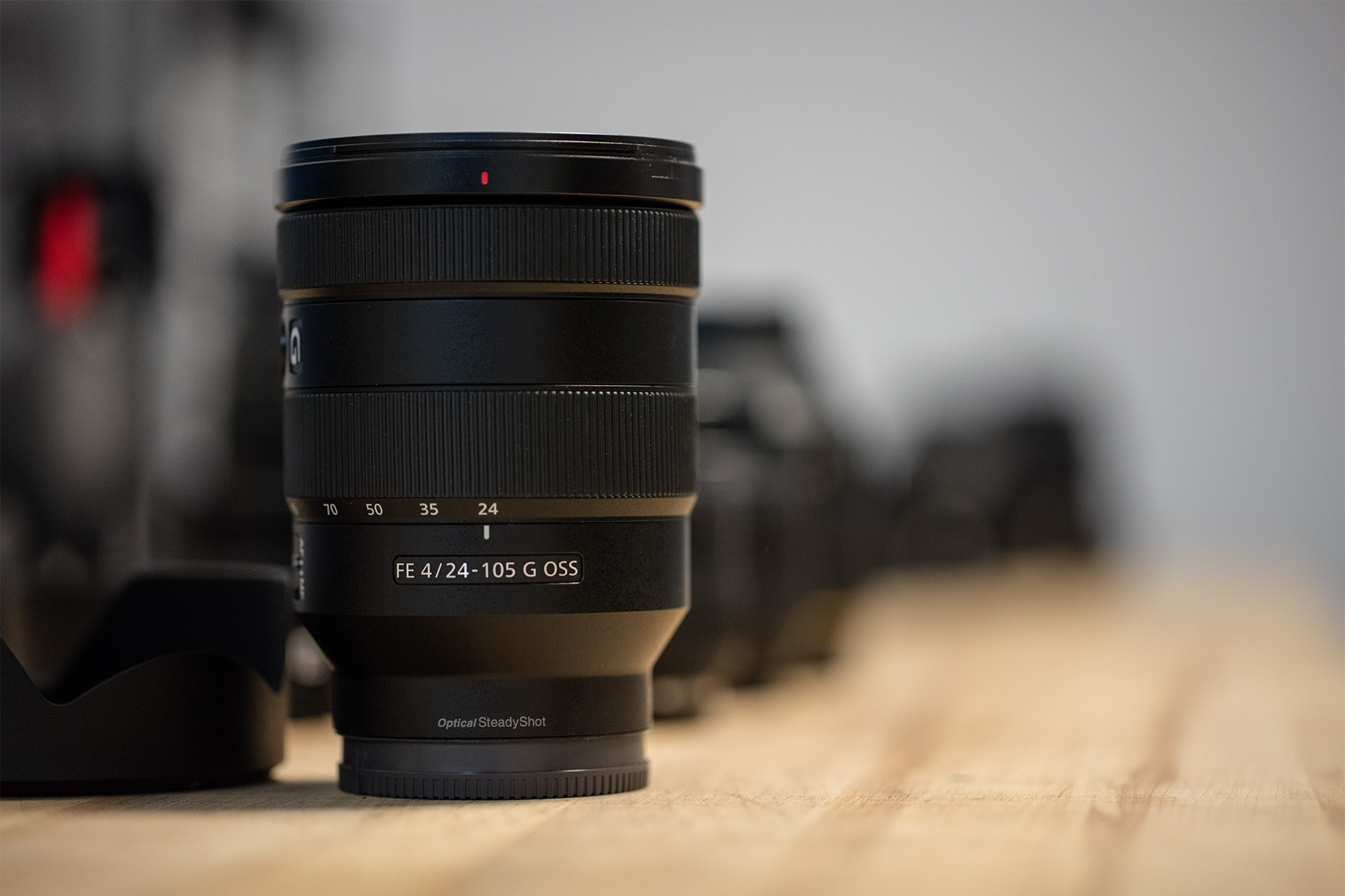
The Sony FE version has some other nice features. At just 663 grams, it’s lighter than any of the DSLR 24-105 f/4 lenses you might (or might not) have been using with an adapter. The 77mm front element makes filters reasonably inexpensive. The $1298 price tag does not make it inexpensive, but it’s about par for the SPP (Sony Price Premium) we’re all used to.
Before I got around to testing this lens, there was a lot of talk on the internet about how superbly sharp it was, but then there is talk on the internet about what’s the fastest dump truck. There were also rumblings about how much vignetting occurred. There’s been a lot of discussion of what’s being referred to as focus shift but is missed focus at smaller apertures. Some of those things we can look into. Some we can’t.
So as always, this is an optical test. It evaluates the optics of the lens. I don’t have any of the very important information about how the lens handles, how quickly it focuses on a camera, or how well the OSS works. You’ll need to read a real lens review for that stuff.
Optical Tests
If you don’t know that MTF stands for Modulation Transfer Function (1, 2, 3, 4), then just look at the pretty graphs and remember that higher is better, the left side of the graph is the center of the image, and the right side is the edge.
One thing to note about optical tests on this particular lens: Sony has built a lot of autocorrection into the raw files that correct distortion (it’s high at both ends) and vignetting (a lot at 24mm) in images taken on-camera. We’re testing just the lens. These factors shouldn’t cause a significant difference between ‘on camera’ testing and our testing, but they could have some minor effects. You might also notice some differences from reviews that test standard raw files and raw files with the ‘autocorrect’ function turned off.
MTF
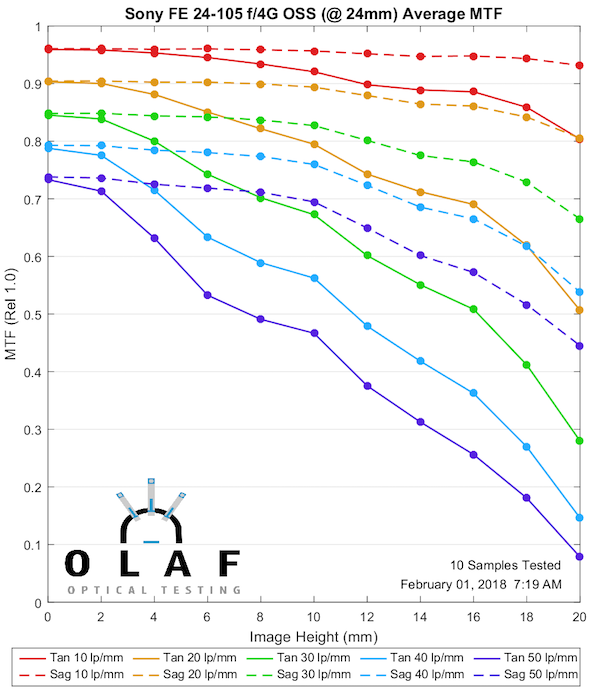
At 24mm
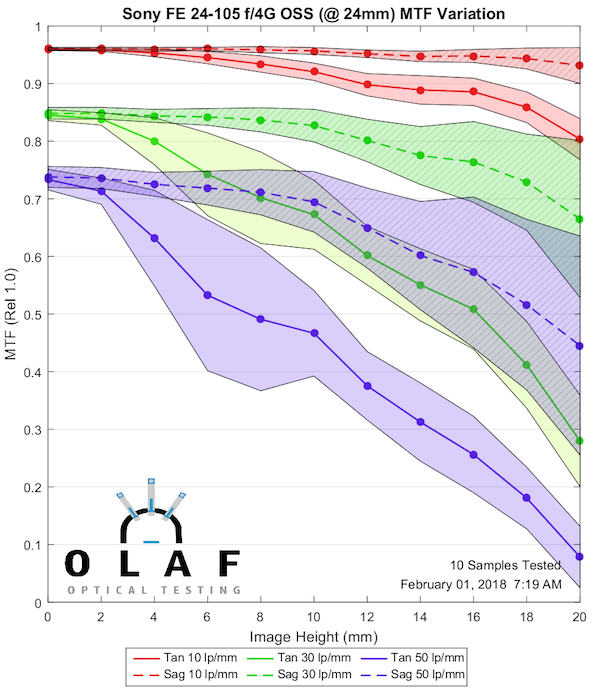
At 24mm we see good center resolution with a smooth drop-off as we head to the edges. There’s a fair amount of astigmatism-like separation of the sagittal and tangential lines, but it’s not bad for 24mm in a zoom lens.
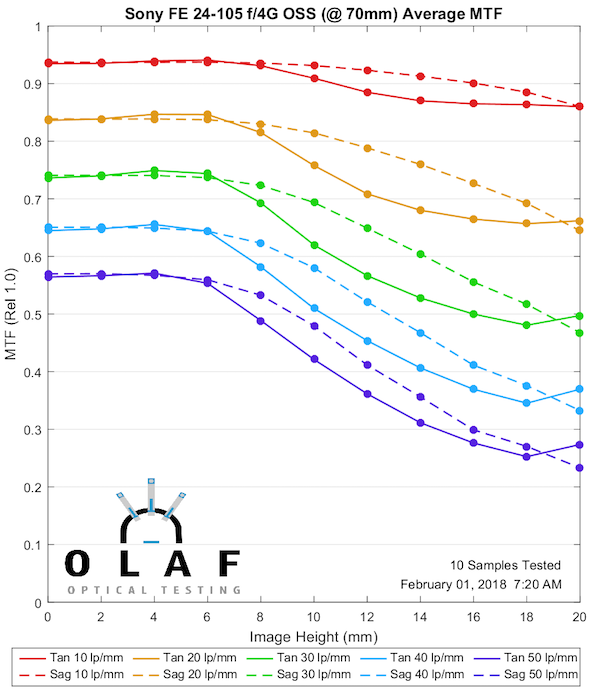
At 70mm
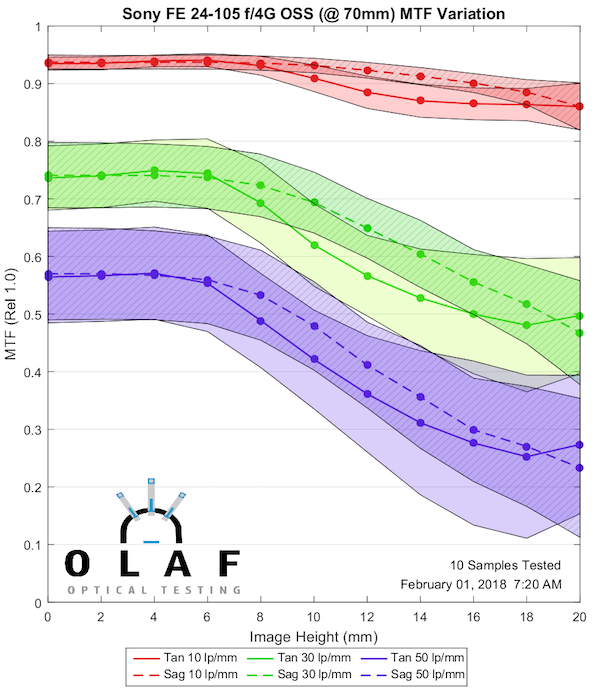
At 70mm the center resolution isn’t as sharp, but it’s still pretty good and is maintained to the edges of the field with a lot less sagittal-tangential separation.
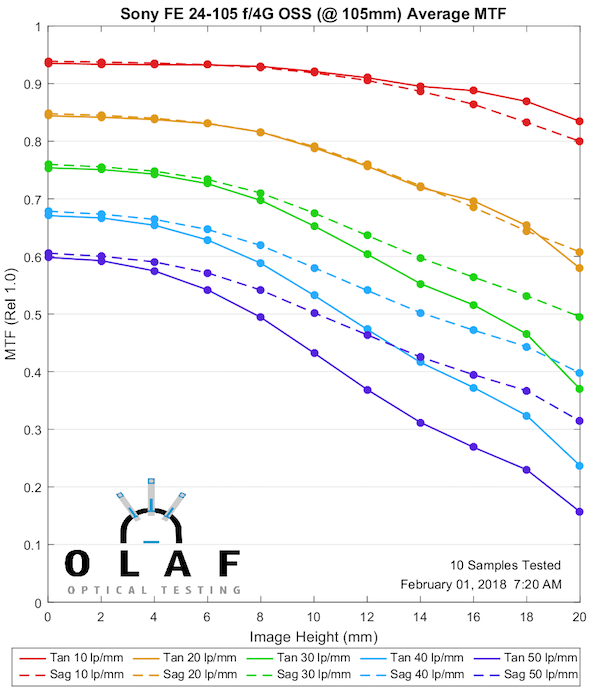
At 105mm
Here’s a bit of a surprise! The Sony is the first 24-105mm I’ve seen to maintain its sharpness out at 105mm. That’s quite unique for the ‘another one like the other ones’ 24-105mm zoom lenses. My usual recommendation for 24-105mm lenses is ‘only use it past 70mm if you don’t have time to change lenses’ but the Sony is actually a little better at 105mm than it was at 70mm.
Sample Variation
At 24mm
There’s almost no copy-to-copy variation in center sharpness, and the variation is well controlled at 24mm overall.
At 70mm
We do start to see a tiny bit of center variation at 70mm, but for a 24-105mm lens this is quite well controlled. (Yes, I know, that’s kind of like being the tallest short person; but still this is a pleasant surprise.)
At 105mm
Again, at 105mm, where most 24-105mm lenses have the most sample variation, the Sony still maintains a good consistency.
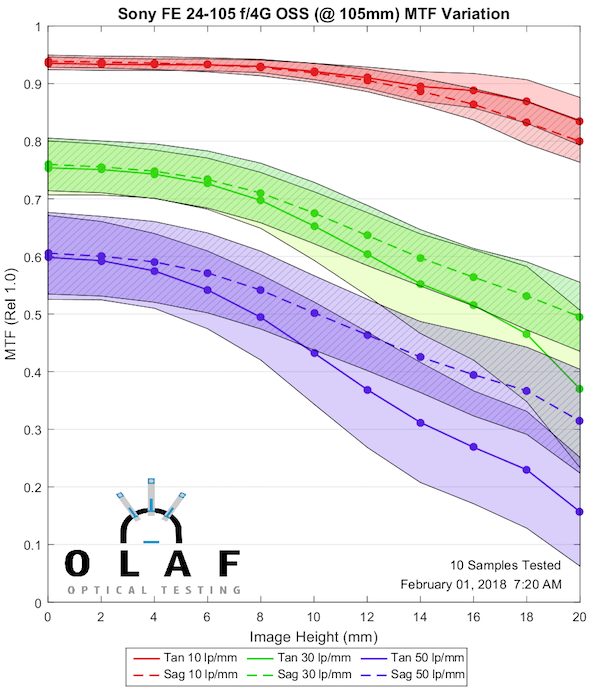
The Canon 24-105mm f/4 IS II has been the standard for consistency in this range zoom, but the Sony is a bit better (as was the Sigma we tested last week). So, let me repeat, because in the past I’ve been pretty harsh about Sony sample variation. While 24-105mm zooms tend to have a a high variation, the Sony does not; it’s very consistent in copy-to-copy.
Sony FE 24-105mm f/4 OSS vs. Sigma 24-105mm f/4 OS Art
At 24mm
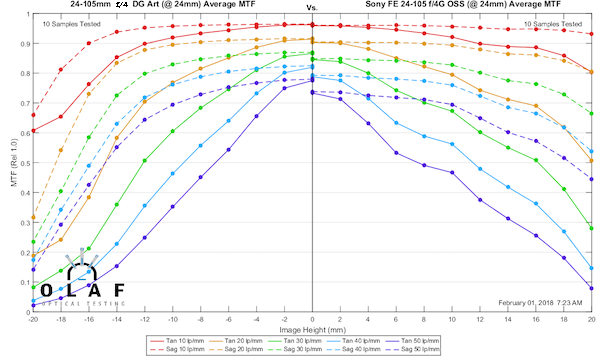
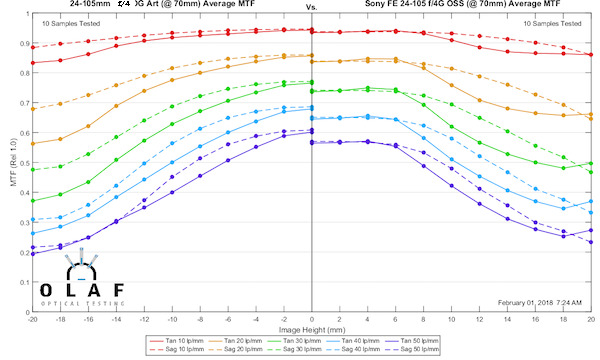
The Sigma has a fantastic center resolution at 24mm, the best of any lens of this type. The Sony isn’t quite that good, but it’s relatively close and is actually a bit better out at the edges of the image.
At 70mm
The Sigma still is a little better in the center of the image at 70mm, but the Sony maintains its resolution almost without change in the center 1/3 of the image, becoming a little better than the Sigma from that point to the edge.
At 105mm
At 105mm the comment I made about the Sony maintaining sharpness at 105mm better than other zooms of this range becomes apparent. The Sigma and Nikon 24-120mm VR lenses were the best at the long end, but Sony has the better MTF.
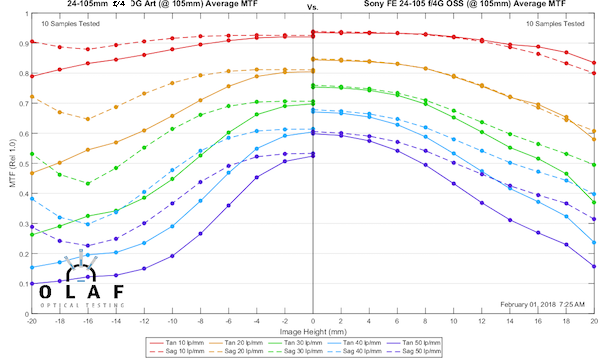
It’s a theoretical question, could we see this difference in an image? I doubt you could see any difference at 70mm. I’m comfortable you could tell the Sony was a bit better at 105mm, and in the very center, you’d notice the Sigma was sharper at 24mm.
Sony FE 24-105mm f/4 OSS vs Canon 24-105mm f/4 IS II
At 24mm
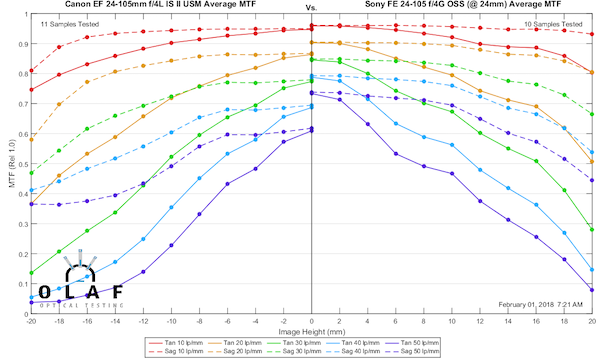
The Canon is an older design, and the Sony is better both in the center and away from the center.
At 70mm
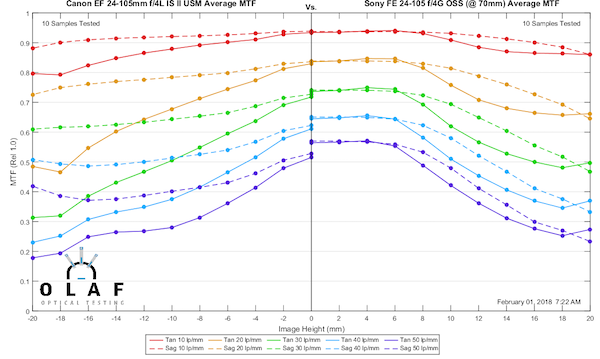
The Canon is at it’s best at 70mm. The Sony is still a little better, and definitely has less separation of sagittal and tangential lines here, but it’s closer.
At 105mm
At 105mm the difference is less dramatic, but the Sony is still a little better at every measurement.
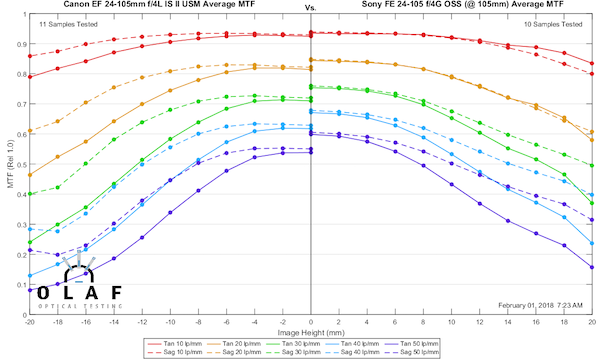
Could we see this difference in an image? Yes, all other things being equal, I think you could tell the Sony was slightly better at each focal length.
Stopping Down
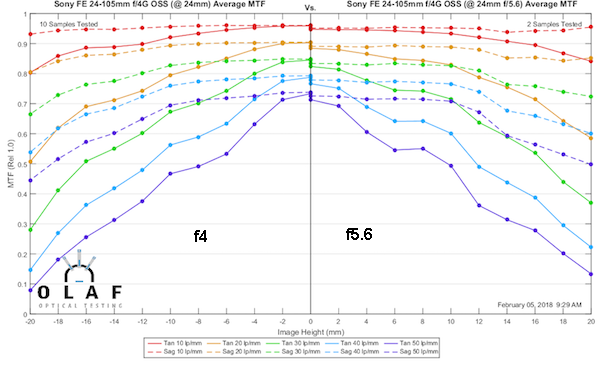
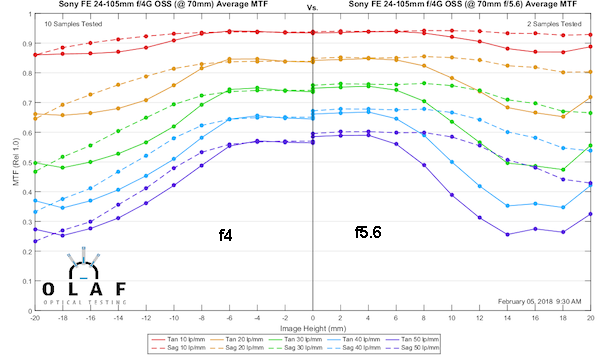
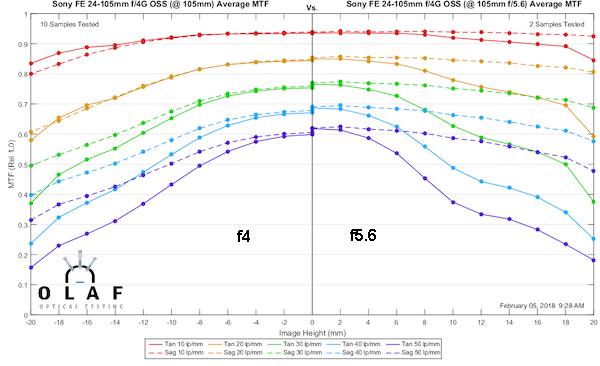
I guess I’m still experimenting with the best way to present the stop-down data. I’ve been taking one copy and testing it wide open and stopped down, but too many people lose their mind because the wide-open single copy looks different from the 10 lens average. So this time I’ll use the ten lens average (on the left) and compare it to the average of two lenses stopped down (on the right).
Before testing, I had been told by some reviewers I respect that the lens isn’t much sharper stopped down. One actually said he thought astigmatism got worse stopped down. I replied with the same response I use for almost everything: “Weird. Maybe it’s sample variation.” Wrong again, Roger, wrong again.
At 24mm
Well, at 24mm I have to say I don’t see much difference between f/4 and f/5.6.
At 70mm
At 70mm, the sagittal MTF (dotted lines) does improve, but the tangential (solid lines) does not; hence there is an increase in astigmatism. There actually are some excellent optical explanations for this, but there’s no need in me writing 1,000 words about it here. (Being old and wise, I’ve learned how to avoid work. If I just don’t discuss it now, Brandon will write about it in the comments tomorrow.)
At 105mm
We see precisely the same behavior at the long end; sagittal improvement while tangential stays the same and therefore astigmatism increases.
Field Curvature
I tend to keep harping on the fact that field curvature (MTF vs. Field vs. Focus) graphs give us a lot more information than just an MTF graph. One thing that is interesting about this lens is that it doesn’t have a lot of sample variation on MTF, but does have a lot on field curvature. How can that be, you must wonder? (If you didn’t, well, you should!)
I’ll show you with a picture. It’s a photography blog and all, so there should be pictures. Here is a thumbnail of a field curvature graph of one copy. The point of focus is right in the center, and the MTF would be measured along the black horizontal line, from one side to the other. If you follow along that line you will see a little difference way out, like between + 18mm and – 18mm from center. But if you go from +15mm to -15mm, the MTF would be very even on both sides.
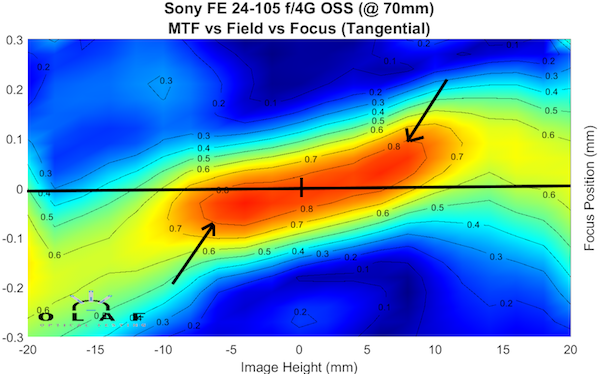
But if you took a photograph of a 3-D field, with things in front of and behind the plane of focus, you’d notice that on one side, things closer to you would be in focus, while on the other side, it would be things further away that were in best focus. (I drew in some high-tech arrows to demonstrate that.) Take a picture of a wall, a test chart, or shoot a portrait and you’ll never notice. Do a landscape and you might. You see why I keep saying taking pictures can give you information that all my testing can’t?
At 24mm
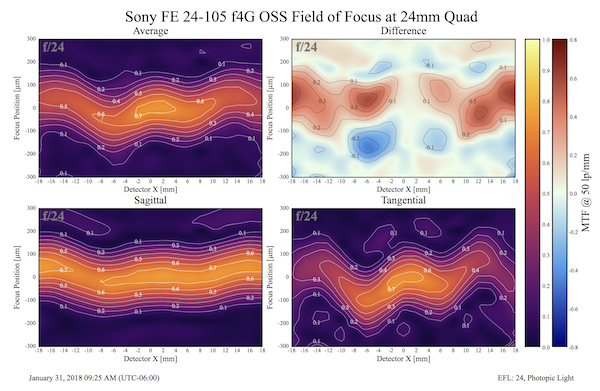
These are done at f5.6 and 50 lp/mm to narrow the field a little bit. Sony has a very mild U-shaped sagittal curve (lower left) and a tangential curve (lower right), on most copies, which can best be described as complex. On some copies, the tangential field was more of a smooth ‘W’ shape (I’ll show you some later), but there was no difference in resolution between the complex copies and the ‘W’ copies.
At 70mm
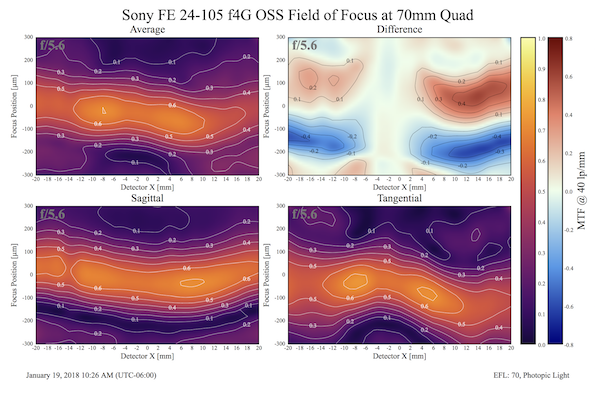
The fields are smoother at 70mm. Notice in the Difference graph (upper right) how this copy will have a bit more astigmatism on the right side than the left.
At 105mm
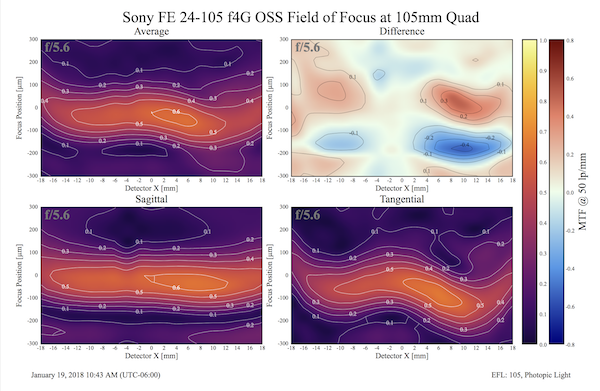
The field at 105mm is similar to what we saw at 70mm, which isn’t surprising since these are both in the telephoto range of the zoom.
Field Variation
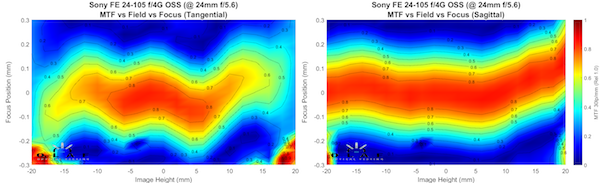
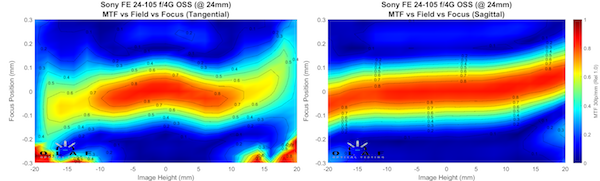
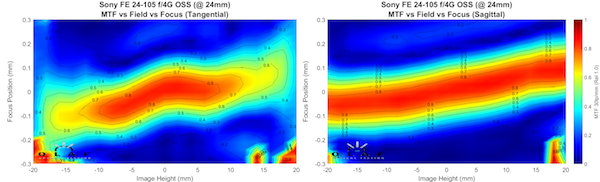
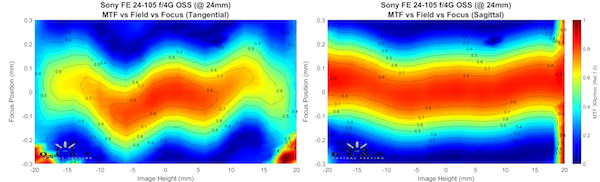
I mentioned that these had a lot of variation in tilt of the field and at 24mm there was variation in the shape of the field. We were investigating some issues and took MTF vs. Field vs. Focus readings on all of these lenses, which we rarely do. I’m going to put a few samples up just to give you an idea of what that looked like to us. These were processed in an older software set, so they look different.
At 24mm
Here you can see the two different types of tangential field shape. Again, MTF did not correlate with the appearance of field curvature. Also, these are processed in our older software, so it looks different. The tangential field is on the left, sagittal on the right.
At 105mm
Things are similar at 105mm and 70mm, and in the interest of keeping this, well, less long, I’ll just show some of the 105mm ones. Don’t lose your mind over this; this is not severe field tilt in any single lens. Instead, I’m pointing out that every single lens has a bit of field tilt.
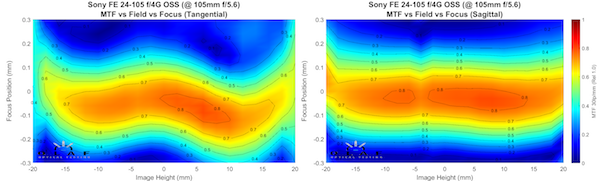
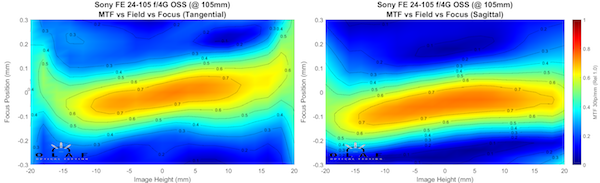
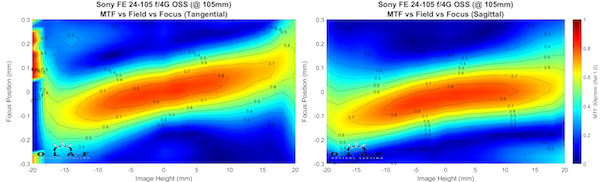
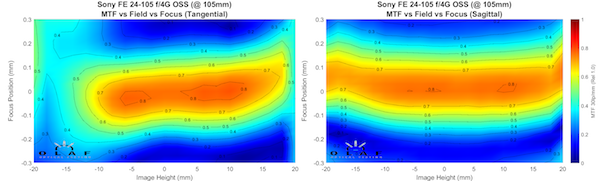
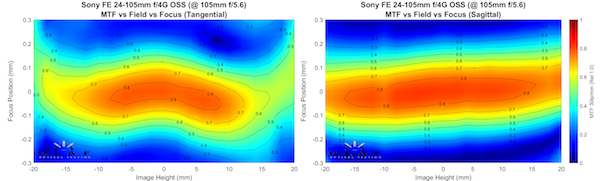
The question you probably have, is ‘will I notice this’. The answer is not if you’re shooting test charts, flat subjects like architecture, centered subjects like portraits, or if you don’t pixel peep. But if you shoot landscapes and do pixel peep, you may notice it, or in some cases, you may notice bokeh differs on one side or the other because of astigmatism. That’s about it.
It’s a zoom, people. You can have all the fantasies you want, but chances are higher that a supermodel finds your profile on Match.com than you find a zoom that’s perfect at all focal lengths. I bring this up because if you DO pixel peep a landscape you will probably notice a field tilt and if you send the lens back you’ll get one with the field tilt on the other side or at another focal length or both.
So What Did We Learn Today?
First, hopefully, that Roger can still make a blog post without putting in the wrong graph. Time, and comments, will tell.

Second, that Sony has made a damn good 24-105mm f/4 lens. Damn good being a relative term, of course, because it’s a 24-105mm lens and I have come to hate them all so I can’t be too nice about it. But it’s clearly better than the Canon 24-105mm f/4 II IS, and at least as good as the Sigma 24-105mm f/4 Art or Nikon 24-120mm VR. Fanboys, may start their hair-splitting engines now about which one is two angstroms better than the other.
But if you shoot Sony and you want a minivan 24-105mm f/4, this is the best option. If you shoot a lot at the long end, it’s the best option for sure. I would recommend shooting it wide open unless you need more depth of field; you don’t gain a lot stopping down. And if you do a lot of landscape shots you might want to do some simple tests to see where the field curvature on your copy goes.
There is a pink elephant in the room; there’s been a lot of discussions that some copies have a severe focusing problem when stopped down. This is true, and I thoroughly tested one copy (it’s not included in these tests) with that behavior. Stopped down even to f/4.5 it misfocused hugely from 35mm and up. This is NOT a focus shift, as it’s being called wrongly on the internet. Focus shift is an optical issue and behaves differently. It appears to be an electronic or mechanical interaction between stopping down the aperture and the focusing system; this lens has a complex, electronically controlled focusing system. It does NOT affect all copies and if yours does this, it needs to be exchanged or fixed. I don’t think it will be a long-term problem.
The simple fact is that Sony, more than any other company, is using electronic correction to a degree that we haven’t seen before. Some seem worked up about in-camera distortion and vignetting correction for reasons I don’t really understand. The bottom line is it allows the lenses to be smaller and makes it easier to manufacture the optics, which are good things.
Having complex electronic look-up tables for focus correction should have some advantages for speed, accuracy, and correcting close-focus aberrations. However, such cutting-edge technology sometimes causes glitches. If you want to live on the cutting edge of technology, then this stuff is going to happen sometimes.
Roger Cicala and Aaron Closz
Lensrentals.com
February, 2018
Addendum: After I wrote this post, Sony announced the recall program for affected copies. You can check here to see if your SN is affected: Out of Focus Repair Program
The fix is straightforward and won’t require opening you lens, at least from what I’m told.
127 Comments
Samuel H ·
Please make that double-nought-secret-agent lens be a Sigma FE lens.
OK, now I’ll try to calm down and read the rest of the article.
Athanasius Kirchner ·
Sounds more like an NSA/CIA/NASA project, to me.
Devil's Advocate ·
agreed.
bdbender4 ·
No disrespect to either you or Sigma, but currently Sigma is using the brute force approach. Stuff a lot of large fancy
individual lenses in the tube, made of several types of anomalous glass, in complex shapes, and coated with varied flavors of secret sauce. Half of them correct the aberrations of the other half, and you end up with something that takes nice images at f/1.4 but is heavy and huge. “Yuuuge!”
There are other approaches out there with different ramifications. See, for example, Leica, who like to see how few elements they can get away with. As Bugs Bunny would say, trays elegonetay!
Samuel H ·
Yet the Sigma, with all its glass and all its complexity, will sell for a fraction of theprce of the Leica.
Don’t get me wrong, I have a full set of Leica-R lenses, from 24 to 180mm, and I love them, but my next set will have AF and it will probably be Sigma.
milkod2001 ·
You have full set of Leica lenses and thinking about Sigma? Lol, that’s like saying my Ferrari is great but im getting Honda Civic next :)))
Samuel H ·
I’m not getting rid of the Leicas, but I do need a set with AF (and at some point I think it will probably get a lot more use than the Leicas – I do like manual focusing as a learning tool because it forces you to slow down and work your shots, but after some time, well, it’s slow) (plus: the Leicas have a truly lovely image, with spectacular bokeh, but the good Sigmas are waaaay sharper)
S.Yu ·
Right now the ZM 35/1.4 seems to be the best modern optic, among those that don’t need to be towed around in a suitcase, shame most of their lenses aren’t made like that.
Samuel H ·
Please make that double-nought-secret-agent lens be a Sigma FE lens.
OK, now I'll try to calm down and read the rest of the article.
bdbender4 ·
No disrespect to either you or Sigma, but currently Sigma is using the brute force approach. Stuff a lot of large fancy
individual lenses in the tube, made of several types of anomalous glass, in complex shapes, and coated with varied flavors of secret sauce. Half of them correct the aberrations of the other half, and you end up with something that takes nice images at f/1.4 but is heavy and huge. "Yuuuge!"
There are other approaches out there with different ramifications. See, for example, Leica, who like to see how few elements they can get away with. As Bugs Bunny would say, trays elegonetay!
Samuel H ·
Yet the Sigma, with all its glass and all its complexity, will sell for a fraction of theprce of the Leica.
Don't get me wrong, I have a full set of Leica-R lenses, from 24 to 180mm, and I love them, but my next set will have AF and it will probably be Sigma.
milkod2001 ·
You have full set of Leica lenses and thinking about Sigma? Lol, that's like saying my Ferrari is great but im getting Honda Civic next :)))
Samuel H ·
I'm not getting rid of the Leicas, but I do need a set with AF (and at some point I think it will probably get a lot more use than the Leicas - I do like manual focusing as a learning tool because it forces you to slow down and work your shots, but after some time, well, it's slow) (plus: the Leicas have a truly lovely image, with spectacular bokeh, but the good Sigmas are waaaay sharper)
S.Yu ·
Right now the ZM 35/1.4 seems to be the best modern optic, among those that don't need to be towed around in a suitcase, shame most of their lenses aren't made like that.
Arsalan ·
Sony’s repair program for this lens is now live so you can check your serial and determine whether it has the issue or not
US page: https://esupport.sony.com/US/p/compatibility.pl?comp_project_id=18&mdl=SEL24105G
Canadian page – https://esupport.sony.com/CA/p/compatibility.pl?comp_project_id=18&mdl=SEL24105G
German page – http://sony-eur-eu-de-web–eur.custhelp.com/app/answers/detail/a_id/146805
For Spain – http://sony-eur-eu-es-web–eur.custhelp.com/app/answers/detail/a_id/146797
For UK – http://sony-eur-eu-en-web–eur.custhelp.com/app/answers/detail/a_id/146785
Arsalan ·
Sony's repair program for this lens is now live so you can check your serial and determine whether it has the issue or not
US page: https://esupport.sony.com/U...
Canadian page - https://esupport.sony.com/C...
German page - http://sony-eur-eu-de-web--...
For Spain - http://sony-eur-eu-es-web--...
For UK - http://sony-eur-eu-en-web--...
Wesley ·
What did I learn today? It’s not worth the asking price. To me.
T N Args ·
If you don’t need this class of lens, then it’s worth $0 to you. It’s a non-comment.
If you *do* need this class of lens, then what *is* worth the asking price? To you?
Wesley ·
What did I learn today? It's not worth the asking price. To me.
T N Args ·
If you don't need this class of lens, then it's worth $0 to you. It's a non-comment.
If you *do* need this class of lens, then what *is* worth the asking price? To you?
Mike Aubrey ·
Waiting for Brandon’s comment about astigmatism…
Athanasius Kirchner ·
+1. I’m dropping a comment here to get notified.
Brandon Dube ·
In a few days maybe — my schedule is overfilled at least until friday.
Justin ·
You’re neither old enough nor wise enough to have mastered avoiding work.
Brandon Dube ·
We develop by working. “The future belongs to those who learn more skills and combine them in creative ways.” ? Robert Greene
Justin ·
I’m right there with you friend. Mostly it was a shout out to Roger’s comment which made me lol.
Athanasius Kirchner ·
So, Brandon, can you find some time now to explain how stopping down can increase astigmatism? Sorry to be a nag, but I’m really interested in that explanation 🙂
Brandon Dube ·
The astigmatism (an aberration, not just the T and S lines separating) can never increase by stopping down, but the more general blur can subside leaving a more three-dot-like pattern from the chromatic aberrations. That will make the difference of the T and S MTF more pronounced.
I left a long comment about lateral color and MTF here — https://www.dpreview.com/forums/post/60734893
my schedule has gone from “slammed for last week” to “slammed through mid march” so I don’t expect to have anything lengthy for here anytime soon. I would probably write a blogpost about it, but the necessary fixes to my modeling program are not something I really want to make over spring break which will rule it out. If someone wanted to implement the convolution cases I haven’t done here — https://github.com/brandondube/prysm/blob/master/prysm/convolution.py#L43 — I would write it up. Otherwise, that code is just a bookkeeping pain in the ass I don’t want to deal with right now.
Athanasius Kirchner ·
Thank you for your time, and good luck with all your work!
Brandon Dube ·
We develop by working. “The future belongs to those who learn more skills and combine them in creative ways.” ― Robert Greene
Athanasius Kirchner ·
So, Brandon, can you find some time now to explain how stopping down can increase astigmatism? Sorry to be a nag, but I'm really interested in that explanation :)
Brandon Dube ·
The astigmatism (an aberration, not just the T and S lines separating) can never increase by stopping down, but the more general blur can subside leaving a more three-dot-like pattern from the chromatic aberrations. That will make the difference of the T and S MTF more pronounced.
I left a long comment about lateral color and MTF here -- https://www.dpreview.com/fo...
my schedule has gone from "slammed for last week" to "slammed through mid march" so I don't expect to have anything lengthy for here anytime soon. I would probably write a blogpost about it, but the necessary fixes to my modeling program are not something I really want to make over spring break which will rule it out. If someone wanted to implement the convolution cases I haven't done here -- https://github.com/brandond... -- I would write it up. Otherwise, that code is just a bookkeeping pain in the ass I don't want to deal with right now.
Roger Cicala ·
I am pretty old. I’ll grant that I’ve managed to attain that without the wisdom that supposedly accompanies my years.
Roger Cicala ·
I am pretty old. I'll grant that I've managed to attain that without the wisdom that supposedly accompanies my years.
Mike Aubrey ·
Waiting for Brandon's comment about astigmatism...
Athanasius Kirchner ·
+1. I'm dropping a comment here to get notified.
Brandon Dube ·
In a few days maybe -- my schedule is overfilled at least until friday.
Athanasius Kirchner ·
Roger: That meme is savage, and I’m totally propagating it!
My 18-105mm f/4 G OSS is much sharper at the long end than the wide, which is curious, but also somewhat consistent with the reviewed lenses’ behavior. It’s certainly not a common feature, though, and I wonder why some manufacturers prefer it, and others don’t.
Athanasius Kirchner ·
Roger: That meme is savage, and I'm totally propagating it!
My 18-105mm f/4 G OSS is much sharper at the long end than the wide, which is curious, but also somewhat consistent with the reviewed lenses' behavior. It's certainly not a common feature, though, and I wonder why some manufacturers prefer it, and others don't.
DP ·
> The simple fact is that Sony, more than any other company, is using electronic correction to a degree that we haven’t seen before. Some seem worked up about in-camera distortion and vignetting correction for reasons I don’t really understand. The bottom line is it allows the lenses to be smaller and makes it easier to manufacture the optics, which are good things.
good point… I ‘d suggest a step furher – start using electronic correction to make say 1″ sensor look like a FF one… just write proper data in exif tags to make raw file look like it is from a FF camera, etc… hell, the savings for manufacturer will be enormous … and we get smaller bodies 🙂
Nobody Knows ·
Take a look at m43 lenses without their raft of software fixes particularly at the wide end you may be in for a surprise about who uses electronic corrections the most
Roger Cicala ·
m43 does do a lot of firmware corrections also, no question.
Nobody Knows ·
Roger , how does the focal length testing work at the wide end . I think { which doesn’t always work out for me lol } that the nature of mirrorless lenses utilizing software corrections is that the physical focal length is somewhat wider than the stated 24-105mm with the extra FOV being designed to be sacrificed to the software corrections
I appreciate that there are no free lunches and software correction has its own gotchas such as extra noise at the corners and so on
Roger Cicala ·
That can be true, but our machine measures the center focal length, then measures distortion by taking the actual focal length at each angle. It’s just another way to look at it, but a lens with distortion could be, for example a 25mm in the center and a 23mm at the edges (that’s an exaggeration or an extremely distorted lens).
Basically the protocol is to measure the distortion and then the machine uses that to measure the MTF properly at each point.
If you’re actually talking does the focal length change slightly in the image, well sure. But remember a lens is ‘roughly’ what it says on the barrel anyway. A 24-105 is usually really a 26 – 102 give or take a mm. The accepted (but not enforced) standard is within 5% of the stated focal length.
Nobody Knows ·
Roger , how does the focal length testing work at the wide end . I think { which doesn't always work out for me lol } that the nature of mirrorless lenses utilizing software corrections is that the physical focal length is somewhat wider than the stated 24-105mm with the extra FOV being designed to be sacrificed to the software corrections
I appreciate that there are no free lunches and software correction has its own gotchas such as extra noise at the corners and so on
Roger Cicala ·
That can be true, but our machine measures the center focal length, then measures distortion by taking the actual focal length at each angle. It's just another way to look at it, but a lens with distortion could be, for example a 25mm in the center and a 23mm at the edges (that's an exaggeration or an extremely distorted lens).
Basically the protocol is to measure the distortion and then the machine uses that to measure the MTF properly at each point.
If you're actually talking does the focal length change slightly in the image, well sure. But remember a lens is 'roughly' what it says on the barrel anyway. A 24-105 is usually really a 26 - 102 give or take a mm. The accepted (but not enforced) standard is within 5% of the stated focal length.
# WLM ·
> The simple fact is that Sony, more than any other company, is using electronic correction to a degree that we haven’t seen before. Some seem worked up about in-camera distortion and vignetting correction for reasons I don’t really understand. The bottom line is it allows the lenses to be smaller and makes it easier to manufacture the optics, which are good things.
good point... I 'd suggest a step furher - start using electronic correction to make say 1" sensor look like a FF one... just write proper data in exif tags to make raw file look like it is from a FF camera, etc... hell, the savings for manufacturer will be enormous ... and we get smaller bodies :-)
Matt ·
After reading all this, I just have one question: is double-naught-secret-agent tested spectacular wide aperture prime lens something we will ever hear about? ie some lens for a camera anyone in the comments section would own or some specialty thing that us peasants need not concern ourselves with?
Brandon Dube ·
If Roger is referring to what I think he is, I’ll probably blog about it in a few months. If it’s what I’m thinking of, the ramifications are much larger than just “there exists a really nice wide aperture lens.”
Matt ·
Oh man, it has ramifications? Now I’m even more curious.
Samuel H ·
Lenses with ramifications are the best lenses. At least for landscape photography.
Brandon Dube ·
If Roger is referring to what I think he is, I'll probably blog about it in a few months. If it's what I'm thinking of, the ramifications are much larger than just "there exists a really nice wide aperture lens."
Matt ·
Oh man, it has ramifications? Now I'm even more curious.
Nobody Knows ·
I am curious why delete my post mentioning that many m43 lenses use software in a much more significant way than Sony ?
Roger Cicala ·
What post? The one below that I responded to? I haven’t deleted any posts in many weeks.
Nobody Knows ·
I posted a question regarding m43 lenses { not the one you responded to } several hours ago perhaps it did not load before I jumped page and as such I apologize for complaining about it
Roger Cicala ·
What post? The one below that I responded to? I haven't deleted any posts in many weeks.
Horshack ·
Roger, are the MTF graphs exclusive of the effects of field curvature? If so, how is the MTF testing performed to exclude it? Are multiple measurements taken at different focus positions and then the maximum MTF results combined for each field? Or are results from the targeted curvature tests mathematically applied to the MTF results (if that’s possible)?
Roger Cicala ·
Field curvature definitely affects the MTF graph, which is performed at ‘best center focus’. What you suggest can be done: https://www.lensrentals.com/blog/2017/11/testing-lenses-best-individual-focus-mtf-curves/
Horshack ·
Thanks Roger, somehow I missed that article. I’ve read it about three times so far, which means I’m about 20% of the way toward fully understanding it 🙂
Here’s a question I have – the field variation graphs depict focus shift and thus give us clues as to what part of the field we should focus to to achieve a given MTF for that region, along with the compromises that entails for other fields. The graphs depict the full diagonal of the sensor (-20mm to +20mm), so any point along the graph for deciding where to focus is actually diagonal from the center rather than what photographers would assume being horizontal to the edges – is that correct? I suppose this wouldn’t matter for lenses which don’t have a tilt in their curvature field, but for the 24-105 copies with tilt or ‘W’ shaped curvature, do we need to pay any consideration for selecting a focus point that may be diagonal from the center rather than horizontal? Or is the field uniform diagonally/horizontally (I guess radially?) for a given side of the frame.
Roger Cicala ·
It would be the same in every rotation, if I’m understanding correctly. Think of it as a cone in 3 dimensions from the center of image.
Brandon Dube ·
If you want the nuanced answer, you need to do the MTF vs Field vs Focus in 2D, which will produce a 5D volume of data (field x, field y, frequency, azimuth [tan/sag], focus).
It wouldn’t really be a conical shape once it’s perturbed from misalignment. This is all governed by Nodal Aberration Theory, see e.g.
http://paristech.institutoptique.fr/site.php?id=562&fileid=20136
slide 21, 22. The length of the lines in the diagram is similar to the y-axis movement on the plots we show here. Radial symmetry is broken, and the pattern becomes complex.
Horshack ·
Roger, are the MTF graphs exclusive of the effects of field curvature? If so, how is the MTF testing performed to exclude it? Are multiple measurements taken at different focus positions and then the maximum MTF results combined for each field? Or are results from the targeted curvature tests mathematically applied to the MTF results (if that's possible)?
Roger Cicala ·
Field curvature definitely affects the MTF graph, which is performed at 'best center focus'. What you suggest can be done: https://www.lensrentals.com...
Horshack ·
Thanks Roger, somehow I missed that article. I've read it about three times so far, which means I'm about 20% of the way toward fully understanding it :)
Here's a question I have - the field variation graphs depict focus shift and thus give us clues as to what part of the field we should focus to to achieve a given MTF for that region, along with the compromises that entails for other fields. The graphs depict the full diagonal of the sensor (-20mm to +20mm), so any point along the graph for deciding where to focus is actually diagonal from the center rather than what photographers would assume being horizontal to the edges - is that correct? I suppose this wouldn't matter for lenses which don't have a tilt in their curvature field, but for the 24-105 copies with tilt or 'W' shaped curvature, do we need to pay any consideration for selecting a focus point that may be diagonal from the center rather than horizontal? Or is the field uniform diagonally/horizontally (I guess radially?) for a given side of the frame.
Roger Cicala ·
It would be the same in every rotation, if I'm understanding correctly. Think of it as a cone in 3 dimensions from the center of image.
Brandon Dube ·
If you want the nuanced answer, you need to do the MTF vs Field vs Focus in 2D, which will produce a 5D volume of data (field x, field y, frequency, azimuth [tan/sag], focus).
It wouldn't really be a conical shape once it's perturbed from misalignment. This is all governed by Nodal Aberration Theory, see e.g.
http://paristech.institutop...
slide 21, 22. The length of the lines in the diagram is similar to the y-axis movement on the plots we show here. Radial symmetry is broken, and the pattern becomes complex.
Deanaaargh ·
Thank you Roger for suffering the indignity of 24-105 f/4 testing. The fruits of your toil are appreciated by many.
Chik Sum ·
Hi Roger, I am more curious about what’s the amazing prime you tested a few weeks ago, was that the 4/3 ones?
The Sony does amaze me on their optical performance as well as their strange field of focus, maybe they achieve that in sacrifice of the field of focus?
YS ·
Hi Roger, I am more curious about what’s the amazing prime you tested a few weeks ago, was that the 4/3 ones?
The Sony does amaze me on their optical performance as well as their strange field of focus, maybe they achieve that in sacrifice of the field of focus?
DrJon ·
Oh dear, does this mean the Panasonic 12-60mm f2.8-4 isn’t getting a look-in? I’d be interested as mine had some weird behaviours. (They have it back and seem to have forgotten to send the replacement… ho hum…)
BTW now Fuji have joined m43 and Sony as companies with IBIS systems have you considered testing beyond the edge of the unshifted sensor, as that’s where my issues with my original 12-60 seem to be?
DrJon ·
Oh dear, does this mean the Panasonic 12-60mm f2.8-4 isn't getting a look-in? I'd be interested as mine had some weird behaviours. (They have it back and seem to have forgotten to send the replacement... ho hum...)
BTW now Fuji have joined m43 and Sony as companies with IBIS systems have you considered testing beyond the edge of the unshifted sensor, as that's where my issues with my original 12-60 seem to be?
obican ·
Roger Cicala (from lensrentals.com) says Sony 24-105 is a spectacular wide aperture prime lens with a resolution that made his jaw drop at frequencies he wasn’t sure was possible to test. Also has less initials than Sigma. Buy at Amazon (link here)
obican ·
Roger Cicala (from lensrentals.com) says Sony 24-105 is a spectacular wide aperture prime lens with a resolution that made Brandon's jaw drop at frequencies he wasn’t sure was possible to test. Also has less initials than Sigma. Buy at Amazon (link here)
Clayton Taylor ·
Ohhhh….I so want to see a t-shirt with a 24 – 105 lens pictured on it along with Roger’s redacted “minivan” graphic!
Roger Cicala ·
That’s a really good idea.
Joey Miller ·
I would wear this to WPPI, just sayin.
Roger Cicala ·
Do we put flames on it?
Roger Cicala ·
https://uploads.disquscdn.com/images/7fbb46d88d9d58c24be24075390903ac5adece8690e18ae3c537f26f7dabbce3.jpg
Roger Cicala ·
@joey https://uploads.disquscdn.com/images/10baa2476c72bd80e835cd29c94956f12e2145179d25ae4096fd5557a7788ad6.jpg
Roger Cicala ·
@joey https://uploads.disquscdn.c...
Clayton Taylor ·
Ohhhh....I so want to see a t-shirt with a 24 - 105 lens pictured on it along with Roger’s redacted “minivan” graphic!
Roger Cicala ·
That's a really good idea.
Sid ·
Forget about everything else, I am most interested in the bikini contest mentioned in the article : ” two weeks ago I’m doing some double-naught-secret-agent testing on a spectacular wide aperture prime lens with a resolution that made my jaw drop”
Sid ·
Forget about everything else, I am most interested in the bikini contest mentioned in the article : " two weeks ago I’m doing some double-naught-secret-agent testing on a spectacular wide aperture prime lens with a resolution that made my jaw drop"
geekyrocketguy ·
A question and a comment:
1) Supposing I shoot landscapes at f/8 (or f/5.6, since, that’s where the stopped-down tests are performed), which 24-105 will give the best edge sharpness?
2) Sony has announced a recall covering the stop-down focus problem with their 24-105.
Roger Cicala ·
At 24mm I don’t see much edge sharpness in any of them, but at the mid and long range, the Sigma has the best edge sharpness at f5.6.
geekyrocketguy ·
A question and two comments:
1) Supposing I shoot landscapes at f/8 (or f/5.6, since, that's where the stopped-down tests are performed), which 24-105 will give the best edge sharpness?
2) Sony has announced a recall covering the stop-down focus problem with their 24-105.
3) I do a lot of statistical analysis and I adore your meme. I will begin sending this to people and receiving ire in return.
Roger Cicala ·
At 24mm I don't see much edge sharpness in any of them, but at the mid and long range, the Sigma has the best edge sharpness at f5.6.
I wish I'd made that meme, but I can't find out who did to credit them. I love it.
Roger Cicala ·
https://uploads.disquscdn.c...
Do we put flames on it?
Michael Stone ·
Sony issued a recall for the ones that have a focus problem.
michaelstone1972 ·
Sony issued a recall for the ones that have a focus problem.
Michael Sandman ·
Thanks — I have the lens and think it’s better than my (traded) Canon 24-105 f/4 ver. 1.
Dumb question, and late as well: You mention that Sony applies corrections to RAW images and then note that there will be a difference in the MTF results for “corrected” RAW files vs. uncorrected RAW files. How do you turn off in-camera corrections?
Roger Cicala ·
The most foolproof way would be to use a raw converter like DCRaw that doesn’t touch the files. You can in theory turn them off in other raw converters with some effort. The big differences will be in those who use default, corrected raw conversion versus those that use none.
Michael Sandman ·
Thanks -- I have the lens and think it's better than my (traded) Canon 24-105 f/4 ver. 1.
Dumb question, and late as well: You mention that Sony applies corrections to RAW images and then note that there will be a difference in the MTF results for "corrected" RAW files vs. uncorrected RAW files. How do you turn off in-camera corrections?
Roger Cicala ·
The most foolproof way would be to use a raw converter like DCRaw that doesn't touch the files. You can in theory turn them off in other raw converters with some effort. The big differences will be in those who use default, corrected raw conversion versus those that use none.
Scott ·
Roger, I like your blog and am learning from it; thanks. This article reminded me of Car and Driver magazine, which likes sport cars and sedans best, and crossovers (SUVs) least. They cannot understand why people buy SUVs that never leave the pavement or tow instead of wagons and minivans. The practicality of the latter apparently becomes rational to them if driving feedback and pleasure loose the battle, e.g. with the spouse. I do wonder if this lens is more of a ‘wagon’ lens, being that it is sportier than a 28-200 superzoom and the like. Are the superzooms the real minivans of camera lenses, or are those more like the full size vans of the lens world?https://uploads.disquscdn.com/images/cfa4372839353c49cf8b4d60a6aa3e35aff7062d7781489d37066b64bdc8fa72.jpg
My minivan’s tranny died at 160,000 miles and, not needing quite as much space, we replaced it with a wagon. We also have an SUV, so I probably missed making the C&D editors’ esteemed readers list. You may have figured out by now where I’m headed… I’m also thinking of buying the Sony minivan lens and forgoing a shot at your esteemed readers list. I previously avoided a full-frame DSLR due to both camera and lens cost. I’m frustrated with focus issues and have decided that if I’m going to spend a hunk of money upgrading, I should switch from from DSLR to the latest generation of mirrorless. I am planning to start with a general purpose zoom for family and travel photography. Performance in the lens center at max aperture is most important to me for that application, but I will shoot landscapes also. Later I plan to add a few inexpensive primes, possibly with manual focus. C&D likes manual transmissions for the driver involvement even though automatics now out-perform them. I wonder how many photographers like the involvement of manual focus. I’m considering them just because of the low cost and high optical performance for occasional use when my family doesn’t have to wait for me. I was thinking of going with the crop-sensor Fuji XH-1 and the 16-55 f/2.8, then Sony announced the full-frame a7III body for a similar price, but the 24-70 f/2.8 GM lens costs a grand more than the Fuji lens. The Sony body with the 24-105 f/4 has the same effective maximum aperture as the Fuji, plus more zoom that I will enjoy, for nearly the same price. Sony also seems a better system choice in the long run. Compared to my current crop-sensor Nikon D7000 and Sigma 17-50 f/2.8, will I experience a significant improvement in image quality? Will the Sony system’s IQ be similar to the Fuji system’s IQ?
Cona ·
Hi
I do food photography and some landscape so I want an All-in-one(ish) lens to start with in A7R3
For All-in-one lens which one you will recommended:
1- Sony 24-105 f4
2- Tamron SP 24-70mm f/2.8 Di USD Lens for Sony
3- Sigma 24-105mm F4.0 Art DG HSM Lens for Sony
4- Sony 24-70 f2.8 (is it worth paying more for it)
5- Anything else ?
Thanks
S.Yu ·
If you do food don’t you need a macro?
David ·
You have a a7RIII but don’t even know that two of the lenses you but into the post aren’t for the needed E-Mount? Mhhh that makes me Sad!
Cona ·
Hi
I do food photography and some landscape so I want an All-in-one(ish) lens to start with in A7R3
For All-in-one lens which one you will recommended:
1- Sony 24-105 f4
2- Tamron SP 24-70mm f/2.8 Di USD Lens for Sony
3- Sigma 24-105mm F4.0 Art DG HSM Lens for Sony
4- Sony 24-70 f2.8 (is it worth paying more for it)
5- Anything else ?
Thanks
S.Yu ·
If you do food don't you need a macro?
David ·
You have a a7RIII but don't even know that two of the lenses you but into the post aren't for the needed E-Mount? Mhhh that makes me Sad!
Larry Templeton ·
“Next thing I know, I’m spending two weeks testing 24-105mm f/4 zooms hoping for signs of adequacy.” That cracked me up. …signs of adequacy… lol
Larry Templeton ·
“Next thing I know, I’m spending two weeks testing 24-105mm f/4 zooms hoping for signs of adequacy.” That cracked me up. ...signs of adequacy... lol
S.Yu ·
What? In all fairness I think Leica Q uses a lot more digital correction.
Y.A. ·
A comparison chart is worth a thousand words, so here is something to put the performance of this good zoom in perspective. Cheap 50s, 2 stops wider:
https://www.lensrentals.com/blog/media/2016/05/sonyvar.jpg
Now imagine those cheap primes stopped down to F/4….
The only zooms I have are a 70-200 2.8, as they combine versatility with good speed and performance… and the cheapest 24-xx I can get autofocus with. Sometimes when you are a goofy tourist you just need a slow zoom… but otherwise……….
Brandon Dube ·
Yeesh. Please don’t make direct comparisons between a three (!) year old chart and a newer one that don’t share the same scale. Notice how the y axes are not the same, because I was still figuring out the presentation at the time…
Y.A. ·
You can read the scale can’t you?
Brandon Dube ·
Yes, since I made the plot and commented on it. The majority of viewers will not notice.
Y.A. ·
Fair point. I understand you guys have changed your testing methodology over time, but there’s still some validity in the comparison. To expand on Roger’s funny analogy, you’re going to get better lap times out of a cheap sports car than a really good minivan.
Busha Busha ·
Fair point. I understand you guys have changed your testing methodology over time, but there's still some validity in the comparison. To expand on Roger's funny analogy, you're going to get better lap times out of a cheap sports car than a really good minivan.
Busha Busha ·
A comparison chart is worth a thousand words, so here is something to put the performance of this good zoom in perspective. Cheap 50s, 2 stops wider:
https://www.lensrentals.com...
Now imagine those cheap primes stopped down to F/4....
The only zooms I have are a 70-200 2.8, as they combine versatility with good speed and performance... and the cheapest 24-xx I can get autofocus with. Sometimes when you are a goofy tourist you just need a slow zoom... but otherwise..........
Brandon Dube ·
Yeesh. Please don't make direct comparisons between a three (!) year old chart and a newer one that don't share the same scale. Notice how the y axes are not the same, because I was still figuring out the presentation at the time...
Busha Busha ·
You can read the scale can't you?
Amin ·
Fantastic work as always, Roger. Much appreciated, even though I would never, ever, buy a 24-105mm zoom lens.
Michael Clark ·
Thanks for taking another minivan for a test drive!
Michael Clark ·
So when can we expect Roger’s test of the new Canon minivan, er, I mean RF 24-105mm f/4 L IS?
Michael Clark ·
So when can we expect Roger's test of the new Canon minivan, er, I mean RF 24-105mm f/4 L IS?
Evan Criscuolo ·
Are there any resources to explain exactly what these graphs are about? I am interested in reading more about this but I don’t know what Im looking at here
Evan Criscuolo ·
Are there any resources to explain exactly what these graphs are about? I am interested in reading more about this but I don't know what Im looking at here
Ron Oeppis ·
I know, this test was made long time ago. But I own a copy of this lens myself, and while it is okay-ish at 24mm, around 70mm and at 105mm on my A7iii, it’s absolutely terrible around 50mm, I mean really, really bad – I have several cheap old adapted manual fifty mills that are immensely more sharp and focused than this Sony lens. Quality decline already starts at 28mm, especially when stopped down a tad or two, worsens at 35mm and is gruesome at 50mm. Surprisingly at 70mm and higher it improves step by step. Pity, 50mm-length was not part of this test here, back in 2018
Ron Oeppis ·
I know, this test was made long time ago. But I own a copy of this lens myself, and while it is okay-ish at 24mm, around 70mm and at 105mm on my A7iii, it's absolutely terrible around 50mm, I mean really, really bad - I have several cheap old adapted manual fifty mills that are immensely more sharp and focused than this Sony lens. Quality decline already starts at 28mm, especially when stopped down a tad or two, worsens at 35mm and is gruesome at 50mm. Surprisingly at 70mm and higher it improves step by step. Pity, 50mm-length was not part of this test here, back in 2018
James Wheeler ·
Really appreciate the work and data you provide. Can you think of a way to help better relate MTF data to observable effects / quality in actual images? I own the 24-105 because it is very flexible especially for travel. I have not had focusing issues. At the same focal length and aperture how much difference in MTF is required before you can easily see it in a photo? Are there certain types of photos that show the difference more like bright sunny day vs moody interior shot? What would a person notice in an image where the tangential and sagittal graphs diverge? Maybe here is a good scenario people could relate too… a full frame headshot… at what MTF would you NOT be able to see the details in the eye or individual eyelashes.
James Wheeler ·
Really appreciate the work and data you provide. Can you think of a way to help better relate MTF data to observable effects / quality in actual images? I own the 24-105 because it is very flexible especially for travel. I have not had focusing issues. At the same focal length and aperture how much difference in MTF is required before you can easily see it in a photo? Are there certain types of photos that show the difference more like bright sunny day vs moody interior shot? What would a person notice in an image where the tangential and sagittal graphs diverge? Maybe here is a good scenario people could relate too... a full frame headshot... at what MTF would you NOT be able to see the details in the eye or individual eyelashes.
Bill Taylor ·
As a landscape lens its a horrible lens I experienced everything you said in Yosemite. Manual focus came back to edit and ugh not sharp at all. On a tripod remote trigger release around 70mm range. I sent it in to Sony and they repaired the lens; pink elephant. I tested it afterward and agree it looks good at 105 now. Lesson learned to focus test a lens before you use the lens. I’m going back to my primes & 70-200 GM. Anyone want to buy a lens?
Bill Taylor ·
As a landscape lens its a horrible lens I experienced everything you said in Yosemite. Manual focus came back to edit and ugh not sharp at all. On a tripod remote trigger release around 70mm range. I sent it in to Sony and they repaired the lens; pink elephant. I tested it afterward and agree it looks good at 105 now. Lesson learned to focus test a lens before you use the lens. I'm going back to my primes & 70-200 GM. Anyone want to buy a lens?