
Teardown of the Canon EOS R Mirrorless Camera
I’ve wanted to look inside the new Canon and Nikon mirrorless cameras since the moment they were announced, so I’m probably more excited about this than you guys are. I’m really not sure what to expect. Early on, when we took apart a Sony A7R, we were struck by how clean and straightforward mirrorless cameras were compared to DSLRs. Later, we took apart an A7RIII and found that increased capabilities led to increased complexity, although still not as complex inside as a DSLR.
So we expected things not to be too complicated – no mirror box, optical prisms, off-sensor AF system, etc. We hope Canon cameras to have clean, even elegant, engineering; like the 5D IV teardown shows. We haven’t done a Nikon SLR teardown in quite a while (the D7000 was the last one), but their camera engineering is pretty similar to Canon’s, although being Nikon they still like to leave some soldered-wire connections here and there. So we figured that the new Canon and Nikon mirrorless full-frame cameras would be more straightforward than their SLR cameras, and perhaps Nikon set down the soldering gun and slowly stepped away.
But really we had no idea how things would look inside, if we might see some cool new engineering, what the weather resistance would be like, etc. So we took apart both a Canon EOS-R and a Nikon Z7 just to have a look around. (The Z will get written up as soon as I can get to it.)
The EOS-R
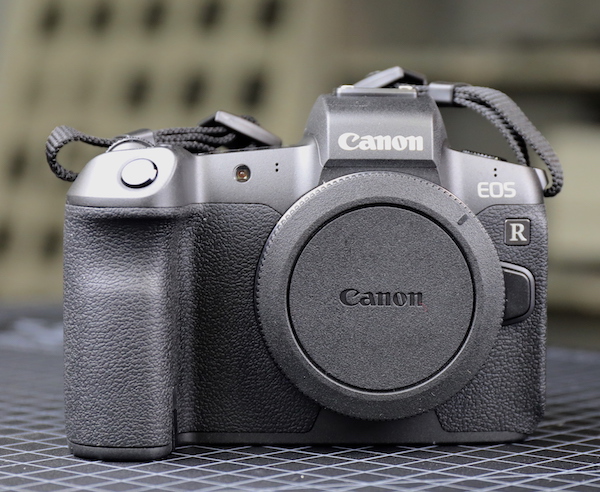
The Outside
Since this is a brand new camera to us, we started by removing all the grip rubber so we could see where most of the screws were. It’s worth noting that Canon seems to have new grip adhesive tape; it was both easier to remove and retained its stickiness for replacement better than what we’ve seen before. Important news for the none of you that intend to repair your cameras at home, but we like it.
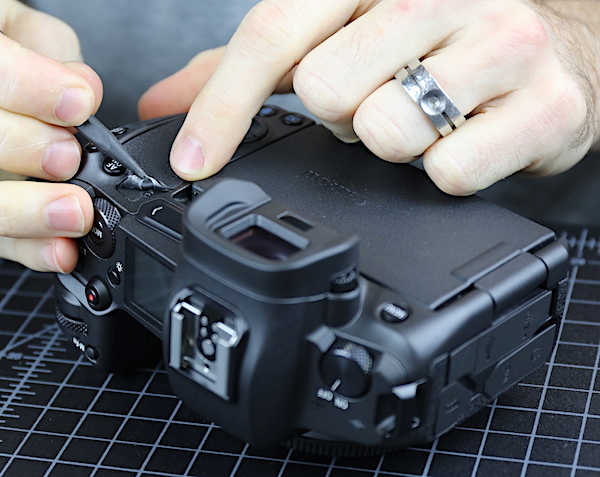
Now the camera looks kind of like your dog shaved down for summer. I kind of like it, though. If I get one, I may just take the grips off. The shell, BTW, seems to be a polycarbonate with a slightly rough surface. It would grip nicely.
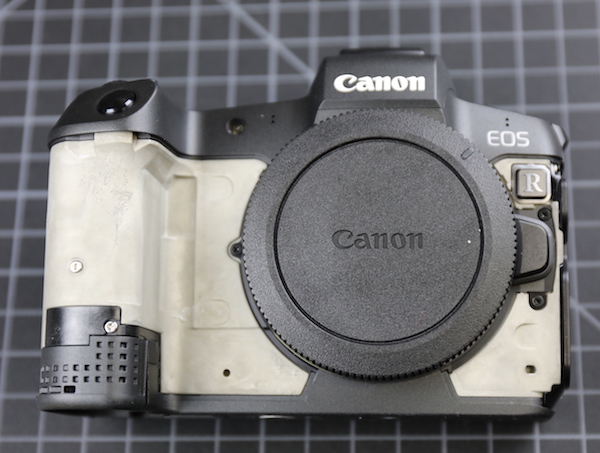
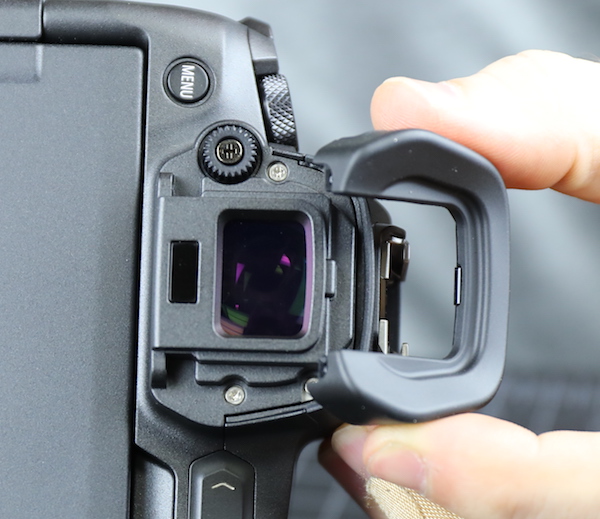
The rubber around the viewfinder is actually screwed into place. Good news for those of you who, like me, sometimes find yourself wondering when the viewfinder rubber came off. Bad news for those of you who like to take it off on purpose for some reason or other.
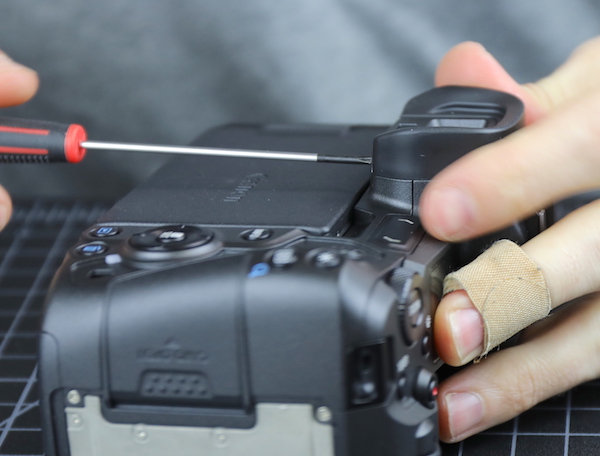
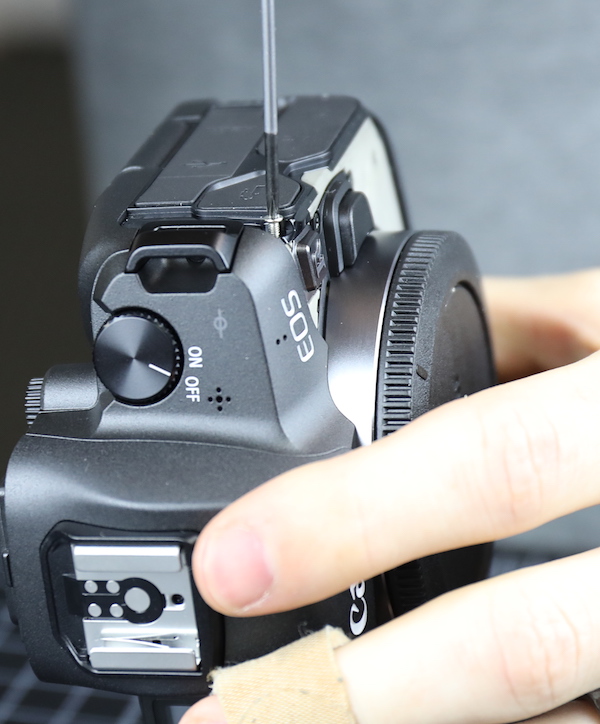
Next, we went to the side to remove the I/O port covers. This is held on by four screws; removing those lets it slide right off.
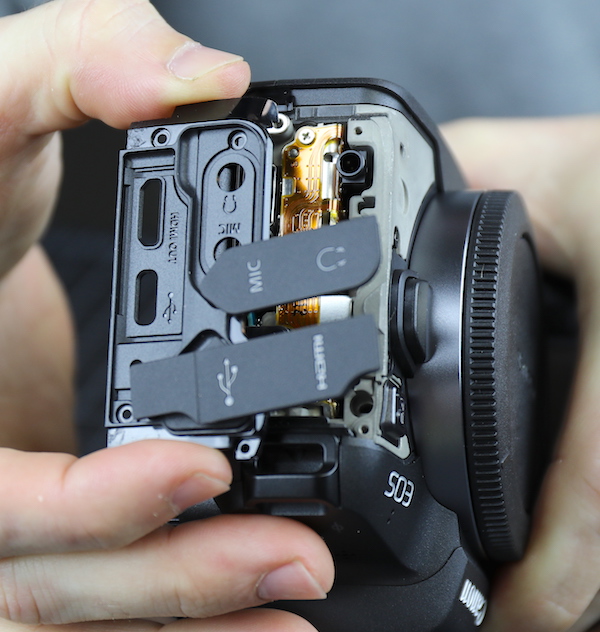
With the cover off we see a very nice flex along the I/O ports. Why ‘nice’ you ask? Because that means that some or all of the I/O ports are not soldered to the main PCB. We have to replace a lot of main PCBs because someone jerked a cable, pulling an I/O port off of the board.

Next, we remove all the visible screws around the body.
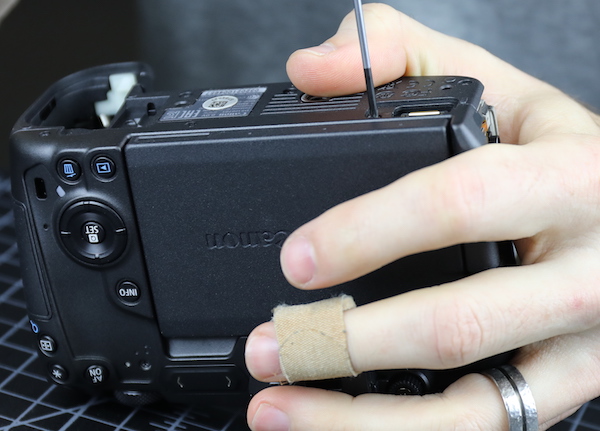
And the diopter adjustment from the viewfinder.
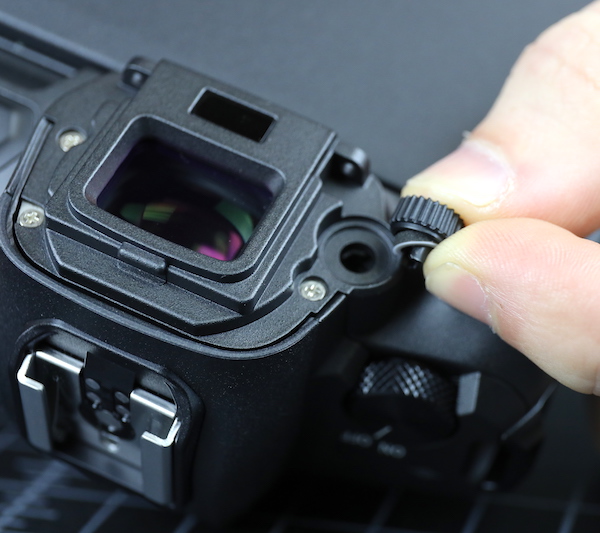
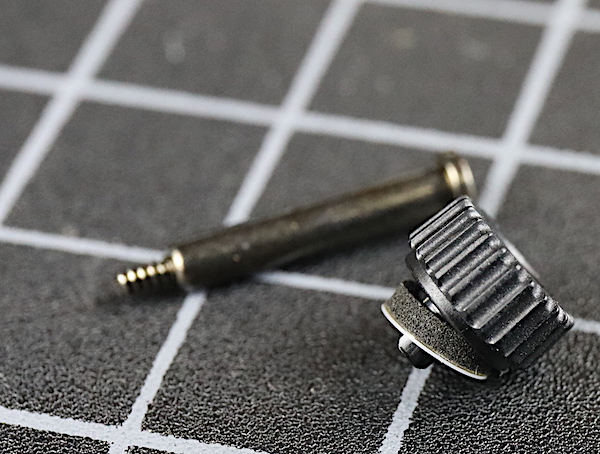
There is a nice thick weather seal under the diopter adjustment knob. For those who want to skip ahead, the knobs and dials are all weather sealed nicely, but not much else. As long as it only rains on your knobs and dials, though, you should be fine.
Opening the Case
With all the screws out, the back assembly can be removed, LCD and all, after the flexes between it and the main PCB are detached.
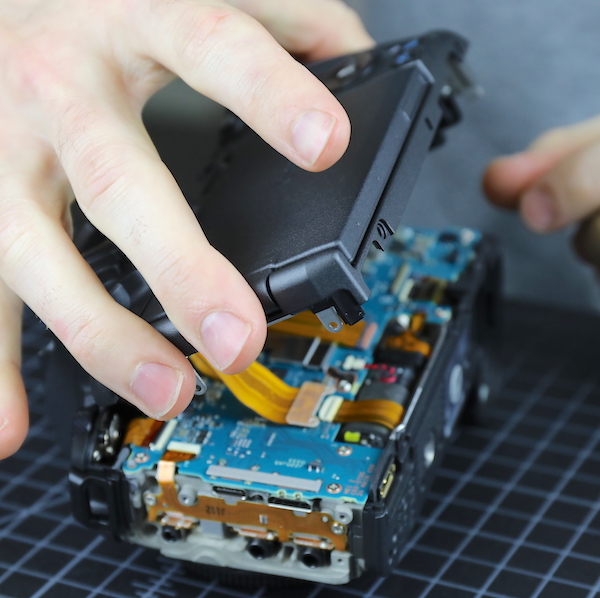
At a glance, this looks much like a Canon SLR: the back assembly containing the LCD and controls, the main PCB with neatly laid out flexes.
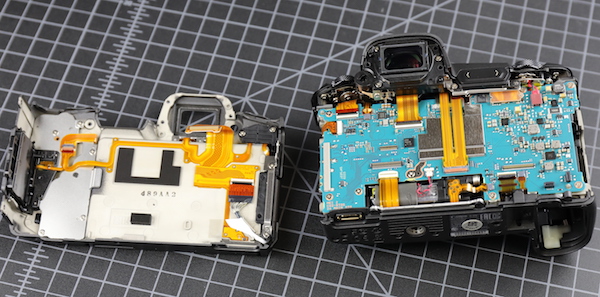
Looking closer, there are some apparent differences. First among these is that the shutter motor and electronics are at the bottom of the camera, underneath the shutter box. In a Canon DSLR, it’s generally to one side.

Here’s a close up of the shutter motor for those into such things.
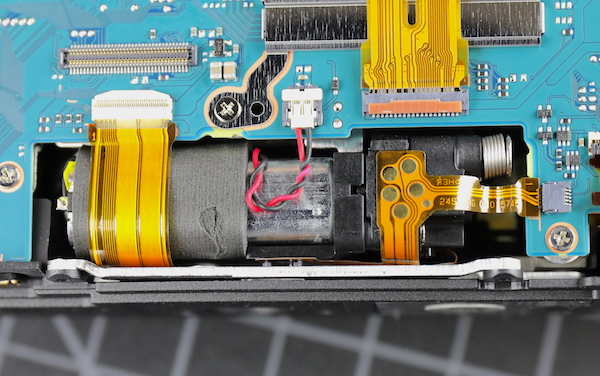
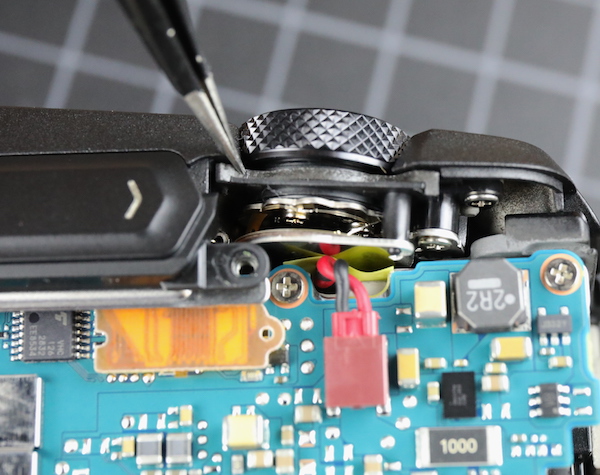
I should also show there’s weather sealing below each of the top dials. As you can see to the right of that, though, the rest of the body depends on a plastic overlap to keep stuff out, there are no gaskets.
The Back and LCD Assembly
The back panel looks like the rear panel from any camera with a hinged LCD. There’s shielding over the controls (left in the picture below) and connections are going out to the LCD.
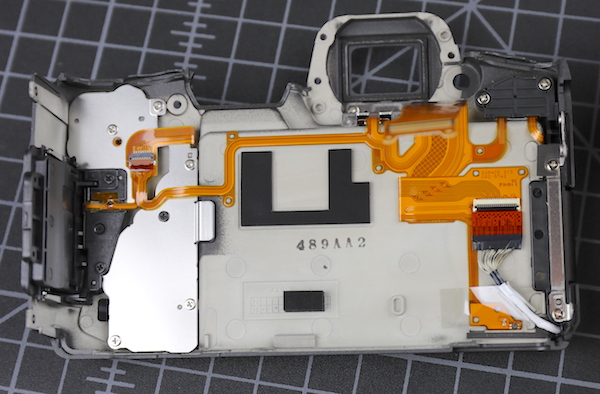
One thing that caught our attention immediately was the LCD attachment. You can see it seems only held down by two screws and a metal clamp. This could be great (LCD change is a common repair) unless it’s weak (making LCD replacement a more common repair).
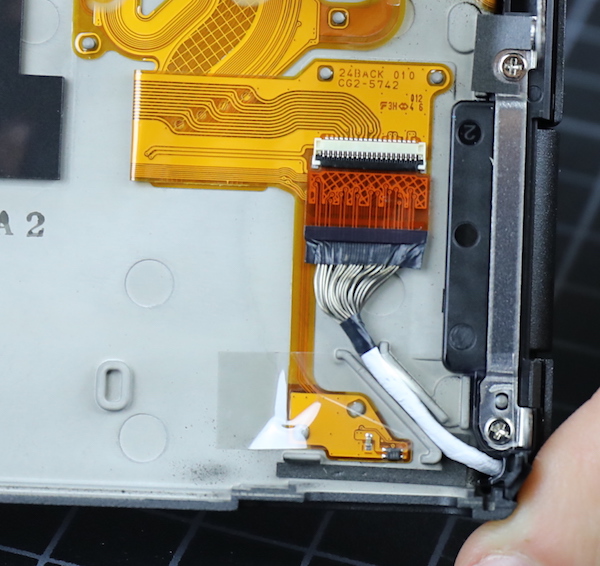
The bracket looks pretty robust, though, and the screws holding it down are the largest in the camera by far.
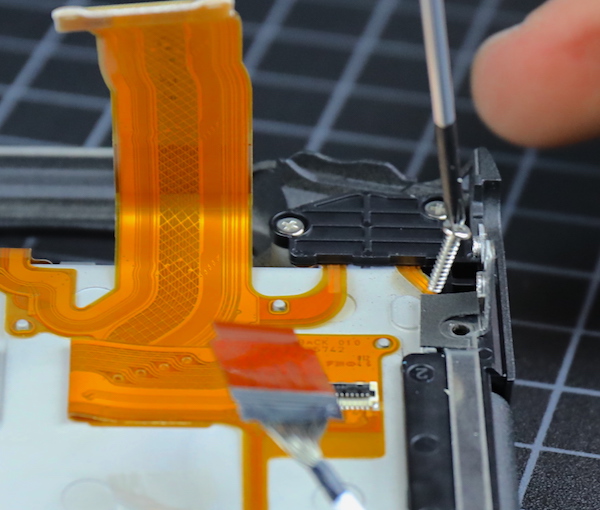
The bottom line is it makes LCD replacement something takes minutes, not hours.
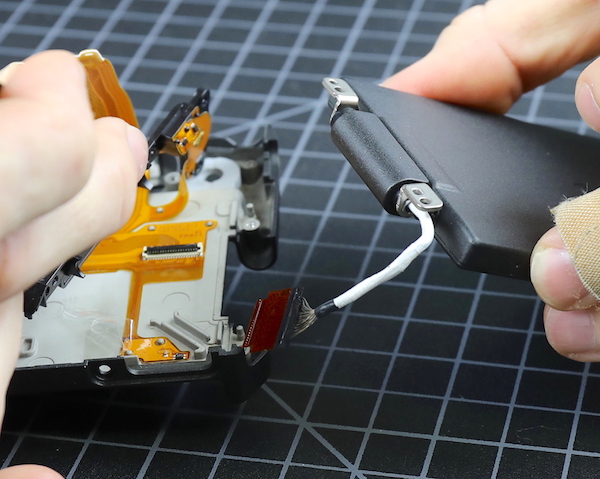
And the bracing and weather sealing around the bracket are excellent and sturdy.
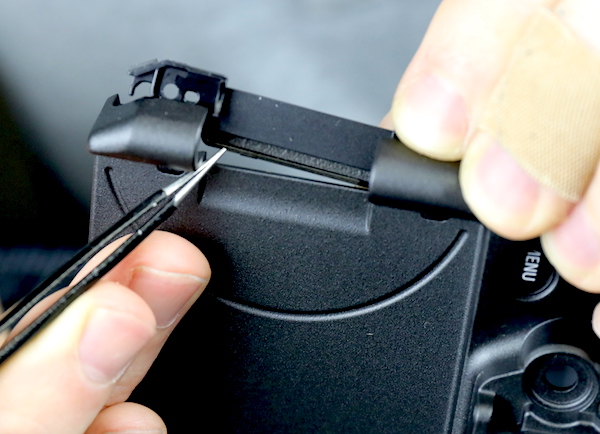
While we were back here, we removed the shielding to look at the weather sealing around the buttons. Again, thick and excellent.
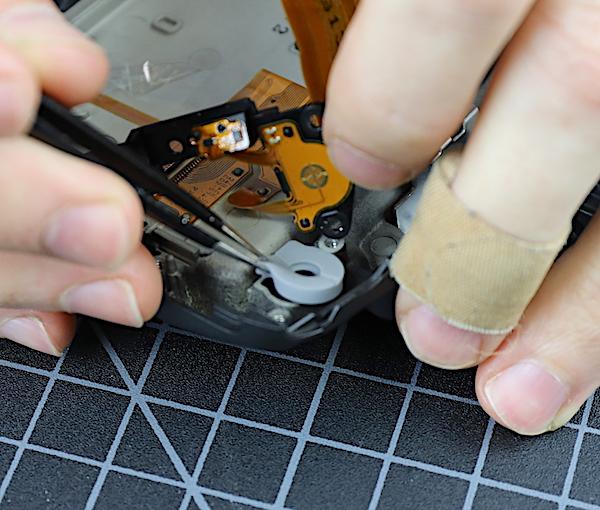
Other Subassemblies
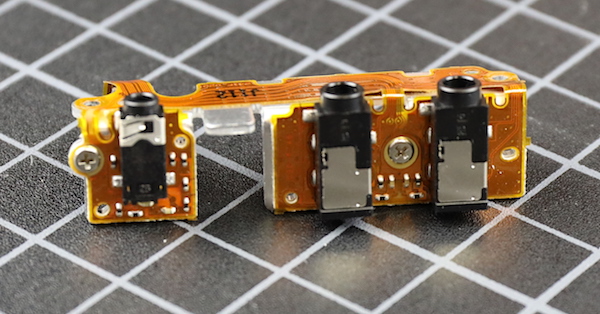
We’d already unfastened all the screws and disconnected flexes, so we slid out the I/O subassembly.

I was a little disappointed, but not surprised, that it contained only the RCA-type plugs. Better than nothing, of course, but the HDMI plug is the one that rips off the board most frequently, at least in our experience.
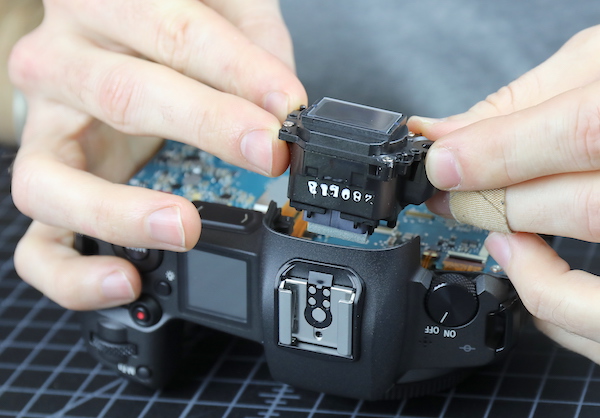
Similarly, the EVF had already been disconnected so it could slide right out.
Finally, the top assembly was removed (there were two more screws internally holding this on).
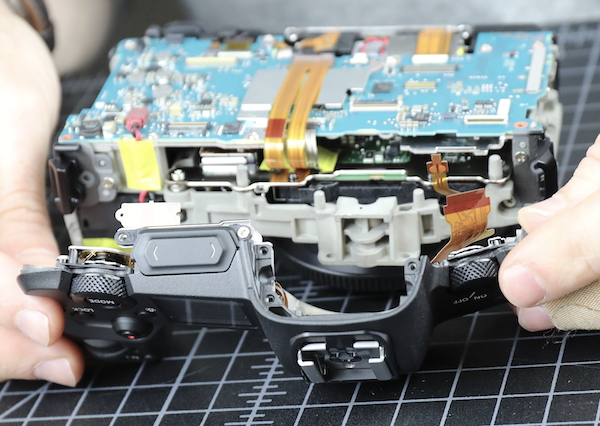
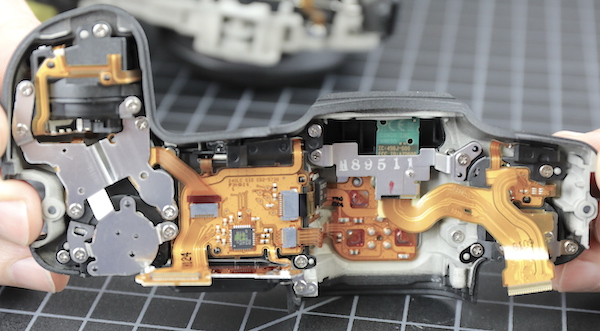
The top assembly has a lot of electronics and connections: EVF, various selectors and switches, the top LCD, and the touch bar. From a repair standpoint the top assembly is a single part; if anything in there breaks, you replace the whole thing. It can be disassembled but it’s very time consuming, and there’s no reason to. I will note, because the photo is small, that there is no weather-sealing foam along the edges. Plastic-to-plastic contact is all the weather sealing there is.
Main Body
With all the subassemblies removed, Aaron just had to remove the half dozen screws to take off the main PCB.
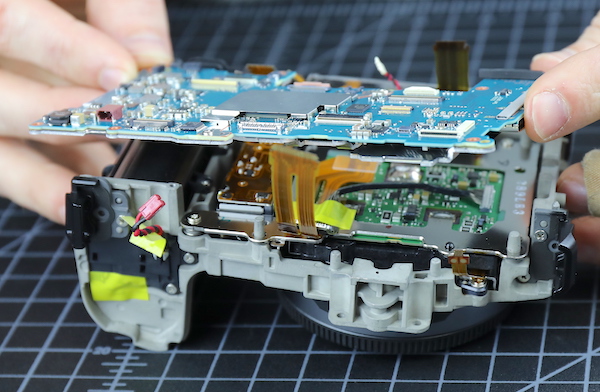
You can see a small electrical shield on the surface of the board in the image above; there’s more significant shielding underneath.
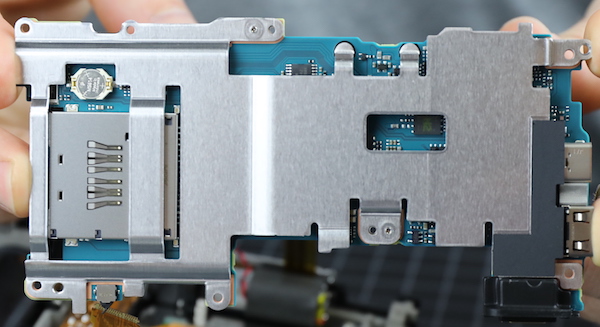
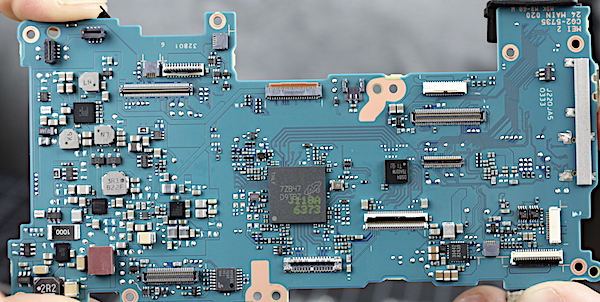
With the shields removed we can see the PCB is not particularly dense.
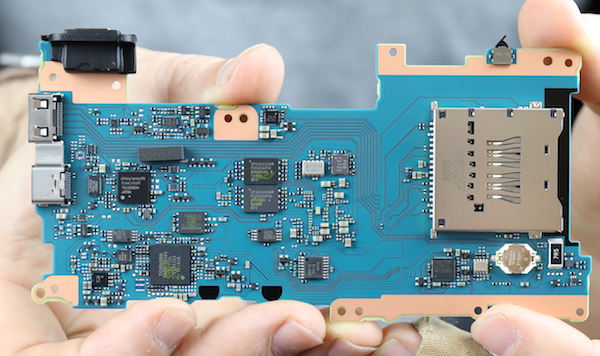
The inner side shows the SD card slot soldered to the board. Repair guys hate this since a broken card slot means replacing the entire board, but SD card slots are certainly more reliable than CF slots. Soldering the SD assembly to the board is the way it’s usually done.
With the PCB removed, all that’s left to see is the image sensor’s board (green), the shutter mechanism below it, and the battery box (black). Like all mirrorless cameras, the EOS-R is simpler than an SLR.
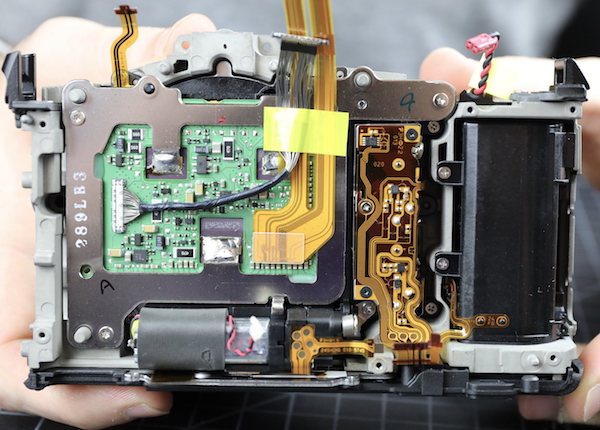
If you look carefully at the aluminum frame over the image sensor, you’ll notice 3 Torx (star) screw heads, two along the left side, one in the upper right. These are the sensor adjustment screws. During assembly, the image sensor is adjusted so that it is perfectly (in theory) aligned with the lens mount.
Each of these screws is spring-loaded. They are loosened and tightened during the adjustment process to align the sensor and lens mount to be within a few microns of parallel. We don’t have the automated equipment to do this adjustment (we can do it, but it involves hours of trial and error) so we aren’t going to do any further disassembly of the sensor plate.

The last piece to take off is the bottom plate.
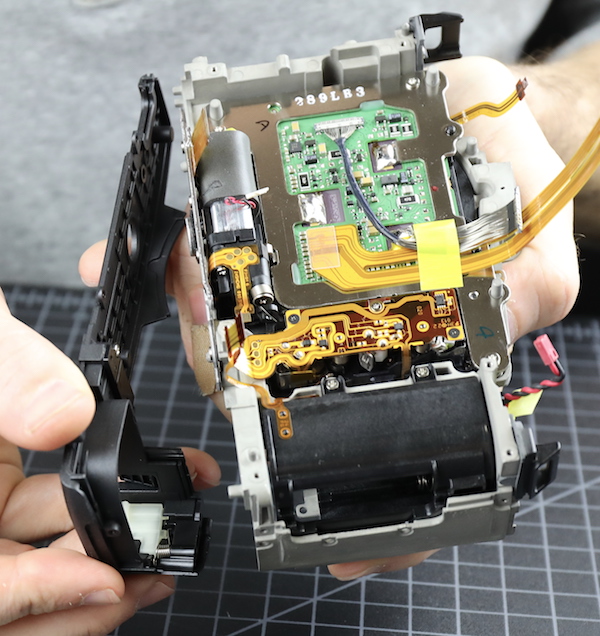
While there was no weather sealing around the edges of the plate, but there is some at the tripod mount.
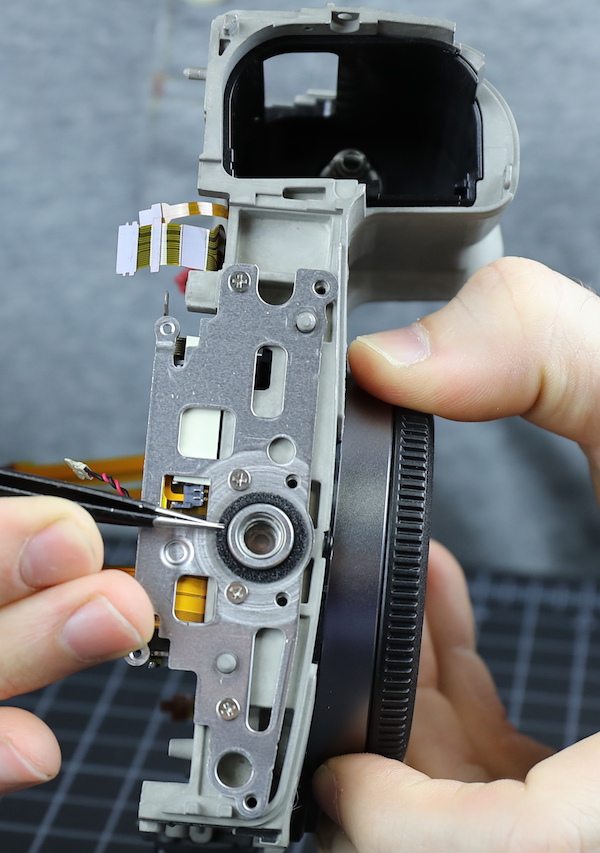
The tripod mounting plate comes off next, and there’s an important detail here. The tripod screw inserts into a pressed out cup (red arrow).
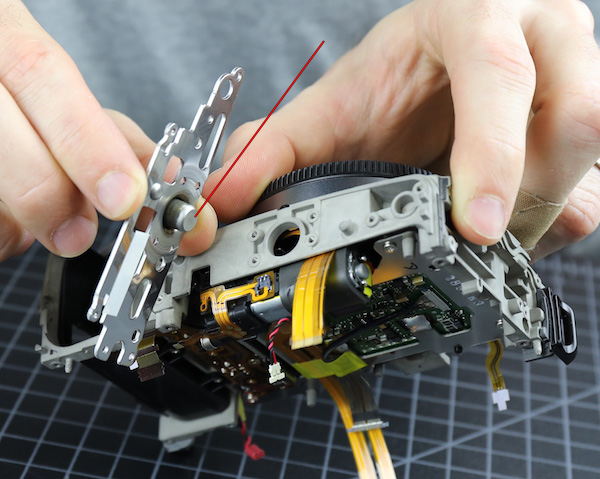
We like long cups because a long tripod plate screw (and they vary in length) can pop the top of a short cup out, leaving a free-floating piece of metal inside your camera. Free-floating metal inside your camera is a bad thing. A very bad thing. This one is nice and long and I can’t imagine a problem occurring.
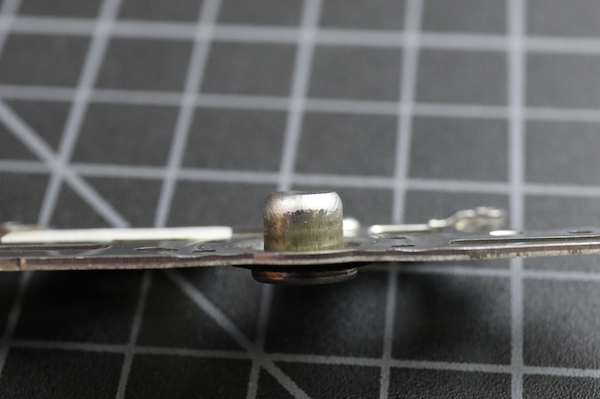
Here is the socket in the camera that the tripod cup sits in. The aluminum plate that you see crossing the hole is the sensor frame. You can see this would be a bad place to have a piece of metal floating around in. Not to mention a bad place to have a hole open to the environment.
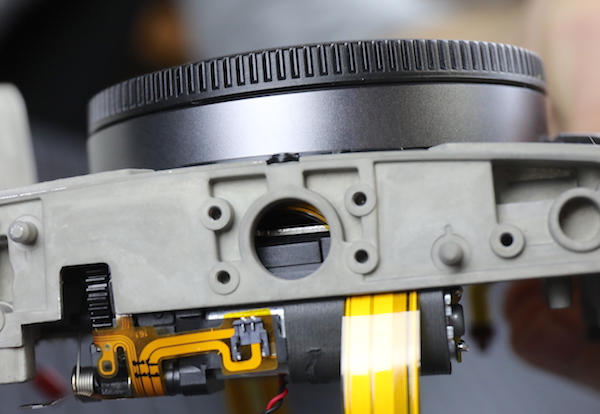
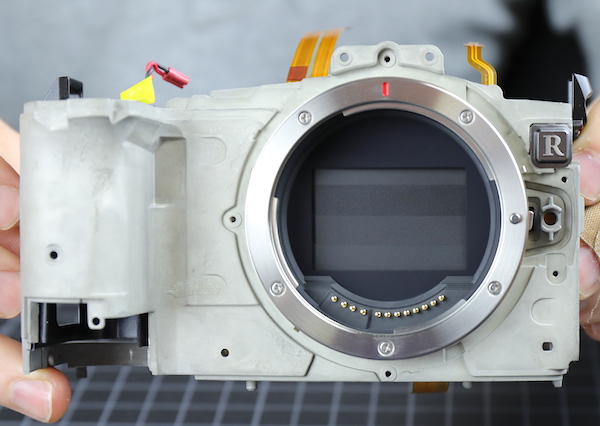
Before we start putting things back together, we’ll show you a front view of the stripped down camera. I’ll mention that I like that auto-close shutter feature a lot.
Summary
It was rather a boring disassembly, really, about what we should expect for Canon doing a Canon 6D Mark II quality mirrorless camera. It’s neatly laid out and nicely engineered inside. One thing that struck me is that it’s not very crowded inside there, or as we like to say ‘they left a lot of air inside’.
This view that I haven’t shown you yet, kind of illustrates that; there’s a pretty big gap between the circuit boards and the image sensor. If you look back at the Sony A7R III teardown (or the Nikon Z teardown to come) you’ll notice there’s not that much space inside; it’s taken up by the IBIS system which is big and thick.
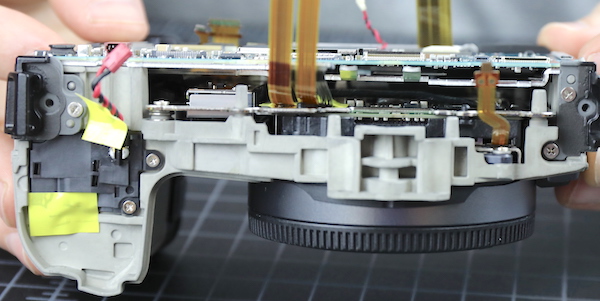
Do I think future Rs are going to have IBIS? No, I don’t. Canon has been very clear that they think lens stabilization is superior. The space is probably just a matter of ergonomics and perhaps heat diffusion. But there’s certainly room for it.
Speaking of the Sony A7RIII, it’s taken a bit of internet trashing for its lack of weather sealing. Throw no stones from your glass house, oh Canon shooters. The Canon EOS-R is just about the same; well-sealed buttons and dials, not much else. That means, I think, that it will be fine in a misty rain for a while, but don’t get it saturated and don’t set it somewhere wet.
You can make an argument that tightly fitted plastic shells are good weather sealing. Then again, you can argue that weather sealing means waterproof. Lots of people do that on the way to finding out the warranty doesn’t cover water damage.
The Canon EOS-R sells currently for $2299. It’s very close in build quality and weather sealing to the Canon 6D II which sells for about $1600. So for $600 you get the R mount, cool new slider bar thingie, a bit better (we assume) processing and four more megapixels. That actually sounds fairly reasonable to me.
Reason also suggests Canon is working the kinks out with a (fairly) reasonably priced camera before they come out with a mirrorless pro-level camera. But being reasonable never got anybody anywhere on the internet. The internet is filled with people pretending they’re moving from one brand to another as they justify the choices they’ve already made. So I will, in internet fashion, do some click-bait brand comparison.
The Sony A7r III can be had for a bit under $3,000, has equal build quality, a better native lens selection, more megapixels, etc. My opinion is it’s a better camera (not necessarily system) for the money. It should be; we’re comparing the first generation to a fourth generation.
The Nikon Z6 (comparable to the Canon EOS-R) is $2150 while the Nikon Z7 (comparable to the Sony A7RIII, at least in megapixels) runs a touch over $3,500. I’ll make more build quality comparison’s when I’ve taken a Z apart.
So, which would I buy, right now? None of the above; I don’t know enough yet, and I try very hard to avoid Generation 1 technology. If you forced me into a corner and said: “if you made your living with a camera, what would you shoot today?” I’d say either a Sony with a lot of adapted lenses or an SLR.
That’s today, and that’s my logical answer. Tomorrow (tomorrow being a couple of years) I will absolutely be shooting a mirrorless camera, but I have no idea yet which one. Of course, those of you who know me very well know I won’t be able to stand it, and I’ll ignore my own advice and get one of these in a month or two; and almost certainly decide it was the wrong one a month or two after that.
Roger Cicala and Aaron Closz
Lensrentals.com
October, 2018
223 Comments
Goran Škrlec ·
Thank you, Mr Cicala, for another great article. Although, I have to admit, I’m a bit worried about you! Always in your article I expect some great joke – this time nothing! Are you OK? 😉
But the real reason for this comment is to check if you have made a mistake regarding the type of material from which Canon EOS R was made.
I think, with official papers and photographs from Canon in mind, that the body of the camera is made of magnesium alloy.
I quote a statement from the Canon official site:
“Magnesium Alloy Body
Comfortable and solid in the hand, the EOS R camera features a rigid yet lightweight magnesium alloy chassis that enhances body durability while shielding the camera from electromagnetic radiation and heat. It also has a tempered front panel for internal rigidity.”
Also attached to this comment is the image of the Canon EOS R (used without permission :p ) which clearly shows that the body is a magnesium alloy. https://uploads.disquscdn.com/images/869ac9713ea685e2ba269c7dbabd3e3f3ec2ded78a14f21f4f96e2c1eed48fd8.jpg
Can you confirm it, or you may still be arguing that it is a plastic material?
Once again thank you and best regards!
bokesan ·
Oh, I kind of liked “As long as it only rains on your knobs and dials, …”
Goran Škrlec ·
Oh, yes…! How did I miss it!? That is, I did not laugh at that statement – now I’m worried about myself! 🙂
Peter ·
And what about this: “Important news for the none of you that intend to repair your cameras at home, but we like it.”
Goran Škrlec ·
Oh, God! I’m blind! 🙂
bokesan ·
May apply to digital, but I think there are a lot of people who are not afraid to take tools to their older cameras (from repairing a hole in bellows to applying a bit of oil or replacing that mirror dampening foam).
Roger Cicala ·
It is magnesium alloy, as they say, but it’s got quite a different feel to it.
Michael Ogle ·
Could it be like Nikon and the 750 body which they claim as carbon but is actually plastic with carbon fibers….Canon may have mag fibers in plastic?
Devil's Advocate ·
No-one’s going to make a woven fibre-reinforced plastic body for a shape as complex as a camera – complex curves are difficult and it’s too labour intensive. The D750 will be a short fibre (“whisker”)-reinforced plastic body though, similar to fishing reel bodies. There’s no point in using metal whiskers – the fibres/whiskers used in reinforcing plastic are there to provide stiffness, and magnesium is less stiff than carbon or ceramic whiskers. The other unlikely option is a metal-matrix-composite in which metal is reinforced by whiskers of stuff like SiC.
bokesan ·
Oh, I kind of liked "As long as it only rains on your knobs and dials, ..."
Maya ·
Thanks for the teardown.
And now the big question : have you already managed to “accidentally” break these new toys to *lowers voice* get parts for lens testing ?
I’m skeptical about the shutter closing when changing lenses. I have seen zero correlation with the cameras I’ve owned between how much the sensor is exposed and how much dust ultimately settles on it. I never had to clean my OM-D E-M1 sensor, only a few times my 5DIII’s, and nearly all the time my 6D’s. I guess that as far as Canon is concerned, they’ve done their homework and found that it worked best for them this way, but I wouldn’t presume in the absence of long term data that this is the best solution for everyone.
Goran Škrlec ·
Dust on the sensor is a very relative problem with the many variables that come into the equation. For example, I have Canon EOS 5D Mark II for 7 years, with far more than 200.000 shots, and I never had to clean the sensor – I just cleaned it in 3-4 times with a regular blower. The sensor on my Canon EOS 80D, in the past two and a half years, has never had to be cleaned, except once and that time also with regular blower.
I think, like Mr Cicala, that this is a good move by Canon that will prove justified in the long run for those who have problems with the dust on their sensors.
Stanislaw Zolczynski ·
Why you should be concerned with auto shutter closing.? Very wise move. All previous mirrorless didn`t have it, the only exception was my old Ricoh GRX m-module. I wonder how you could avoid tiny droplets of mist in blowing wind. We are talking about mirrorless not DSLR where sensor is kind of shielded by mirror, apples and pears. Beside it you may disable the feature in menu, at least in Ricoh, for cleaning purpose. When I tried NikonZ7 they told me that it caps the sensor when powered off but they couldn´t find out if it does it automatically.
Maya ·
I am not concerned by it. I’m sure Canon has done their homework and that this is what they think is best for them. I’m questioning people’s assertion that it’s necessarily going to limit the quantity of dust that will eventually settle on their sensor, and that it’s a solution that’s “obvious” or should be implemented in all other cameras. Roger will have more to comment, particularly in the long run with Lensrental’s experience of various FF mirrorless cameras’ cleaning requirements.
As far as I’m concerned, my anecdotal experience tells me that there is no correlation between dust on a sensor and sensor exposure to the elements. As I said, the camera that gave me the least amount of dust problems are my ex OM-D E-M1s, which sensors always exposed. Why is that ? I don’t know. More effective dust reduction system ? Thicker filter stack ? And the camera that’s giving me the most issues ? My Canon 6D, despite its sensor being “shielded by mirror, apples and pears”. Anyway, proof is in the pudding !
Regarding the Z7, I don’t think that it closes its shutter blades when powered off. What I read was that it locks the sensor’s IBIS system so that it doesn’t move about inside the camera when it’s powered off, like the OM-D E-M1.
Stanislaw Zolczynski ·
Yes it does, Nikon z7 when powered off. I had it in my hands. The question is whether it does automatically when removing the lens as it should.
Thom Hogan ·
No it doesn’t. Mine’s powered off. Shutter open. You might want to check your yes, not your hands.
Stanislaw Zolczynski ·
I´ve had the bloody camera in my hand and shutter was closed, dude. Probably yours had open sensor setting used for cleaning. My old Ricoh GXR m-module has that function. As to shutter, you can ruin it by firing it with lens removed and you finger up the cavity. I don`t think weaning face mask will stop tiny mist droplets blown in.
Thom Hogan ·
No it doesn't. Mine's powered off. Shutter open. You might want to check your yes, not your hands.
I should also mention that I'm ambivalent over shutter closed/open. The problem with shutters is that anything that touches those delicate blades can completely screw them up. Maybe wear a face mask if you have a bad cold ;~).
Stanislaw Zolczynski ·
As to shutter, you can ruin it by firing it with lens removed and you finger up the cavity. I don`t think weaning face mask will stop tiny mist droplets blown in.
sikaheimo ·
One thing going for the Olympus is the sensor size, it’s approximately four times smaller than a full frame sensor. Chance of dust landing on the sensor is thus smaller, but if that happens, it will appear proportionally larger in the image.
But I believe big part of the equation is the Olympus dust reduction system. IIRC Pentax also uses Olympus developed DR, and the same will also be implemented in the coming Ricoh GRIII. Wouldn’t be surprised if other manufacturers also use it.
Ada ·
I’ve EOS Ms, Fuji Xs, and a Canon FF DSLR. My none scientific experience is: I had way more issues with dust and dirt on my ML systems over 2 years than over 10+ years DSLR. I’m now traveling with a “sensor pen” because of this
dkphotoman723 ·
I agree – more dust with mirrorless in my experience. And not only dust. Once had a drop of water (from a tree still wet after rain) drip onto the sensor of my mirrorless when changing lenses. Very glad to see Canon has come up with this feature.
Athanasius Kirchner ·
Ugh, you don’t know all the awful kinds of damage that water can cause to a shutter curtain, do you?
Michael Clark ·
dkphotoman723 Isn’t that why we always make sure the camera is pointed at least slightly down when we change lenses?
dkphotoman723 ·
I agree - more dust with mirrorless in my experience. And not only dust. Once had a drop of water (from a tree still wet after rain) drip onto the sensor of my mirrorless when changing lenses. Very glad to see Canon has come up with this feature.
Athanasius Kirchner ·
Ugh, you don't know all the awful kinds of damage that water can cause to a shutter curtain, do you?
Michael Clark ·
dkphotoman723 Isn't that why we always make sure the camera is pointed at least slightly down when we change lenses?
lucascirineu ·
disqus_xTSJnEavDb why
Maya ·
I am not concerned by it. I'm sure Canon has done their homework and that this is what they think is best for them. I'm questioning people's assertion that it's necessarily going to limit the quantity of dust that will eventually settle on their sensor, and that it's a solution that's "obvious" or should be implemented in all other cameras. Roger will have more to comment, particularly in the long run with Lensrental's experience of various FF mirrorless cameras' cleaning requirements.
As far as I'm concerned, my anecdotal experience tells me that there is no correlation between dust on a sensor and sensor exposure to the elements. As I said, the camera that gave me the least amount of dust problems are my ex OM-D E-M1s, which sensors always exposed. Why is that ? I don't know. More effective dust reduction system ? Thicker filter stack ? And the camera that's giving me the most issues ? My Canon 6D, despite its sensor being "shielded by mirror, apples and pears". Anyway, proof is in the pudding !
Regarding the Z7, I don't think that it closes its shutter blades when powered off. What I read was that it locks the sensor's IBIS system so that it doesn't move about inside the camera when it's powered off, like the OM-D E-M1.
sikaheimo ·
One thing going for the Olympus is the sensor size, it's approximately four times smaller than a full frame sensor. Chance of dust landing on the sensor is thus smaller, but if that happens, it will appear proportionally larger in the image.
But I believe big part of the equation is the Olympus dust reduction system. IIRC Pentax also uses Olympus developed DR, and the same will also be implemented in the coming Ricoh GRIII. Wouldn't be surprised if other manufacturers also use it.
Maya ·
Thanks for the teardown.
And now the big question : have you already managed to "accidentally" break these new toys to *lowers voice* get parts for lens testing ?
I'm skeptical about the shutter closing when changing lenses. I have seen zero correlation with the cameras I've owned between how much the sensor is exposed and how much dust ultimately settles on it. I never had to clean my OM-D E-M1 sensor, only a few times my 5DIII's, and nearly all the time my 6D's. I guess that as far as Canon is concerned, they've done their homework and found that it worked best for them this way, but I wouldn't presume in the absence of long term data that this is the best solution for everyone.
Peter ·
And what about this: "Important news for the none of you that intend to repair your cameras at home, but we like it."
jp ·
Thanks Roger,
Well, how it will be next EOS R “professional”,…. full weather sealed??…. Less plastic…. and near heavy as the EOS 1D!???
Hm, Canon take care about weather sealed body! That could be a “NO-GO” for much Mirrorless fan photo/videographer…
jp ·
Thanks Roger,
Well, how it will be next EOS R "professional",.... full weather sealed??.... Less plastic.... and near heavy as the EOS 1D!???
Hm, Canon take care about weather sealed body! That could be a "NO-GO" for much Mirrorless fan photo/videographer...
Roger Cicala ·
It is magnesium alloy, as they say, but it's got quite a different feel to it.
Michael Ogle ·
Could it be like Nikon and the 750 body which they claim as carbon but is actually plastic with carbon fibers....Canon may have mag fibers in plastic?
Devil's Advocate ·
No-one's going to make a woven fibre-reinforced plastic body for a shape as complex as a camera - complex curves are difficult and it's too labour intensive. The D750 will be a short fibre ("whisker")-reinforced plastic body though, similar to fishing reel bodies. There's no point in using metal whiskers - the fibres/whiskers used in reinforcing plastic are there to provide stiffness, and magnesium is less stiff than carbon or ceramic whiskers. The other unlikely option is a metal-matrix-composite in which metal is reinforced by whiskers of stuff like SiC.
obican ·
Roger Cicala (from Lensrentals.com) says he’d try very hard to avoid CaNikon mirrorless systems.
EVener ·
he also says he’d avoid the Sony mirrorless systems as well.
MEAllred ·
No he didn’t. He said he’d pick the Sony with adapted lenses. Please take a reading comprehension class
Refurb7 ·
No he didn’t. He said, “I’d say either a Sony with a lot of adapted lenses or an SLR.” Please take a reading comprehension class yourself.
EVener ·
Sorry, I forgot to put my fanboy blinders on.
Roger wrote: “So, which would I buy, right now? None of the above; I don’t know enough yet, and I try very hard to avoid Generation 1 technology. If you forced me into a corner and said: “if you made your living with a camera, what would you shoot today?” I’d say either a Sony with a lot of adapted lenses or an SLR.
That’s today, and that’s my logical answer. Tomorrow (tomorrow being a couple of years) I will absolutely be shooting a mirrorless camera, but I have no idea yet which one. Of course, those of you who know me very well know I won’t be able to stand it, and I’ll ignore my own advice and get one of these in a month or two; and almost certainly decide it was the wrong one a month or two after that.”
That does not read like a ringing endorsement to me. Of the four working photographers I know well who shoot with Sony cameras: one shoots sports and concerts, one shoots landscapes, one shoots fine art, and the fourth uses his Sony’s for video work, all of them have tried using adapters with their A7R II, A& R III, and A9 camewras and not one of them have been happy with the results. However they all love the Zeiss for Sony and Sony lenses.
Silvestro Crino ·
Sure… Sony native lenses will always beat the adapted stuff when it counts…. but it’s still nice to be able to adapt other brands of lenses… especially older stuff with a bit of character… to my Sony bodies.
MEAllred ·
Refurb – Please – My take is correct especially with regards to EVeners statement saying “he’d avoid the Sony mirrorless systems as well” – so get the sh*t out of your head and but out.
Panacea ·
Nobody in this thread had yet to catch that obican posts in EVERY lensrentals blog post as (barely) a parody of the editor of a certain Sony-centric site infamous for misrepresenting Roger’s words into candy for the Sony fanboys.
Ada ·
Thank you, we don’t need you to misrepresent and drag out of context what Roger wrote above, we can read it ourselves.
You could join the trolls at dpreview.com. Over there many people are not skilled enough to go over here, so they might even trust you.
obican ·
Roger Cicala (from Lensrentals.com) says he'd try very hard to avoid CaNikon mirrorless systems.
EVener ·
he also says he'd avoid the Sony mirrorless systems as well.
MEAllred ·
No he didn't. He said he'd pick the Sony with adapted lenses. Please take a reading comprehension class
Silenced by PetaPixel ·
No he didn't. He said, "I'd say either a Sony with a lot of adapted lenses or an SLR." Please take a reading comprehension class yourself.
EVener ·
Sorry, I forgot to put my fanboy blinders on.
Roger wrote: "So, which would I buy, right now? None of the above; I don’t know enough yet, and I try very hard to avoid Generation 1 technology. If you forced me into a corner and said: “if you made your living with a camera, what would you shoot today?” I’d say either a Sony with a lot of adapted lenses or an SLR.
That’s today, and that’s my logical answer. Tomorrow (tomorrow being a couple of years) I will absolutely be shooting a mirrorless camera, but I have no idea yet which one. Of course, those of you who know me very well know I won’t be able to stand it, and I’ll ignore my own advice and get one of these in a month or two; and almost certainly decide it was the wrong one a month or two after that."
That does not read like a ringing endorsement to me. Of the four working photographers I know well who shoot with Sony cameras: one shoots sports and concerts, one shoots landscapes, one shoots fine art, and the fourth uses his Sony's for video work, all of them have tried using adapters with their A7R II, A& R III, and A9 camewras and not one of them have been happy with the results. However they all love the Zeiss for Sony and Sony lenses.
Silvestro Crino ·
Sure... Sony native lenses will always beat the adapted stuff when it counts.... but it's still nice to be able to adapt other brands of lenses... especially older stuff with a bit of character... to my Sony bodies.
MEAllred ·
Refurb - Please - My take is correct especially with regards to EVeners statement saying "he'd avoid the Sony mirrorless systems as well" - so quit trying to micro analyze and butt out. The gist of what I wrote is perfectly accurate within the scope of this debate.
Panacea ·
Nobody in this thread had yet to catch that obican posts in EVERY lensrentals blog post as (barely) a parody of the editor of a certain Sony-centric site infamous for misrepresenting Roger's words into candy for the Sony fanboys.
Ada ·
Thank you, we don't need you to misrepresent and drag out of context what Roger wrote above, we can read it ourselves.
You could join the trolls at dpreview.com. Over there many people are not skilled enough to go over here, so they might even trust you.
JosephAndrews ·
1. Thanks for the (literal!) nuts-and-bolts teardown and the resulting images
2. Thanks even more for the nuts-and-bolts writing style; I always know I’ll leave this website feeling a bit smarter.
It did just occur to me, Roger, after finding out (too late to buy) that a fabulous bargain for a Canon 5DMk4 with kit lens (and US warranty) was available for a few hours last night…that even had I been ‘in time’…I would not have pulled the trigger.
Why? My Mk3 is fine for my current needs…and to be honest my stable of EOS M-format cameras (including the wonderful M6) gets used more often these days. I’ve also put off the purchase of at least one EF lens (the 11-24)…which makes it more likely that I’ll be renting that baby from you!
What does Canon’s move to full-frame mirrorless mean for your business, Roger? I know it has changed how I look at buying additional Canon gear.
Thanks for reading (and writing).
Roger Cicala ·
I honestly don’t know what it will mean long-term. For a while, we’ll be spending a lot of money and renting a lot of mirrorless stuff for people to try; that usually lasts 6 months or so. I’m not sure after that.
JosephAndrews ·
1. Thanks for the (literal!) nuts-and-bolts teardown and the resulting images
2. Thanks even more for the nuts-and-bolts writing style; I always know I'll leave this website feeling a bit smarter.
It did just occur to me, Roger, after finding out (too late to buy) that a fabulous bargain for a Canon 5DMk4 with kit lens (and US warranty) was available for a few hours last night...that even had I been 'in time'...I would not have pulled the trigger.
Why? My Mk3 is fine for my current needs...and to be honest my stable of EOS M-format cameras (including the wonderful M6) gets used more often these days. I've also put off the purchase of at least one EF lens (the 11-24)...which makes it more likely that I'll be renting that baby from you!
What does Canon's move to full-frame mirrorless mean for your business, Roger? I know it has changed how I look at buying additional Canon gear.
Thanks for reading (and writing).
Roger Cicala ·
I honestly don't know what it will mean long-term. For a while, we'll be spending a lot of money and renting a lot of mirrorless stuff for people to try; that usually lasts 6 months or so. I'm not sure after that.
desertglow2 ·
Hello Roger, just a question, is the mount bolted directly into the magnesium frame, or in between there’s a black plastic spacer… on 5d MK iv there are 4 bolts screwed on plastic…I hope on this camera they made it more robust (i noticed they put 5 instead of 4) by screwing on magnesium alloy.
Roger Cicala ·
Through a plastic spacer into the frame.
desertglow2 ·
Hello Roger, just a question, is the mount bolted directly into the magnesium frame, or in between there's a black plastic spacer... on 5d MK iv there are 4 bolts screwed on plastic...I hope on this camera they made it more robust (i noticed they put 5 instead of 4) by screwing on magnesium alloy.
Roger Cicala ·
Through a plastic spacer into the frame.
Jam005 ·
So, by the looks of it, there’s ample space to assemble the 2nd card slot. Would it piggy back? Or mini standoff board? How would you suppose they would go about? curious.
Roger Cicala ·
Assuming it’s not an SD second slot, it would probably be a separate board.
Jam005 ·
So, by the looks of it, there's ample space to assemble the 2nd card slot. Would it piggy back? Or mini standoff board? How would you suppose they would go about? curious.
Roger Cicala ·
Assuming it's not an SD second slot, it would probably be a separate board.
Freddo ·
As an engineer (of sorts), the optimistic mixing of various metals and alloys I see in camera teardowns makes me cringe every time. It’s like a smörgåsbord of galvanic corrosion opportunities. But I guess it’s all going to be dandy as long as no electrolyte (water) is added. Then it’s game over anyway. 😛
“If you forced me into a corner and said: “if you made your living with a camera, what would you shoot today?” I’d say either a Sony with a lot of adapted lenses or an SLR.” Are Sony lenses really that bad Roger? (I shoot Sony, but with unadapted Zeiss Loxia glass.)
Roger Cicala ·
They aren’t that bad. Some are absolutely superb. They miss some things I would shoot with: tilt shifts, affordable telephoto primes. There is also, as would be inevitable when you bring out an incredible amount of new lenses rapidly, several that aren’t what I’d hope or that have consistency issues.
pest ·
That Batis 135/2.8 let me smile every time i review the taken photos. What a lens!
EsaTuunanen ·
No worries about lack of possibilities for getting electrolyte in…
That’s why they sealed only knobs and dials.
I mean we can’t ask them to do more substantial sealing in camera of this price level…
PS. Don’t check materials used in nowadays fashionable PC CPU “AIO water coolers” wanted by everyone and their dog.
Freddo ·
As an engineer (of sorts), the optimistic mixing of various metals and alloys I see in camera teardowns makes me cringe every time. It's like a smörgåsbord of galvanic corrosion opportunities. But I guess it's all going to be dandy as long as no electrolyte (water) is added. Then it's game over anyway. :P
"If you forced me into a corner and said: “if you made your living with a camera, what would you shoot today?” I’d say either a Sony with a lot of adapted lenses or an SLR." Are Sony lenses really that bad Roger? (I shoot Sony, but with unadapted Zeiss Loxia glass.)
Roger Cicala ·
They aren't that bad. Some are absolutely superb. They miss some things I would shoot with: tilt shifts, affordable telephoto primes. There is also, as would be inevitable when you bring out an incredible amount of new lenses rapidly, several that aren't what I'd hope or that have consistency issues.
EsaTuunanen ·
No worries about lack of possibilities for getting electrolyte in...
That's why they sealed only knobs and dials.
I mean we can't ask them to do more substantial sealing in camera of this price level...
PS. Don't check materials used in nowadays fashionable PC CPU "AIO water coolers" wanted by everyone and their dog.
geekyrocketguy ·
Will we be seeing optical evaluation of the lenses? I’m particularly interested in the 24-105 and 50mm.
geekyrocketguy ·
Will we be seeing optical evaluation of the lenses? I'm particularly interested in the 24-105 and 50mm.
EVener ·
Roger, that was fascinating.
You remark “This view that I haven’t shown you yet, kind of illustrates that; there’s a pretty big gap between the circuit boards and the image sensor” and go on to say that you believe that Canon will not be filling that space with an IBIS system. Do you think the extra space is there to help dissipate reduce heat build up while shooting video or very long exposures?
Roger Cicala ·
Probably both heat and ergonomics; I’m sure they wanted a body of a certain size. And I expect there might be more chips, maybe even a secondary board in whatever “pro mirrorless” camera comes out one day.
EVener ·
Roger, that was fascinating.
You remark "This view that I haven’t shown you yet, kind of illustrates that; there’s a pretty big gap between the circuit boards and the image sensor" and go on to say that you believe that Canon will not be filling that space with an IBIS system. Do you think the extra space is there to help dissipate reduce heat build up while shooting video or very long exposures?
Roger Cicala ·
Probably both heat and ergonomics; I'm sure they wanted a body of a certain size. And I expect there might be more chips, maybe even a secondary board in whatever "pro mirrorless" camera comes out one day.
MEAllred ·
Roger basically says all the Sony lenses suck. As a Sony shooter, this is disturbing news as this is by far the most important part.
I’m shocked by the statement and I think it deserves more discussion from him than a one sentence take down of the Sony lens line.
Additionally, Sonys been at mirrorless for several generations now, and we have to do a bunch of arm twisting for Roger to pick Sony as the best camera/system currently – that’s a very sad state of affairs for Sony…
Roger Cicala ·
Roger doesn’t think Roger said that, or did he mean too. But Roger did say, and did mean, that Canon’s 40 years has led to a broader lens lineup than Sony’s 4 years. Cause, well, common sense.
obican ·
Roger Cicala (from Lensrentals.com) says that Roger Cicala (from Lensrentals.com) does think Roger Cicala (from Lensrentals.com) said that Sony lenses rule!
MEAllred ·
Why say that you’d only pick the Sony with a bunch of adapted glass? The obvious takeaway there is the native glass isn’t any good…
Fawn__Liebowitz ·
He didn’t say that he’d only use the Sony with a bunch of adapted glass. He said “…either a Sony with a lot of adapted lenses or an SLR”.
That statement doesn’t rule out the option of using Sony glass too. I think that’s true of many Nikon and Canon shooters: there are lens from those vendors that aren’t available from Sony so switching to Sony right now would require the use of adapters.
Roger Cicala ·
If you want some quick examples, I’m a 35mmm f1.4 fan and that’s one where I’d be shooting adapted along with a 24mm f1.4 which I also like. Also all supertelephotos which I use quite a bit. Tilt-shifts, of course. Maybe also a 70-200 zoom, although that would be from a reliability and price standpoint, not image quality. For standard and wide zooms, at 50 and 85mm, for a macro I’d go with native Sony.
Nick Podrebarac ·
That makes a lot of sense. There are definitely some areas where the e-mount lineup is overpriced and/or meh. It’ll be interesting if the 24mm F1.4 GM would supplant the adapted alternative. Either way, as a fledgling Sony shooter, I’m feverishly taking notes of which lens areas to possibly wait out a bit.
Alec Kinnear ·
Sony telephotos are priced wildly, in comparison to performance, vs at least Canon lenses.
MEAllred ·
Roger basically says all the Sony lenses suck. As a Sony shooter, this is disturbing news as this is by far the most important part of the system.
I'm shocked by the statement and I think it deserves more discussion from him than a one sentence take down of the Sony lens line/ecosystem.
Additionally, Sonys been at mirrorless for several generations now, and Roger has to do a bunch of gyrating to finally pick Sony as the best camera/system currently - that's a very sad state of affairs for Sony...
Roger Cicala ·
Roger doesn't think Roger said that, or did he mean too. But Roger did say, and did mean, that Canon's 40 years has led to a broader lens lineup than Sony's 4 years. Cause, well, common sense.
obican ·
Roger Cicala (from Lensrentals.com) says that Roger Cicala (from Lensrentals.com) does think Roger Cicala (from Lensrentals.com) said that Sony lenses rule!
MEAllred ·
Roger - Why say that you'd only pick the Sony with a bunch of adapted glass? The obvious takeaway there is the native glass isn't any good (as the current lineup is fairly broad)...
Fawn__Liebowitz ·
He didn't say that he'd only use the Sony with a bunch of adapted glass. He said "...either a Sony with a lot of adapted lenses or an SLR".
That statement doesn't rule out the option of using Sony glass too. I think that's true of many Nikon and Canon shooters: there are lens from those vendors that aren't available from Sony so switching to Sony right now would require the use of adapters.
Roger Cicala ·
If you want some quick examples, I'm a 35mmm f1.4 fan and that's one where I'd be shooting adapted along with a 24mm f1.4 which I also like. Also all supertelephotos which I use quite a bit. Tilt-shifts, of course. Maybe also a 70-200 zoom, although that would be from a reliability and price standpoint, not image quality. For standard and wide zooms, at 50 and 85mm, for a macro I'd go with native Sony.
Nick Podrebarac ·
That makes a lot of sense. There are definitely some areas where the e-mount lineup is overpriced and/or meh. It'll be interesting if the 24mm F1.4 GM would supplant the adapted alternative. Either way, as a fledgling Sony shooter, I'm feverishly taking notes of which lens areas to possibly wait out a bit.
Per Inge Oestmoen ·
Nice camera, and nice job by Roger as always.
Mirrorless is fine, if video is important.
If still images are more important, SLR holds its ground and will continue to do so in my opinion.
Adapted lenses is not a good solution. No, the adapter has no influence at all on the optics, but we have not invested $$$$ in lenses to use them with a clunky adapter. Yes, it means clunkiness to have to insert an adapter the size of an extension tube between the body and each and every lens. Compatibility means the lens can be used natively with no need for an adapter.
I, for one, will stick with SLR’s for that reason and several other reasons. A SLR with an optical finder and a sensor that “rests” between exposures has much better battery life given a specific battery capacity in mAh. If there had been no optical viewfinders in existence, the optical viewfinder would have to be invented.
Nikooles ·
“If still images are more important, SLR holds its ground and will continue to do so in my opinion.”
Sounds like you’re forgetting things like Eye-AF, the no need for focus calibration, seeing exposure&white balance in the finder before the image is taken, focus magnification for manual lenses, and that IBIS also helps for still images.
I have no idea how you come to the conclusion that mirrorless makes more sense for video than stills.
Em Bee ·
An SLR can support all those things in live view.
Nikooles ·
IBIS too? You must be joking. That is a very poor excuse. The entire point is that you get all of those things in the big clear viewfinder.
Em Bee ·
Yes, IBIS too. Case in point: Pentax K-1.
Additionally if you wanted to, you could put an EVF into an SLR for use in lockup mode.
Nikooles ·
K-1 while being an excellent example, also has the issue that the viewfinder doesn’t get stabilized. Albeit it’s a very small issue.
“Additionally if you wanted to, you could put an EVF into an SLR for use in lockup mode” Yeah, I’d love that. If there was a true hybrid DSLR that could switch on an EVF when in Live-view, I might consider it.
Daniel Taylor ·
Tony Northrup had a graph comparing in-focus A7 III (75%) and EOS R (50%) Eye-AF shots, and I regularly do better than either on my own. Focus calibration is done once, on some lenses. WB is set when converting your RAWs. (Or in controlled lighting prior to the shoot with a white card and custom WB.) And nearly every lens I own has IS. (The few that don’t are ‘speciality’ lenses shot from a tripod.)
Focus magnification for manual lenses is a mirrorless win and if I wanted to adapt a large number of old FF lenses I would have an R or a Sony.
I used to think exposure preview was a big leap, but my most recent Canon body (5Ds) has such a reliable meter that I’ve gone back to just trusting it and being fine. With my previous body I spent a great deal of time in M. Now I’m in Av, Tv, or M with auto ISO set.
So while those things are sorta nice, they are not the revolutions mirrorless fans portray them to be. OVF, battery life, no lens adapters…that’s enough to keep a lot of people in the DSLR camp for a while.
pest ·
Sure you are better then eyeAF lol. Paid models willing to wait for you 😉
Daniel Taylor ·
Yes, I can get a higher than 75% hit rate by keeping the AF point on the eye myself. Just because you have trouble doing so do not assume others can’t do it.
pest ·
It depends on the target. Do it with playing toddlers and your hitrate gets a massive hit.
Nick Podrebarac ·
You’re referencing these percentages as gospel. There are so many variables that you, comparing your anecdotal success rate, is completely irrelevant.
-What type of shooting are we talking about? Sports shooting? Studio shooting?
-What are the conditions of your anecdotal hit rate? Sunny day? Overcast? Dimly lit room?
-Acceptable focus is relative, and you likely have different standards than Tony.
-How fast are you shooting? Slower shooting rates will tend to have better hit rates.
I could go on, but your hit rate assertion is meaningless without context, and would be at best anecdotal with context. From your previous comments, and hefty lean on a Tony Northrup chart, it sounds like you don’t have first-hand experience with modern Eye-AF.
Daniel Taylor ·
I do have experience with modern EyeAF and I do not consider it “revolutionary.” I can see it being useful for casual shooters, particularly parents for whom photography is a means to an end (memories of children) and not a hobby or profession.
BTW, those who claim it is revolutionary based on their on personal experience are ALSO offering anecdotes.
I quoted Northrup’s test because it was a legitimate effort by a respected reviewer to ascertain how EyeAF performs on two modern FF mirrorless bodies. Somehow a published test is still “anecdotal” though because it doesn’t reinforce the “mirrorless revolution” narrative. I bet if he got 100% hit rates on both bodies it would all of a sudden become “gospel truth.”
Also: I’m pretty sure both Tony and my own standard for acceptable focus is tack sharp while pixel peeping.
The free market is a wonderful thing. You want EyeAF? Go buy a camera that has it. Someone else wants long battery life and OVF? They have their choices to. Stop treating it like a religion.
Nikooles ·
Yeah YOU don’t use any lenses that would benefit from IBIS, but you do not represent the majority. By far the majority of users would like to have IBIS, as most prime lenses don’t have IS.
The same thing about exposure preview in the viewfinder. You don’t use it, but a lot of people do. And if you don’t need it you can turn it off.
Interesting how you begin by saying that mirrorless makes more sense for video as if it was a general truth, and when called out for being wrong, say that it only applies to your limited usage. You should have made that clear to begin with. Those things ARE revolutionary for those who need it, I’m one of them and I know it’s the case for many more.
Alec Kinnear ·
The Canon 5DS is very, very quiet, even in burst mode. Search on “The Sounds of the Canon EOS 5Ds” for a side by side comparison with a bunch of recent DSLRs. I don’t like shutter noise, but I could live with that, especially as single photos and not bursts. Anybody shooting live performance should get a lifetime ban for using burst mode during a performance (unless of course there’s a crescendo of noise on stage).
Nikooles ·
Still not as quiet as completely electronic shutter.
“Anybody shooting live performance should get a lifetime ban for using burst mode during a performance”
And this is precisely what you can do with a mirrorless cameras without worrying about getting banned.
I did some documentary photo jobs a few years ago, which included many sensitive situations where silence was preferred, and I constantly had to think about when I could shoot just due to the shutter noise. I wouldn’t have had that issue today.
Alec Kinnear ·
Fully electronic shutter usually gets you banding under artificial light. With motion, fully electronic shutter gets you rolling shutter. Electronic shutter is not fit for purpose for live performance in any way, shape or form.
Nikooles ·
Have you not read about Sony A9? That thing can shoot sports without rolling shutter issues. The development is going in that direction.
Alec Kinnear ·
Of course I know the A9 is a capable camera. Sadly it’s the only one – the X-T3 has taken some reasonable steps in the right direction as well to reduce rolling shutter on both video and stills taken with electronic shutter.
We’re not there yet though – on most of these expensive recent mirrorless cameras the video is cripple by design and the electronic shutter stills as well.
Alec Kinnear ·
Of course I know the A9 is a capable camera. Sadly it's the only one - the X-T3 has taken some reasonable steps in the right direction as well to reduce rolling shutter on both video and stills taken with electronic shutter.
We're not there yet though - on most of these expensive recent mirrorless cameras the video is cripple by design and the electronic shutter stills as well.
disqus_6vrepOkqlx ·
nikoolix gg
dkphotoman723 ·
Seriously? The majority of camera buyers will use the kit lens – which is a zoom with IS. Or other zoom lenses bought within the last 5-10 years – the majority of which have IS. Most primes are wide angle where you rarely need any IS since they can be hand held at considerably slower exposure times. Sure IBIS would be nice – and certainly for that small percentage of folks with older lenses, mayne even a necessity, but for most users will have IS lenses. One should also mention that a number of reviewers mention that IBIS on a FF camera is not nearly as effective as IBIS on cropped cameras – such as the Olympus M4/3rds cameras, or as effective as lens IS for FF cameras.
Nikooles ·
“The majority of camera buyers will use the kit lens”
I didn’t say that the majority DOES buy it, I said that the majority probably WANTS it. But they can’t get it since most beginner cameras don’t have it.
“Most primes are wide angle…”
What about popular lenses like 35/50/85 1.8/1.4?
“..that IBIS on a FF camera is not nearly as effective as IBIS on cropped cameras..”
And for some reason people extend this argument to say that IBIS on full frame cameras is not useful at all, like “Full frame IBIS is not as good as m4/3, therefore it’s not a problem that EOS R completely lacks IBIS”. That’s a very false argument.
Daniel Taylor ·
I did not say a thing about video. You seem to be confusing me with Per Inge Oestmoen.
You’re still describing ‘sorta nice’ features, not revolutionary features. The first IS lenses were revolutionary. IBIS in a sea of lenses with IS is…nice. Really nice if you have a lot of older glass. But the majority do not seem to care that much about IBIS otherwise sales of IBIS cameras would be far higher relative to non-IBIS cameras. (And for the record: I think Canon should add IBIS to both the M and R lines. I doubt they will, and it’s not a deal breaker, but it would be the smart move.)
I don’t deny that mirrorless camera bodies have some neat innovations. But the religious revolutionary tone by mirrorless fans is…grating. Dare to mention that you prefer OVF or longer battery life and you get crucified because how could you question IBIS or AF calibration? It’s beyond annoying.
Nikooles ·
“But the majority do not seem to care that much about IBIS otherwise sales of IBIS cameras would be far higher relative to non-IBIS cameras.”
It’s not that simple, because many users are locked to their system due to lens investment. It’s not like just switching your phone every now and then. If people were to start from zero, and given a choice between IBIS and no IBIS, all other things equal, pretty sure that most would choose it.
Saying that the majority doesn’t want IBIS because most people don’t buy it is a false argument, because not everyone can buy it. Most beginner cameras don’t have it, most DSLRs don’t, etc. People don’t skip IBIS by choice specifically, but they accept being without it for those reasons. Anyways you get my point, it’s not false to assume that most would want it.
“But the religious revolutionary tone by mirrorless fans is…grating. Dare to mention that you prefer OVF or longer battery life and you get crucified because how could you question IBIS or AF calibration? It’s beyond annoying”
You’re not reading what I say correctly. I don’t have any issues with people saying that >they< don't like mirrorless. My issue is with people saying things like "mirrorless doesn't make sense" as if it was a fundamental fact and not an opinion. There is a big difference between those two statements. For some users, those features ARE revolutionary. For me and many others, seeing exposure in the viewfinder, and also not having to worry about micro adjust focus far outweigh the bad battery life and other things.
Per Inge Oestmoen ·
I find it hard to recommend mirrorless with manual lenses. With manual lenses, there is no way for the camera to perform wide open metering. Thus, even if the camera will meter the incoming light it will be stop down metering – which is hardly what we expect in the 21th century. More often than not, we are shooting with an aperture smaller than the largest one. When stopping down, the viewfinder has to compensate for the major loss of light that occurs when stopping down from, say, 2.8 to 5.6 or 8.0. Then the viewfinder image really takes a hit – dynamic range as well as clarity suffer visibly and even greatly. Wide open metering was progress, no need to regress back to the days of stop down metering.
Why mirrorless makes more sense for video than stills? Simply because the still image camera with an optical finder has advantages since it does not consume energy and moreover the sensor “rests” and is protected between the exposures. In contrast, with an electronic finder in a mirrorless the finder as well as the sensor is active all the time. This latter system is a must and a matter of course in video, but in still image photography it is a weakness and a constant cause of unnecessary battery drain. Any DSLR will have a considerably longer battery time as compared to a mirrorless camera, given the same capacity in mAh.
Nikooles ·
Many mirrorless cameras have viewfinders that perform well enough in dark conditions that stopped down metering isn’t a problem. Except in night photography where it’s a problem.
Also, if you don’t feel like mirrorless makes sense for stills, that’s fine and all. But don’t try to make it seem like a universal truth that they mostly make sense for video. Many photographers have switched to mirrorless specifically for those advantages, without having any interest in video. Me included, seeing the exposure in the viewfinder before the image is taken, and not needing focus micro adjustment for the lenses were my two biggest reasons. And for many of us, those advantages far outweigh disadvantages in battery life. It’s flat out wrong to say that “those features aren’t revolutionary” – for many users they actually are.
Per Inge Oestmoen ·
Nice camera, and nice job by Roger as always.
Mirrorless is fine, if video is important.
If still images are more important, SLR holds its ground and will continue to do so in my opinion.
Adapted lenses is not a good solution. No, the adapter has no influence at all on the optics, but we have not invested $$$$ in lenses to use them with a clunky adapter. Yes, it means clunkiness to have to insert an adapter the size of an extension tube between the body and each and every lens. Compatibility means the lens can be used natively with no need for an adapter.
I, for one, will stick with SLR's for that reason and several other reasons. A SLR with an optical finder and a sensor that "rests" between exposures has much better battery life given a specific battery capacity in mAh. If there had been no optical viewfinders in existence, the optical viewfinder would have to be invented.
Nikooles ·
"If still images are more important, SLR holds its ground and will continue to do so in my opinion."
Sounds like you're forgetting things like Eye-AF, the no need for focus calibration, seeing exposure&white balance in the finder before the image is taken, focus magnification for manual lenses, and that IBIS also helps for still images.
I have no idea how you come to the conclusion that mirrorless makes more sense for video than stills.
Daniel Taylor ·
Tony Northrup had a graph comparing in-focus A7 III (75%) and EOS R (50%) Eye-AF shots, and I regularly do better than either on my own. Focus calibration is done once, on some lenses. WB is set when converting your RAWs. (Or in controlled lighting prior to the shoot with a white card and custom WB.) And nearly every lens I own has IS. (The few that don't are 'speciality' lenses shot from a tripod.)
Focus magnification for manual lenses is a mirrorless win and if I wanted to adapt a large number of old FF lenses I would have an R or a Sony.
I used to think exposure preview was a big leap, but my most recent Canon body (5Ds) has such a reliable meter that I've gone back to just trusting it and being fine. With my previous body I spent a great deal of time in M. Now I'm in Av, Tv, or M with auto ISO set.
So while those things are sorta nice, they are not the revolutions mirrorless fans portray them to be. OVF, battery life, no lens adapters...that's enough to keep a lot of people in the DSLR camp for a while.
pest ·
Sure you are better then eyeAF lol. Paid models willing to wait for you ;)
Daniel Taylor ·
Yes, I can get a higher than 75% hit rate by keeping the AF point on the eye myself. Just because you have trouble doing so do not assume others can't do it.
Nick Podrebarac ·
You're referencing these percentages as gospel. There are so many variables that you, comparing your anecdotal success rate, is completely irrelevant.
-What type of shooting are we talking about? Sports shooting? Studio shooting?
-What are the conditions of your anecdotal hit rate? Sunny day? Overcast? Dimly lit room?
-Acceptable focus is relative, and you likely have different standards than Tony.
-How fast are you shooting? Slower shooting rates will tend to have better hit rates.
I could go on, but your hit rate assertion is meaningless without context, and would be at best anecdotal with context. From your previous comments, and hefty lean on a Tony Northrup chart, it sounds like you don't have first-hand experience with modern Eye-AF.
Daniel Taylor ·
I do have experience with modern EyeAF and I do not consider it "revolutionary." I can see it being useful for casual shooters, particularly parents for whom photography is a means to an end (memories of children) and not a hobby or profession.
BTW, those who claim it is revolutionary based on their on personal experience are ALSO offering anecdotes.
I quoted Northrup's test because it was a legitimate effort by a respected reviewer to ascertain how EyeAF performs on two modern FF mirrorless bodies. Somehow a published test is still "anecdotal" though because it doesn't reinforce the "mirrorless revolution" narrative. I bet if he got 100% hit rates on both bodies it would all of a sudden become "gospel truth."
Also: I'm pretty sure both Tony and my own standard for acceptable focus is tack sharp while pixel peeping.
The free market is a wonderful thing. You want EyeAF? Go buy a camera that has it. Someone else wants long battery life and OVF? They have their choices to. Stop treating it like a religion.
Nikooles ·
Yeah YOU don't use any lenses that would benefit from IBIS, but you do not represent the majority. By far the majority of users would like to have IBIS, as most prime lenses don't have IS.
The same thing about exposure preview in the viewfinder. You don't use it, but a lot of people do. And if you don't need it you can turn it off.
Having to calibrate the focus once doesn't beat having to never calibrate it. Besides it's not particularly true as some lenses will only be properly calibrated at one focal length of you're unlucky. Mirrorless solves all those issues.
Oh and I forgot, silent shooting with electronic shutter. Can be crucial in some sensitive situations. I've done photo jobs where I sometimes literally had to stop shooting because silence was required. I wish I had mirrorless back then.
Interesting how you begin by saying that mirrorless makes more sense for video as if it was a general truth, and when called out for being wrong, say that it only applies to your limited usage. You should have made that clear to begin with. Those things ARE revolutionary for those who need it, I'm one of them and I know it's the case for many more.
Alec Kinnear ·
The Canon 5DS is very, very quiet, even in burst mode. Search on "The Sounds of the Canon EOS 5Ds" for a side by side comparison with a bunch of recent DSLRs. I don't like shutter noise, but I could live with that, especially as single photos and not bursts. Anybody shooting live performance should get a lifetime ban for using burst mode during a performance (unless of course there's a crescendo of noise on stage).
Nikooles ·
Still not as quiet as completely electronic shutter.
"Anybody shooting live performance should get a lifetime ban for using burst mode during a performance"
And this is precisely what you can do with a mirrorless cameras without worrying about getting banned.
I did some documentary photo jobs a few years ago, which included many sensitive situations where silence was preferred, and I constantly had to think about when I could shoot just due to the shutter noise. I wouldn't have had that issue today.
dkphotoman723 ·
Seriously? The majority of camera buyers will use the kit lens - which is a zoom with IS. Or other zoom lenses bought within the last 5-10 years - the majority of which have IS. Most primes are wide angle where you rarely need any IS since they can be hand held at considerably slower exposure times. Sure IBIS would be nice - and certainly for that smaller percentage of folks with older lenses, maybe even a necessity, but most users will have IS zoom lenses. One should also mention that a number of reviewers mention that IBIS on a FF camera is not nearly as effective as IBIS on cropped cameras - such as the Olympus M4/3rds cameras, or as effective as lens IS for FF cameras.
Nikooles ·
"The majority of camera buyers will use the kit lens"
I didn't say that the majority DOES buy it, I said that the majority probably WANTS it. But they can't get it since most beginner cameras don't have it.
"Most primes are wide angle..."
What about popular lenses like 35/50/85 1.8/1.4?
"..that IBIS on a FF camera is not nearly as effective as IBIS on cropped cameras.."
And for some reason people extend this argument to say that IBIS on full frame cameras is not useful at all, like "Full frame IBIS is not as good as m4/3, therefore it's not a problem that EOS R completely lacks IBIS". That's a very false argument.
Daniel Taylor ·
I did not say a thing about video. You seem to be confusing me with Per Inge Oestmoen.
You're still describing 'sorta nice' features, not revolutionary features. The first IS lenses were revolutionary. IBIS in a sea of lenses with IS is...nice. Really nice if you have a lot of older glass. But the majority do not seem to care that much about IBIS otherwise sales of IBIS cameras would be far higher relative to non-IBIS cameras. (And for the record: I think Canon should add IBIS to both the M and R lines. I doubt they will, and it's not a deal breaker, but it would be the smart move.)
I don't deny that mirrorless camera bodies have some neat innovations. But the religious revolutionary tone by mirrorless fans is...grating. Dare to mention that you prefer OVF or longer battery life and you get crucified because how could you question IBIS or AF calibration? It's beyond annoying.
Nikooles ·
"But the majority do not seem to care that much about IBIS otherwise sales of IBIS cameras would be far higher relative to non-IBIS cameras."
It's not that simple, because many users are locked to their system due to lens investment. It's not like just switching your phone every now and then. If people were to start from zero, and given a choice between IBIS and no IBIS, all other things equal, pretty sure that most would choose it.
Saying that the majority doesn't want IBIS because most people don't buy it is a false argument, because not everyone can buy it. Most beginner cameras don't have it, most DSLRs don't, etc. People don't skip IBIS by choice specifically, but they accept being without it for those reasons. Anyways you get my point, it's not false to assume that most would want it.
It's like saying "If everyone wanted a top spec computer and 4K screen, they would buy it. But since most people don't have it, it must mean they don't want it!" which is very false for obvious reasons.
"But the religious revolutionary tone by mirrorless fans is...grating. Dare to mention that you prefer OVF or longer battery life and you get crucified because how could you question IBIS or AF calibration? It's beyond annoying"
You're not reading what I say correctly. I don't have any issues with people saying that >they< don't like mirrorless. My issue is with people saying things like "mirrorless doesn't make sense" as if it was a fundamental fact and not an opinion. There is a big difference between those two statements. For some users, those features ARE revolutionary. For me and many others, seeing exposure in the viewfinder, and also not having to worry about micro adjust focus far outweigh the bad battery life and other things.
Case in point, just like you right now said "You're still describing 'sorta nice' features, not revolutionary features." You write it like it's a fact, as opposed to just being your opinion (you'd write "those features aren't important for Me") and that's flat out wrong. And that kind of statement is what I'm reacting to.
Per Inge Oestmoen ·
I find it hard to recommend mirrorless with manual lenses. With manual lenses, there is no way for the camera to perform wide open metering. Thus, even if the camera will meter the incoming light it will be stop down metering - which is hardly what we expect in the 21th century. More often than not, we are shooting with an aperture smaller than the largest one. When stopping down, the viewfinder has to compensate for the major loss of light that occurs when stopping down from, say, 2.8 to 5.6 or 8.0. Then the viewfinder image really takes a hit - dynamic range as well as clarity suffer visibly and even greatly. Wide open metering was progress, no need to regress back to the days of stop down metering.
Why mirrorless makes more sense for video than stills? Simply because the still image camera with an optical finder has advantages since it does not consume energy and moreover the sensor "rests" and is protected between the exposures. In contrast, with an electronic finder in a mirrorless the finder as well as the sensor is active all the time. This latter system is a must and a matter of course in video, but in still image photography it is a weakness and a constant cause of unnecessary battery drain. Any DSLR will have a considerably longer battery time as compared to a mirrorless camera, given the same capacity in mAh.
Nikooles ·
Many mirrorless cameras have viewfinders that perform well enough in dark conditions that stopped down metering isn't a problem. Except in night photography where it's a problem.
Also, if you don't feel like mirrorless makes sense for stills, that's fine and all. But don't try to make it seem like a universal truth that they mostly make sense for video. Many photographers have switched to mirrorless specifically for those advantages, without having any interest in video. Me included, seeing the exposure in the viewfinder before the image is taken, and not needing focus micro adjustment for the lenses were my two biggest reasons. And for many of us, those advantages far outweigh disadvantages in battery life. It's flat out wrong to say that "those features aren't revolutionary" - for many users they actually are.
pl capeli ·
great
bdbender4 ·
I have overcome my Canikon FF mirrorless GAS. I got the new 32mm f/1.4 lens for my EOS M5 and am happily playing with that. I like the size and weight of APS-C mirrorless, used Fuji for a while also.
Meanwhile I am waiting for the Nikon Z6 to actually appear, and for Roger and Aaron to do a teardown on that.
Personally the control setup on the R doesn’t appeal to me at all, and the R also looks overpriced in comparison to the Z6. The bodies are comparably priced, but if you want either one with the kit lens – i.e. if you want to take advantage of either new mount rather than use adapted “old system” lenses – the Canon is $800 more(!) I think Nikon is being smarter by having a good package price from the get-go, rather than hi-pricing the initial demand the way Canon tends to.
bdbender4 ·
I have overcome my Canikon FF mirrorless GAS. I got the new 32mm f/1.4 lens for my EOS M5 and am happily playing with that. I like the size and weight of APS-C mirrorless, used Fuji for a while also.
Meanwhile I am waiting for the Nikon Z6 to actually appear, and for Roger and Aaron to do a teardown on that.
Personally the control setup on the R doesn't appeal to me at all, and the R also looks overpriced in comparison to the Z6. The bodies are comparably priced, but if you want either one with the kit lens - i.e. if you want to take advantage of either new mount rather than use adapted "old system" lenses - the Canon is $800 more(!) I think Nikon is being smarter by having a good package price from the get-go, rather than hi-pricing the initial demand the way Canon tends to.
Paul Bishop Jr. ·
I have read many of Roger’s articles. They have provide important information for making a informed purchase. I own two identical canon bodies and use them heavily. I shoot over 100 images EVERY day.. The 7D Mark II bodies have never let me down. But after being in the technical field for over 30 years.. The most important thing to do with ANY brand of equipment is to READ THE MANUAL.. I am willing to bet over 80% of camera owners do not even know where the manual is.. Sad.. Because the majority of features are best applied when you know how to use them. Yes this R body is new territory sort of.. Lots of stuff designed on proven equipment. I will likely replace both bodies with mirror-less when the 2nd generation hits the market..
Paul Bishop Jr. ·
I have read many of Roger's articles. They have provide important information for making a informed purchase. I own two identical canon bodies and use them heavily. I shoot over 100 images EVERY day.. The 7D Mark II bodies have never let me down. But after being in the technical field for over 30 years.. The most important thing to do with ANY brand of equipment is to READ THE MANUAL.. I am willing to bet over 80% of camera owners do not even know where the manual is.. Sad.. Because the majority of features are best applied when you know how to use them. Yes this R body is new territory sort of.. Lots of stuff designed on proven equipment. I will likely replace both bodies with mirror-less when the 2nd generation hits the market..
Sir Stewart Wallace ·
That soldered on SD slot makes me sad. Way back in 2013, my SD slot broke a pin. It was mostly a breeze to replace being that it was on it’s own board. Hell, I didn’t even fully disassemble the camera (I couldn’t find all the screws), I just got enough out to remove the slot and swap in the new one.
Sir Stewart Wallace ·
That soldered on SD slot makes me sad. Way back in 2013, my SD slot broke a pin. It was mostly a breeze to replace being that it was on it's own board. Hell, I didn't even fully disassemble the camera (I couldn't find all the screws), I just got enough out to remove the slot and swap in the new one.
Em Bee ·
“The inner side shows the SD card slot soldered to the board. Repair guys hate this since a broken card slot means replacing the entire board,”
Roger – why wouldn’t you just reflow the solder and replace the component?
Roger Cicala ·
We don’t trust ourselves to accurately solder to the board traces; the machine welds are tiny and we don’t have the mad soldering skills doing that kind of work takes. Ditto for HDMI ports.
Em Bee ·
Thanks!
Jefferson ·
These teardown pieces, I’m finding, are always thorough, clearly and brilliantly written. Thank you for all the effort you put into them. Just this week, after a long run of using Canon, I purchased my first Sony a9 and a few lenses. Then earlier today I held an EOS-R for the first time. I was struck by how solid the build was and the very logical and intuitive, at least for a current Canon user, button and dial placement. I’m very, very conflicted.
Jefferson ·
These teardown pieces, I'm finding, are always thorough, clearly and brilliantly written. Thank you for all the effort you put into them. Just this week, after a long run of using Canon, I purchased my first Sony a9 and a few lenses. Then earlier today I held an EOS-R for the first time. I was struck by how solid the build was and the very logical and intuitive, at least for a current Canon user, button and dial placement. I'm very, very conflicted.
StefenSlagowski ·
Term: ROBUST. Canon doesn’t have it https://uploads.disquscdn.com/images/002102946b90aaa51840c61123500a3347b2d0ddc93fc4d6de992ed91497d920.jpg
Turk Turkleton ·
I’m a Nikon guy but I’d still pick Canon over Fuji any day. The metal body won’t do you any good when the shock from the drop messes up your shutter and other components.
Em Bee ·
The canon body is metal, with a plastic shell.
mtnman1984 ·
My a7rii survived a 50mph car accident where it had an adapted 50mm Sigma attached with the Metabones adapter. It flew off the seat and smacked the sill trim near the front of the door destroying the screen and denting the filter ring on the lens. Both were completely functional. That lens is not light and the back of the body took the initial impact. I did have the lens completely rebuilt and aligned while the dress ring was replaced and I’m not a cheerleader of Sony durability, but I was completely impressed that the whole kit was usable. Cameras are more sturdy than we realize.
yukosteel ·
It depends on the type, place and severity of the impact. Once I accidentally dropped Fuji X-T1 on a concrete ground (with XF 23 F1.4), and it just got few dents and slight deformations of metal corners and brass lens filter. Camera worked perfectly after that hit. Looks like Canon R would also survive in similar case. Each camera has own weak spots and it’s definitely great when composite plastic/metal body is able to absorb extra stress without serious failures.
Turk Turkleton ·
I’m a Nikon guy but I’d still pick Canon over Fuji any day. The metal body won’t do you any good when the shock from the drop messes up your shutter and other components.
mtnman1984 ·
Nice hot take. Various types of polycarbonate and frp are used in industrial power tool construction. I’m sure the Canon is fine.
Michael Clark ·
Yeah, because we all know an aluminum soda can is so much more robust than a thermos made out of engineered plastics, right?
Anneke Giersbergen ·
Term: ROBUST. Canon doesn't have it https://uploads.disquscdn.c...
Turk Turkleton ·
I'm a Nikon guy but I'd still pick Canon over Fuji any day. The metal body won't do you any good when the shock from the drop messes up your shutter and other components.
yukosteel ·
It depends on the type, place and severity of the impact. Once I accidentally dropped Fuji X-T1 on a concrete ground (with XF 23 F1.4), and it just got few dents and slight deformations of metal corners and brass lens filter. Camera worked perfectly after that hit. Looks like Canon R would also survive in similar case. Each camera has own weak spots and it's definitely great when composite plastic/metal body is able to absorb extra stress without serious failures.
mtnman1984 ·
Nice hot take. Various types of polycarbonate and frp are used in industrial power tool construction. I'm sure the Canon is fine.
Michael Sandman ·
Thoughtful and fun to read, as usual.
Stefanie Daniella ·
EOS R
Looks superbly engineered
robust yet light for a wi-fi
=(polycarbonate body; instead of metal-alloy body)
mobile-centric
shoot-n-share
FF camera body
(cine + stills)
much like it’s smaller APSC EOS M50 wifi-friendly sibling
other FF/APSC mfrs
none from Sony/Nikon
offer anything in the shoot-n-share “on the go” mobile friendly category
their users may be more post-it-after-processing-at-home types
so, EOS R / EOS M50 is not for everyone
Stefanie Daniella ·
EOS R
Looks superbly engineered
robust yet light for a wi-fi
=(polycarbonate body; instead of metal-alloy body)
mobile-centric
shoot-n-share
FF camera body
(cine + stills)
much like it's smaller APSC EOS M50 wifi-friendly sibling
other FF/APSC mfrs
none from Sony/Nikon
offer anything in the shoot-n-share "on the go" mobile friendly category
their users may be more post-it-after-processing-at-home types
so, EOS R / EOS M50 is not for everyone
Roger Cicala ·
We don't trust ourselves to accurately solder to the board traces; the machine welds are tiny and we don't have the mad soldering skills doing that kind of work takes. Ditto for HDMI ports.
dacian ·
Can you give an opinion about the IBIS systems of Sony, Nikon and Canon (lack of)?
I never understood why Sony’s rattles around so wildly when the camera is turned off. Now I saw that on the Nikon it’s fixed. I didn’t feel any movement at all. I don’t know about Olympus or other smaller sensor cameras.
Any thoughts on the implementation options the companies went with?
Roger Cicala ·
I really don’t have a lot of expertise on that. The early Sony IBIS broke a lot and was very free floating, but they seem to have solved that problem.
dacian ·
Can you give an opinion about the IBIS systems of Sony, Nikon and Canon (lack of)?
I never understood why Sony's rattles around so wildly when the camera is turned off. Now I saw that on the Nikon it's fixed. I didn't feel any movement at all. I don't know about Olympus or other smaller sensor cameras.
Any thoughts on the implementation options the companies went with?
Roger Cicala ·
I really don't have a lot of expertise on that. The early Sony IBIS broke a lot and was very free floating, but they seem to have solved that problem.
Chik Sum ·
Nice tear down, a bit off topic roger, I personally tried thenA7R ii and a Leica S2 previously and what I found uncomfortable is that it really look less 3D and lively in the EVF compared to the ovf, and I can actually see the screen flickers or refreshes which makes my eye sour much easier than with a DSLR, do you find this a problem?
Roger Cicala ·
I thought both the R and Z viewfinders, as well as the A7Riii were flicker free. But my eyes aren’t great, so you may see something I can’t see.
YS ·
Nice tear down, a bit off topic roger, I personally tried thenA7R ii and a Leica S2 previously and what I found uncomfortable is that it really look less 3D and lively in the EVF compared to the ovf, and I can actually see the screen flickers or refreshes which makes my eye sour much easier than with a DSLR, do you find this a problem?
Roger Cicala ·
I thought both the R and Z viewfinders, as well as the A7Riii were flicker free. But my eyes aren't great, so you may see something I can't see.
Kirk Durston ·
Given the odd weather sealing on the R (great on the knobs and dials, but plastic-plastic everywhere else), I would have liked to see the tear-down performed after letting the camera sit in the shower for about 10 minutes. That would tell the story re. plastic-plastic water leakage.
Roger Cicala ·
Kirk, send me the camera and I’ll do it. Tyler isn’t donating one for the cause. BTW – I’d suggest food coloring in the water, makes the pictures better.
Kirk Durston ·
Hmmmm. I’ve only had mine for just over a week. I’ll have to mull this over in my mind for a day or two before deciding whether or not to hose it down.;)
Roger Cicala ·
Kirk, send me the camera and I'll do it. Tyler isn't donating one for the cause. BTW - I'd suggest food coloring in the water, makes the pictures better.
Kirk Durston ·
Hmmmm. I've only had mine for just over a week. I'll have to mull this over in my mind for a day or two before deciding whether or not to hose it down.;). Really enjoyed the teardown report, by the way. The photos really help satisfy my curiosity as to what is inside my camera.
Michael Clark ·
Burning man is only a few months away. We’ll probably find out then.
Michael Clark ·
Burning man is only a few months away. We'll probably find out then.
hugh crawford ·
“Each of these screws is spring-loaded. They are loosened and tightened during the adjustment process to align the sensor and lens mount to be within a few microns of parallel. We don’t have the automated equipment to do this adjustment (we can do it, but it involves hours of trial and error) so we aren’t going to do any further disassembly of the sensor plate.”
Roger I can think of at least two* simple fixtures to make that alignment really simple and fast, but I am sure you can too. I mean aligning a shiny reflective flat piece of glass, how hard could it be?
*Now I’m up to six
Roger Cicala ·
Hugh, 10 micron accuracy and you can’t touch the sensor with anything. GO!!! 🙂
hugh crawford ·
Oh of the top of my head…
You could do like the old autofocus slide projectors . Use a light beam reflected off the sensor at the greatest angle you can manage through the lens mount that you calibrating to to find the depth roughly, and a beam on axis to get the sensor aligned much like aligning an enlarger, but if you had the target 20 feet aray it would be pretty accurate.
Of course if you happened to have an autocollimator lyin around it would save you the trouble of making your own janky substitute.
Anyway that would get you pretty close, then to get the sensor positioned within a wavelength there are all sorts of laser interferometer designs that hobbyists have made. If you set up the test fixture against a known good camera, the fact that it is relatively uncalibrated wouldn’t be a problem. A Michelson interferometer design wouldn’t be too hard but a Bath interferometer would be dead easy.
https://www.instructables.com/id/Desktop-Michelson-Morely-Interferometer/
a Bath
https://www.youtube.com/watch?v=6KQAjmUC7KE
I have also heard of folks using the servo mechanism for focusing the laser in DVD players ans a distance measuring tool. you get a millimeter or two of standoff distance and a micron of accuracy.
That’s probably the cheapest and easiest test fixture. Take four DVD player laser assemblies, attach them to a lens mount, get them a millimeter away from the sensor and lock them down. Read the servo feedback voltages off of a known good sensor. Attach the test fixture to the camera you want to adjust and tweak the screws until the voltages match.
http://www.repairfaq.org/sam/laserlia.htm#liarfi4 gives some details.
If you could adjust the sensor while it was operating you could do all sorts of other things. Holographic interferometry would be interesting if you wanted to make a cheap commercial product since you can literally contact print the optics and they are sensitive enough to measure the index of refraction of the air.
Roger Cicala ·
Thank you Hugh! Those seem like pretty straightforward methods that have promise!
hugh crawford ·
If you can adjust the sensor position with the camera powered on:
Another idea is to have two lenses projecting an identical pattern of dots on the sensor, so that they superimpose when the sensor is in the correct position. At any other position they would not be aligned. To make it extra easy you could have a mode for course adjustment where the two patterns were in different colors.This is probably the easiest one to implement.
A high quality high speed short focal length lens with an aperture stop that blocked the center of the aperture rather than the periphery would make the out of focus points rings rather than points. Ordinary photographic lenses might not be up to it but “laser grade” lenses that are corrected for one wavelength with a matching LED would do the trick. This is actually sort of the same idea as the DVD laser servo thing where the spot changes shape depending on distance
Roger Cicala ·
It has to be mechanical – the camera can’t be powered on during the adjustment: it’s basically disassembled except for the frame, sensor, and mount.
hugh crawford ·
If you can adjust the sensor position with the camera powered on:
Another idea is to have two lenses projecting an identical pattern of dots on the sensor, so that they superimpose when the sensor is in the correct position. At any other position they would not be aligned. To make it extra easy you could have a mode for course adjustment where the two patterns were in different colors.This is probably the easiest one to implement.
A high quality high speed short focal length lens with an aperture stop that blocked the center of the aperture rather than the periphery would make the out of focus points rings rather than points. Ordinary photographic lenses might not be up to it but "laser grade" lenses that are corrected for one wavelength with a matching LED would do the trick. This is actually sort of the same idea as the DVD laser servo thing where the spot changes shape depending on distance
Roger Cicala ·
It has to be mechanical - the camera can't be powered on during the adjustment: it's basically disassembled except for the frame, sensor, and mount.
Thomas ·
But you have to align the sensor, not the cover glass. I doubt they are (or even should be) aligned. The sensor is not smooth.
Then again, just imaging the sensor surface through that beam splitter could give an accurate distance measurement – just check if the bayer pattern is in focus.
Thomas ·
But you have to align the sensor, not the cover glass. I doubt they are (or even should be) aligned. The sensor is not smooth.
Then again, just imaging the sensor surface through that beam splitter could give an accurate distance measurement - just check if the bayer pattern is in focus.
hugh crawford ·
"Each of these screws is spring-loaded. They are loosened and tightened during the adjustment process to align the sensor and lens mount to be within a few microns of parallel. We don’t have the automated equipment to do this adjustment (we can do it, but it involves hours of trial and error) so we aren’t going to do any further disassembly of the sensor plate."
Roger I can think of at least two* simple fixtures to make that alignment really simple and fast, but I am sure you can too. I mean aligning a shiny reflective flat piece of glass, how hard could it be?
*Now I'm up to six
Roger Cicala ·
Hugh, 10 micron accuracy and you can't touch the sensor with anything. GO!!! :-)
hugh crawford ·
Oh of the top of my head...
You could do like the old autofocus slide projectors . Use a light beam reflected off the sensor at the greatest angle you can manage through the lens mount that you calibrating to to find the depth roughly, and a beam on axis to get the sensor aligned much like aligning an enlarger, but if you had the target 20 feet aray it would be pretty accurate.
Of course if you happened to have an autocollimator lyin around it would save you the trouble of making your own janky substitute.
Anyway that would get you pretty close, then to get the sensor positioned within a wavelength there are all sorts of laser interferometer designs that hobbyists have made. If you set up the test fixture against a known good camera, the fact that it is relatively uncalibrated wouldn't be a problem. A Michelson interferometer design wouldn't be too hard but a Bath interferometer would be dead easy.
https://www.instructables.c...
a Bath
https://www.youtube.com/wat...
I have also heard of folks using the servo mechanism for focusing the laser in DVD players ans a distance measuring tool. you get a millimeter or two of standoff distance and a micron of accuracy.
That's probably the cheapest and easiest test fixture. Take four DVD player laser assemblies, attach them to a lens mount, get them a millimeter away from the sensor and lock them down. Read the servo feedback voltages off of a known good sensor. Attach the test fixture to the camera you want to adjust and tweak the screws until the voltages match.
http://www.repairfaq.org/sa... gives some details.
If you could adjust the sensor while it was operating you could do all sorts of other things. Holographic interferometry would be interesting if you wanted to make a cheap commercial product since you can literally contact print the optics and they are sensitive enough to measure the index of refraction of the air.
Em Bee ·
Is there any conformal coat on the circuit cards? That might alleviate the percieved weakness in moisture resistance provided by tight-fit panels.
Bruce Campbell ·
Love these teardown articles, it’s like Modern Photography did in the old days, and I’ve really missed them.
Bruce Campbell ·
Love these teardown articles, it's like Modern Photography did in the old days, and I've really missed them.
Mugatu ·
Kinda disapointing news but we’ll have to see how it holds up IRL.
Also can’t say i agree with the 6D comparison that “for $600 you get the R mount, cool new slider bar thingie, a bit better (we assume) processing and four more megapixels”. EOS R also includes a Digic 8, 5D4 sensor, EVF, 4K, Canon Log, 10-bit 4:2:2 out.. all that in a lighter more compact package.
Mugatu ·
Kinda disapointing news but we'll have to see how it holds up IRL.
Also can't say i agree with the 6D comparison that "for $600 you get the R mount, cool new slider bar thingie, a bit better (we assume) processing and four more megapixels". EOS R also includes a Digic 8, 5D4 sensor, EVF, 4K, Canon Log, 10-bit 4:2:2 out.. all that in a lighter more compact package.
Baconator ·
I had no chance to shoot the 3rd generation of the Sony A7 series, but the 2nd one is frustrating with adapted Canon glass. To my surprise the EOS R handles the ol’ good EF lenses better than my two Canon DSLRs. The AF works in pretty much total darkness when the 1DX2 can’t catch anything in focus. The only thing this camera is missing is IBIS for landscape work in dusk without a tripod.
The weather sealing report is a little troubling. I wasn’t much concerned getting the EOS R soaked in rain a few days ago, but I guess I should! 🙂 It’s still working though…
Baconator ·
I had no chance to shoot the 3rd generation of the Sony A7 series, but the 2nd one is frustrating with adapted Canon glass. To my surprise the EOS R handles the ol' good EF lenses better than my two Canon DSLRs. The AF works in pretty much total darkness when the 1DX2 can't catch anything in focus. The only thing this camera is missing is IBIS for landscape work in dusk without a tripod.
The weather sealing report is a little troubling. I wasn't much concerned getting the EOS R soaked in rain a few days ago, but I guess I should! :) It's still working though...
Michael Hickey ·
I’ve always wondered, how do you keep all of the screws sorted so that they go back in the right place?
Roger Cicala ·
Basically it’s just being OCD. In general screws kept with the part they held in, and if they are different sizes near the hole they go though.
Michael Hickey ·
I've always wondered, how do you keep all of the screws sorted so that they go back in the right place?
Roger Cicala ·
Basically it's just being OCD. In general screws kept with the part they held in, and if they are different sizes near the hole they go though.
Nikooles ·
K-1 while being an excellent example, also has the issue that the viewfinder doesn't get stabilized. Albeit it's a very small issue.
"Additionally if you wanted to, you could put an EVF into an SLR for use in lockup mode" Yeah, I'd love that. If there was a true hybrid DSLR that could switch on an EVF when in Live-view, I might consider it.
Pat Farrell ·
Nice teardown. You wrote: “I was a little disappointed, but not surprised, that it contained only the RCA-type plugs. ” Do you really mean RCA plugs, which were used in WW2 radios and were therefore cheap for use in Hi Fi and later Stereo. RCA have a ground sheild and a single conductor. Hard to tell from the photos, but they probably are really “phone plugs” like the now obsolete 1/8″ stereo headphone jack that stereos, iPods and smartphones had. Its easy and cheap to find “phone” plugs in 3 and 4 wire configuration.
Pat Farrell ·
Nice teardown. You wrote: "I was a little disappointed, but not surprised, that it contained only the RCA-type plugs. " Do you really mean RCA plugs, which were used in WW2 radios and were therefore cheap for use in Hi Fi and later Stereo. RCA have a ground sheild and a single conductor. Hard to tell from the photos, but they probably are really "phone plugs" like the now obsolete 1/8" stereo headphone jack that stereos, iPods and smartphones had. Its easy and cheap to find "phone" plugs in 3 and 4 wire configuration.
Martin K. ·
Roger, could I kindly ask you to make a similar disassembly and analysis of the Leica SL?
Adam Fo ·
I’m a bit bemused you say the main body is polycarbonate ? Canon specifically say in their technical analysis quote:
“With the EOS R we decided to use magnesium alloy not only for the exterior, but also for the body. Magnesium
alloy excels at heat dissipation, and it is an ideal material for a heat sink. The heat generated by the imaging
processor etc. is distributed efficiently within the camera through this body…”
The photo shown shows a large magnesium casting https://d25tv1xepz39hi.cloudfront.net/2018-09-05/files/EOS_R_An_Interview_with_the_Developers_.pdf
(one way to tell metal from GRP and other composites is the tongue test. Metal, apart from titanium, always feels colder at room temperature)
Michael Clark ·
Hmmm. Maybe the info at that link is for the next ‘R’ body that some folks think will be a higher end model? Or maybe they changed their mind after that brocure was in the works? Much of the language in it suggest it is a fairly rough translation from something that was originally produced in Japanese.
Adam Fo ·
Look at the underside of the top cover, It’s the same ivory color ? If the covers and main frame are plastic the camera is way off the build quality compared to what was found in the Z7 tear down and presumably Z6…
Michael Clark ·
Only if you consider engineered plastics that possibly outperform metal alloys in terms of strength (tensile, compressive, and torsional rigidity), thermal contraction, etc. to be lower build quality.
Adam Fo ·
The canon top of the range 1D series have always had magnesium mainframes as have the top line Nikons.
Interestingly, Nikon dropped the GRP mainframe used on the D810 and went back to magnesium for the D850 claiming better strength for the lens mount and thermal properties. You can see the magnesium main frame on the earlier D800 in this detailed tear down https://www.fixyourcamera.org/nikon-d800/
Adam Fo ·
The canon top of the range 1D series have always had magnesium mainframes as have the top line Nikons.
Interestingly, Nikon dropped the GRP mainframe used on the D810 and went back to magnesium for the D850 claiming better strength for the lens mount and thermal properties. You can see the magnesium main frame on the earlier D800 in this detailed tear down https://www.fixyourcamera.o...
Adam Fo ·
The canon top of the range 1D series have always had magnesium mainframes as have the top line Nikons.
Interestingly, Nikon dropped the GRP mainframe and mirrorbox housing used on the D810 and went back to magnesium for the D850 claiming better strength for the lens mount and thermal properties.
Adam Fo ·
The canon top of the range 1D series have always had magnesium mainframes as have the top line Nikons.
Interestingly, Nikon dropped the GRP mainframe and mirrorbox housing used on the D810 and went back to magnesium for the D850 claiming better strength for the lens mount and thermal properties.
Adam Fo ·
I'm a bit bemused you say the main body is polycarbonate ? Canon specifically say in their technical analysis quote:
"With the EOS R we decided to use magnesium alloy not only for the exterior, but also for the body. Magnesium
alloy excels at heat dissipation, and it is an ideal material for a heat sink. The heat generated by the imaging
processor etc. is distributed efficiently within the camera through this body..."
Their photos show a large magnesium casting https://d25tv1xepz39hi.clou...
(one way to tell metal from GRP and other composites is the tongue test. Metal, apart from titanium, always feels colder at room temperature when you touch it with your tongue ! )
Michael Clark ·
Hmmm. Maybe the info at that link is for the next 'R' body that some folks think will be a higher end model? Or maybe they changed their mind after that brocure was in the works? Much of the language in it suggest it is a fairly rough translation from something that was originally produced in Japanese.
Adam Fo ·
Look at the underside of the top cover, It's the same ivory color ? If the covers and main frame are plastic the camera is way off the build quality compared to what was found in the Z7 tear down and presumably Z6...
Zerphannes ·
On the pictures with the SD card slots, I think I see a small battery, does anyone know what it is for and how to change it?
Jonathan Taylor ·
Hi, what a great teardown! If the hot shoe has broken off, do I need a new top assembly or just new screws and lots of time? Thanks for your time:)
Paul Hester ·
I don’t know if anyone would be able to respond to this but I have broken down my Eos R to replace the top cover but now when I connect my back cover the camera loses all power. But soon as I unplug it I get power again. I’ve even replaced the motherboard thinking that was the problem. But even with the new one I’m still getting the same issue. Can anyone help?
valentin ·
It would be nice to see a teardown of a Lumix S1 series camera.