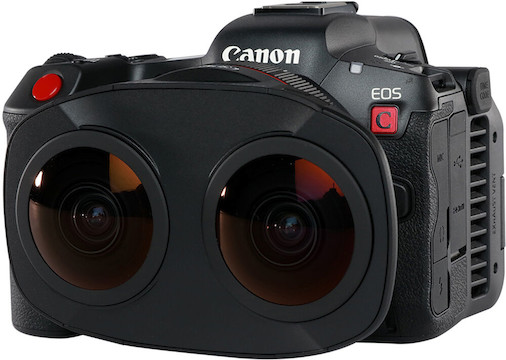
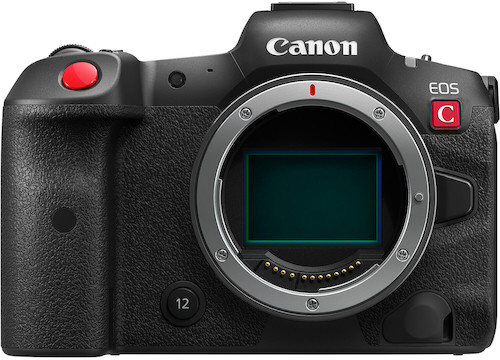
Hybrid Mirrorless/Cinema Camera. The Canon EOS R5 C is ideal for anyone who has professional still-photo and video production needs, such as drone camera ops, multimedia journalists, and wedding videographers. A simple switch on top of the camera body lets you toggle between a full-featured still-camera mode based on the EOS R5 and a full-frame 8K60 cinema-camera mode based on the EOS C70.
Up to 8K60 RAW Video. The 8K CMOS sensor works in tandem with the DIGIC X processor to produce high-quality video at up to 8K60 Cinema RAW Light resolution, a high-efficiency format that lets you internally record to a card without an external recorder. This camera even offers three newly developed Cinema RAW Light modes to best suit your shooting needs—high-quality RAW HQ, standard-quality RAW ST, and light recording RAW LT. You can also record lighter, smaller proxy video files in 8K.
Additional Video Features. The EOS R5 C features the Canon Log 3 gamma, which is easy to use and designed for simple grading, like adjusting tones and tightening dark areas. This camera also supports HDR recording in Hybrid Log Gamma (HLG) and Perceptual Quantization (PQ) format, which give you full, true-to-life color rendition and wide latitude. Shooting in Cinema RAW Light in 8K is ideal for post-production grading and archiving, while MP4 format is optimized for fast online use. You can also internally record to CFexpress cards at 5.9K in Super 35mm mode and at 2.9K in Super 16mm mode. This camera supports RAW output via HDMI and ProRes RAW with compatible recorders, and you can shoot in Apple ProRes RAW at up to 8K30 with the R5 C connected to a supported external recorder. Audio in and out are available through standard 3.5mm jacks for both microphones and headphones.
High-Speed Continuous Stills. The 45MP full-frame CMOS sensor and DIGIC X processor combine to produce high-resolution stills with plenty of speed. You can shoot up to 12 fps with the mechanical shutter and up to 20 fps with the silent electronic shutter, and you get high-speed continuous shooting at all still-image quality settings even when you’re using autofocus with full subject detection and tracking. The native ISO range of 100-51200 can be expanded to 100-102400, making this camera suitable for working in a wide range of lighting conditions.
Dual-Pixel CMOS Autofocus. This camera incorporates a Dual-Pixel CMOS Autofocus system, which uses every pixel on the imaging sensor to detect focus. Its 1,053 manually selectable points cover 100% of the image frame to give you smooth, fast focusing, while its use of deep learning tech gives you improved subject tracking and more precise eye, face, and head detection. Autofocus for video can use roughly 80% of the screen’s vertical and horizontal area when shooting with most Canon RF and EF lenses, and the Touch AF feature lets you simply touch the LCD to select an AF point. You get a broad range of different AF modes for maximum flexibility. When you’re shooting stills, autofocus can operate in lighting down to an EV -6 rating, making the R5C a great choice for night photography.
Body Design. The large OLED live viewfinder has a 5.7m-dot resolution, 0.76x magnification, and 120 fps refresh rate that make it great for easy eye-level composition. The 3.2-inch rear touchscreen LCD monitor allows you to pull focus in video mode and make quick adjustments in the camera’s menu system, while its vari-angle design makes it great for vlogging and other front-facing recording applications, and for shooting at high and low angles. A top status LCD lets you quickly and easily review camera and shooting settings. A tank-like magnesium-alloy build and weather sealing keep out the elements and dust, but that camera body weighs just 1.7 lbs. with the battery and memory cards installed.
Enhanced Image Stabilization. While this camera doesn’t have a built-in image-stabilization system, it has electronic image stabilization that is capable of achieving enhanced vibration correction when you use native RF lenses that have optical image stabilization to shoot XF-AVC or MP4 video. If you’re using image-stabilization equipped EF-mount lenses with an adapter, you’ll get limited stabilization performance when shooting XF-AVC or MP4.
Memory Flexibility. The R5 C records images/video to CFexpress Type B and SD UHS-II memory cards (not included), and has a dedicated slot for each card type. CFexpress cards are great for 8K video and high-speed, high-res burst shooting, while SD cards offer broad compatibility in a familiar format.
Multiple Power Options. The camera is powered by the popular LP-E6NH rechargeable lithium-ion battery, which gives you about 320 shots on a single charge. It’s also compatible with the LP-E6N and LP-E6 batteries. If you’re recording full-frame 8K60, Super 35 5.9K60, and Super 16 2.9K120 with Cinema RAW Light recording, standard LP-E6NH, LP-E6N, or LP-E6 batteries won’t be able to power the electronics in RF lenses or EF lenses attached via an adapter. For full electronic lens functionality in Cinema RAW Light resolutions at any frame rate, you’ll need an additional power source, such as the Anker PowerCore+ 26800 PD Battery w/ 30W Charger. You can use purely mechanical lenses to shoot Cinema RAW Light at any frame rate without issue using a standard LP-E6NH, LP-E6N, or LP-E6 battery.
Built-In Bluetooth and Wi-Fi. Integrated Bluetooth and Wi-Fi let you use Canon’s Camera Connect app to instantly transfer images to your mobile device so that you can easily share them on social media, in email, and to the cloud. You can also use it to shoot remotely.
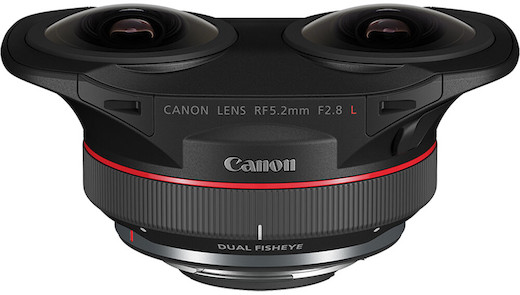
3D 180° VR Capture. The Canon RF 5.2mm f/2.8L Dual Fisheye 3D VR is a manual focus, electronic aperture lens and dual optical systems solution for capturing stereoscopic 3D 180° images to a single sensor. With stereoscopic 3D 180° VR, your audience can see life-like depth and look around the viewing environment. The lens features a beautifully engineered and optimized folded optical design, with separate left and right optical systems.
VR with Ease. Pairing this one lens to an EOS R5 or R5 C provides you with the ability to deliver a single file, unlike traditional VR systems that uses two separate fisheye lenses, recorded to two separate cameras, that write two separate files. This gives you a leg up in post-production by helping tackle common annoyances, such as multi-camera positioning, multi-lens syncing, image stitching, audio syncing, encoding, and more.
Canon’s EOS VR System. Canon’s EOS VR System is comprised of this lens plus an EOS R5 or R5 C with the latest firmware and subscription-based software, either the Canon EOS VR Utility (which requires a paid subscription) or EOS VR plug-in for Adobe Premiere Pro.
Dual-Synchronized Electro-Magnetic Diaphragm. Each of the left and right fisheye lenses have their own optical system, including separate but coordinated aperture mechanisms. Together they seamlessly and simultaneously control the exposure of both lenses, so setting your aperture is the same process as with any other RF lenses.
L-Series Lens Elements. Engineered with 12 elements in 10 groups and highlighted by two ultra-low dispersion glass elements and prisms in both the left and right lenses, this lens delivers impressive color and clarity with minimal chromatic aberration. Featuring dual 5.2mm fisheye lenses positioned with 60mm of spacing between left and right lens centers, this lens provides an interpupillary distance closely resembling human vision.
Large Aperture. Providing a highly adaptable aperture range, the RF 5.2mm f/2.8L Dual Fisheye 3D VR lens allows you to go from a bright f/2.8 aperture in low light shooting, to a deep depth of field of f/16 for more control of your exposure in brighter environments. Additionally, a gelatin filter holder is located at the rear of the lens allowing optional gel filters to be used similarly to previous ultrawide-angle Canon lens offerings.
Compact, Lightweight, and Portable. Thanks to the RF mount and the folded optical design, the size and weight of this lens makes it easy to use in tight spaces and easy to carry in a camera bag. The lens weighs under 1 lb and is just slightly over 2" in depth from the rear mount to the front side of the lens, creating a compact, portable, and lightweight solution.