
Things to Know When Transitioning to Sony Mirrorless Camera Systems
There is no doubt that Sony has made some massive changes over the last few years in the photography industry. What was once a brand that many laughed at, has now become the leading sensor manufacturer and most exciting camera manufacturer in the digital era. So I wanted to take a moment and give you some advice and tips on how to painlessly transition from Canon or Nikon to Sony.
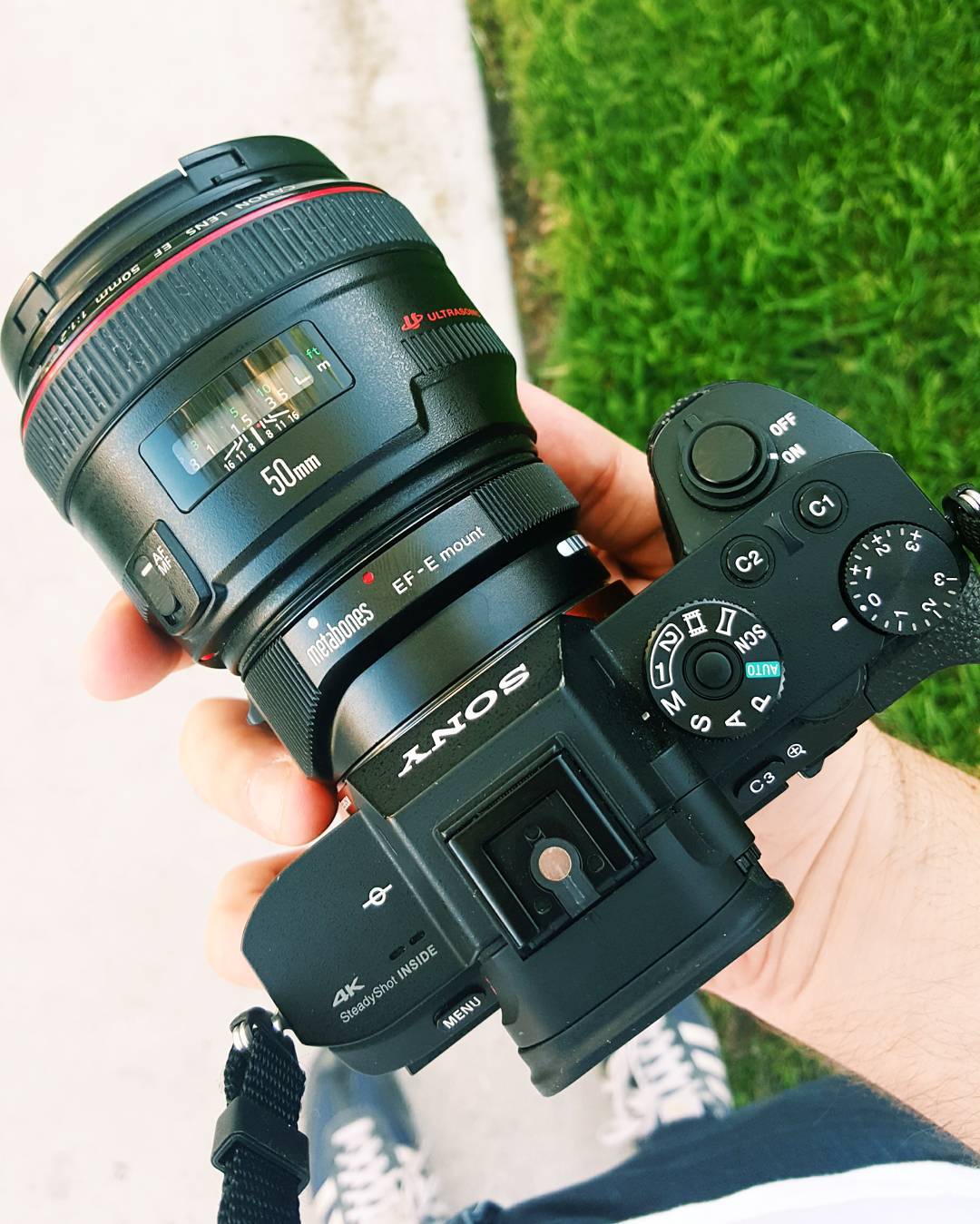
I’ll start by saying that I haven’t made this change personally, but have been considering it for the better part of the year. My research comes from a number of rentals of the Sony a7rII system, and talking endlessly to those who have switched. You’ve certainly seen an article or two denouncing Sony systems, for those accustomed to the DSLR format, but there is a huge number of reasons to make the switch. So here are a few things I’ve learned about the Sony system that will help with your transition.
Growth – At A Massive Rate
Perhaps the biggest challenge of making the switch to something like the Sony a7rII or Sony a6500 is understanding the growth of Sony. They’re pushing out more new lenses, and more new products faster than anyone, which can make the shopping process a bit confusing. This year alone, Sony has released eight new lenses to their E-mount/FE mount platform (and two teleconverters), significantly more than Canon with their EF mount at three this year (two of which were version upgrades to lenses already developed).
But all this still requires patience. Canon has been using the EF mount system since 1987, and Nikon has had their lens mount since the late 50s. So while Sony is making a lot of lenses quickly, they have 30-60 years of catching up to do.
Segmentation in the System
The first thing you’ll notice when diving into the research about mirrorless systems from Sony is that they’re segmented with their lens lineup. A-mount, E-mount, FE-mount, how can you tell which one is best for you? The answer is FE mount. E-mount is the format that Sony has chosen for their crop sensor alpha series (confusing, I know), and the FE mount correlates to the full frame sensor cameras. While you can use the E-mount lenses on the a7 series of cameras, the camera will auto crop the sensor to APS-C format to avoid any vignetting caused by the lens designed for the crop sensor. Both of these lens mounts work on the Sony a7s/a7R lines of cameras, though it’s probably best to stick with FE lenses, where 99% of Sony’s research and development is going.
The second thing you’ll notice is that its hot shoe and many of the design elements are different than what’s on a traditional DSLR or camera. This means you’re not going to necessarily be able to put that old flash trigger on the camera and expect it to fire. But new flash triggers will have their problems as well. This becomes most obviously true with the Profoto TLL triggers, which allow for HSS and TTL on their Profoto B1‘s and Profoto B2 strobes. However, Profoto has announced the TTL-S remote, bringing those functionalities to the Sony platform soon. Additionally, anything using a center pin can be expected to work, so all PocketWizards and other common flash units will still work, at least in manual mode.
Third Party Acknowledgement
Another important thing of noting is that third parties are finally happening, though it’s not as fast as many are hoping. For one, Sigma has finally acknowledged Sony as a contender and has started developing an adapter for their Art series lenses – though still no word on when an E-mount Art series line will be released (note, they do have Art series lenses for Sony A-mount, but nothing for E-mount…yet).
Adapting Isn’t The Best Answer
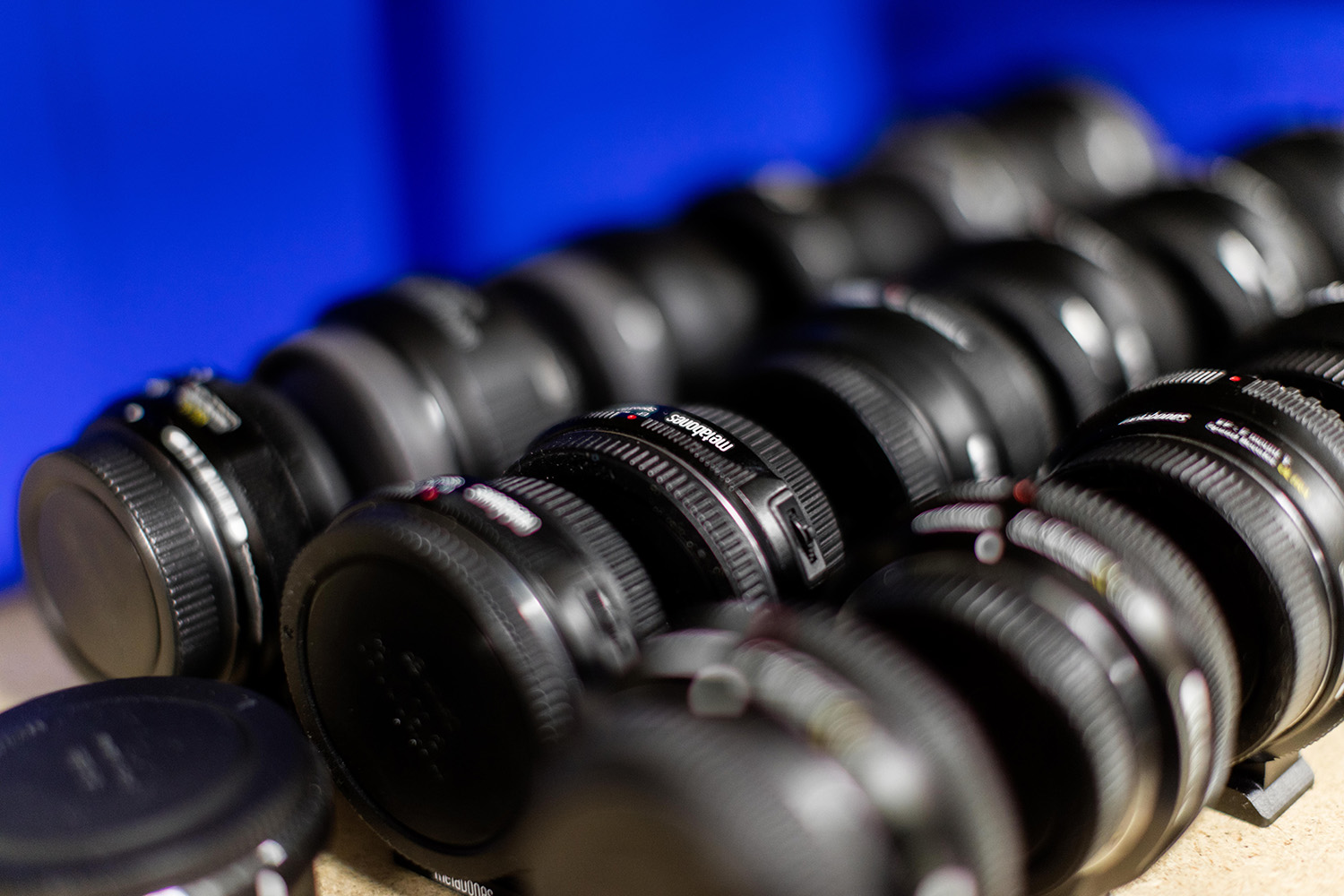
The solution to the limited, but growing, lens lineup is just to use an adapter, but that isn’t exactly the best answer. The Metabones lens adapter systems are great for many, but we’ve personally had problems with them in the past, which is why I do not recommend them for professional use. While the Sigma MC-11 adapter seems to be more reliable through our studies, it is designed to be limited to Sigma lenses exclusively. The reality is that you can delay the transition of switching your glass out for Sony glass, but it’s not advised to prolong it. The world of shooting Sony camera bodies while using Canon glass isn’t exactly ideal.
You’re Not Saving Space
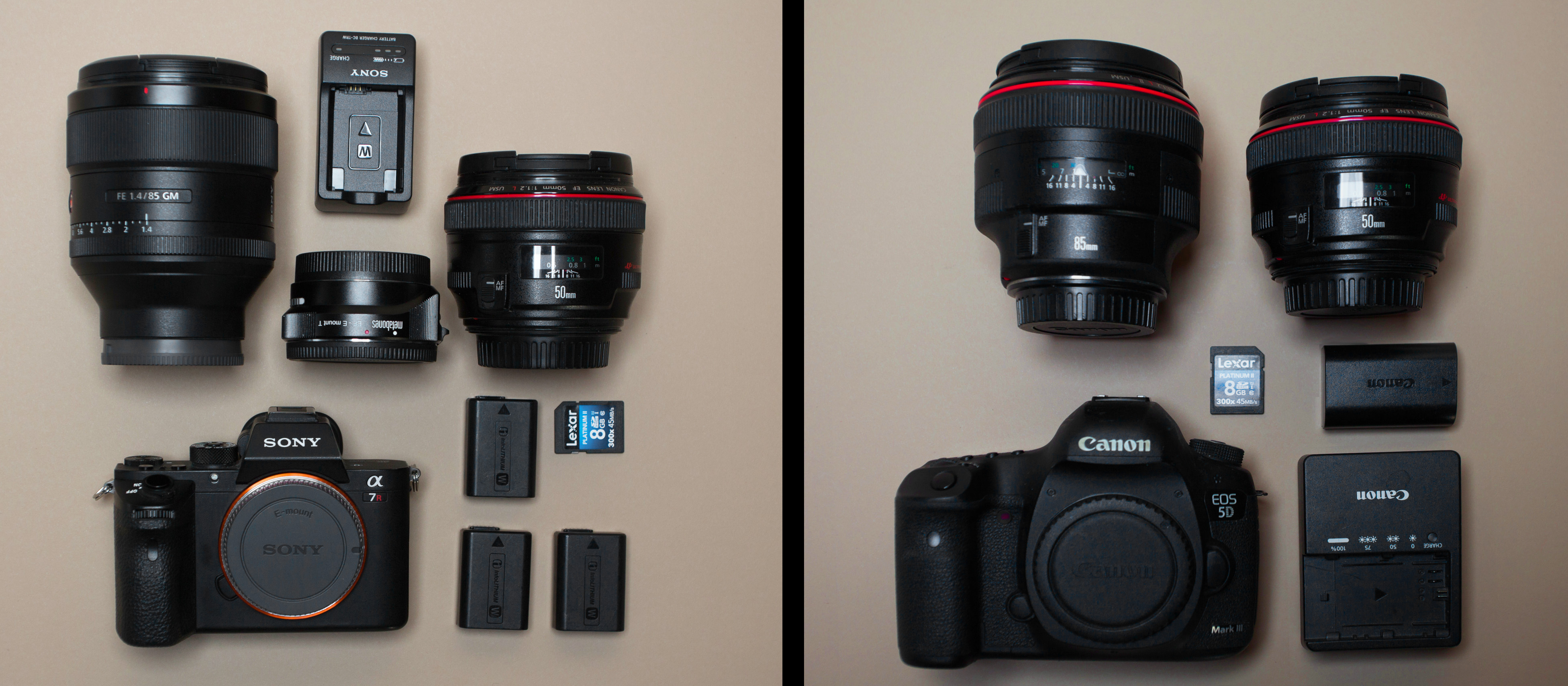
One of the biggest misconceptions with mirrorless systems is that you’re going to save space in your camera bag. If you’re just carrying around a camera with a lens attached, sure…but if you’re like me and usually bring a variety of lenses and tools, you’ll find that the Sony systems don’t save space – as the lenses are often larger, and the battery life is a real issue. If we’re honest, you’ll likely get ~260 shots from a single battery using the Sony A7r II, 3.5 times less than what you can expect with a Canon 5d Mark IV or similar. So with batteries taking up that saved space in your bag, we have to look at the cameras on equal playing fields. Which brings me to my next point –
The Future is Awesome
The number one reason for you to consider switching to Sony is that it’s primarily from the future. The tech within the systems is so incredibly far ahead of Canon and Nikon, giving you more power to do what you love. For one, the digital viewfinder feels cutting edge, giving you exposure and depth of field in (virtually) real time. For those who grew up on DSLRs, and especially those who started on film, this feels like cheating. Quite simply, that battery draining viewfinder will, without question, make photography easier for everyone who uses it. Additionally, something like the Sony a7R II has wifi, 399 focus points, 4K video capabilities, 5-axis internal image stabilization, and a beautifully crafted full frame 42mp sensor. Virtually everything you would need, and didn’t know you wanted is available in a mirrorless system, making your bulk DSLR feel like a relic from another, much older era in comparison.
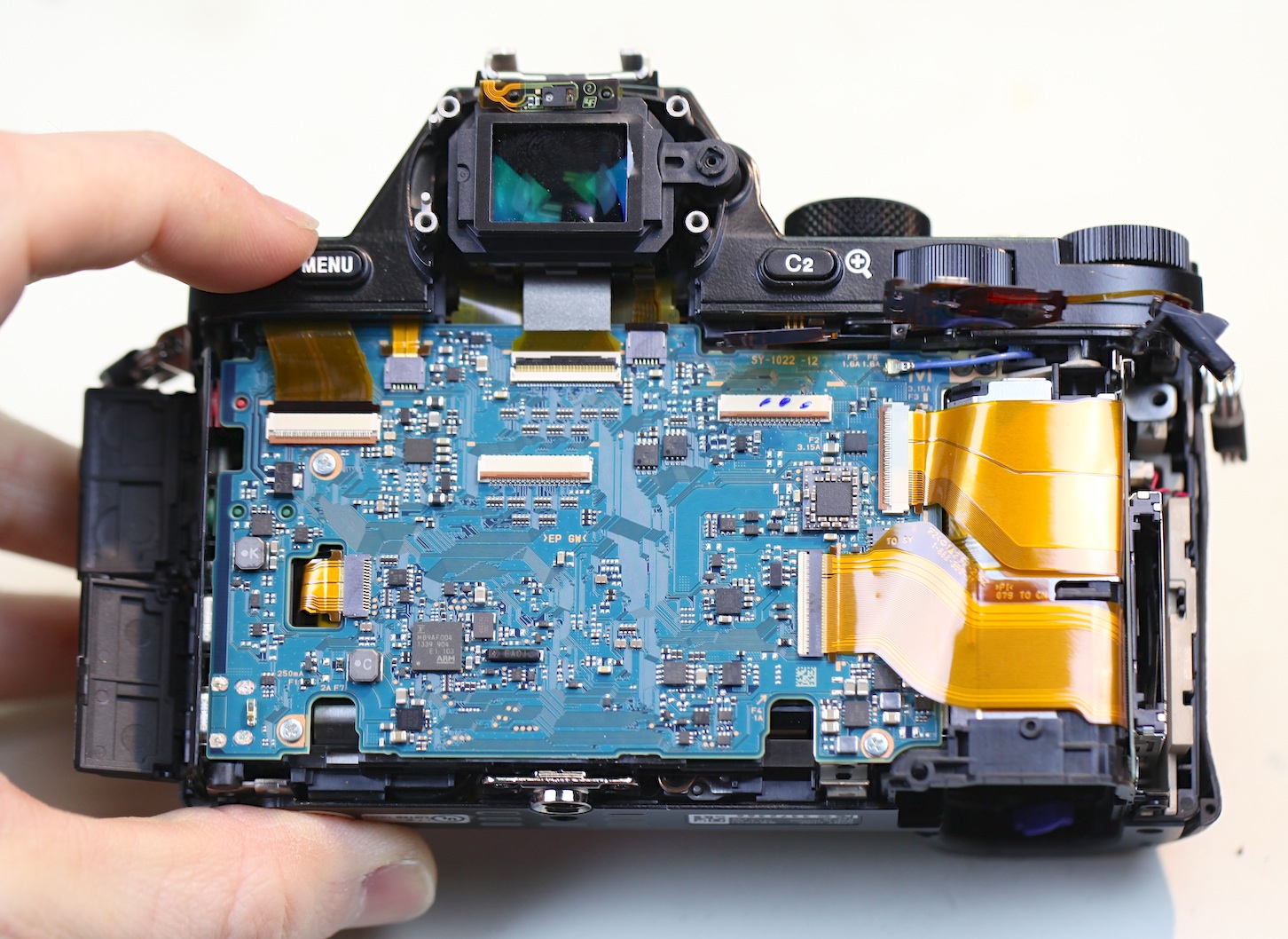
And that is the biggest reason to switch. Over the years, Nikon and Canon have left many frustrated. They haven’t innovated enough, and many feel that the DSLRs released in 2008 can still hold up to today’s DSLR cameras. But our plea’s for wifi, for GPS functionality, and for intelligent autofocus systems has been answered, but as many have found out, they’re being solved by Fuji and Sony systems.
But The Answer Isn’t Always Yes
There is some bad with the good, though, and Sony isn’t all blue skies and rose bushes. The harsh reality that many people have had with the Sony systems comes from their full understanding of the bad. The mirrorless system in the Sony lineup isn’t a DSLR killer, or not yet at least.
For one, the Sony is a bit slower than a DSLR, which could have massive effects on sports photography, or other time sensitive aspects of photography. I’m not talking frames per second, but rather the time the photo takes from pressing the shutter, to the camera responding. The reality is that it’s microseconds in time, but the short delay from the digital viewfinder to your hand, to the shutter activating, can add up – and help you miss the shot. Even still, I often write this off as a learning curve problem, but it’s hard to go back when we have grown so used to real time.
Secondly, I wouldn’t exactly call the Sony a7RII weather sealed, and ready for action. Having said that, I’ve never had, or heard of them failing under extreme conditions – but I believe that’s because people might be sensible enough not to put them through the reigns like you might with a Canon 1DX Mark II or Nikon D5. With it’s smaller form factor and tech design, it’s easy to assume that it’s more likely to break. Canon and Nikon are still on a mechanical platform, where Sony has taken the digital approach, meaning more pieces of hardware can fail.
So is it time to switch? Well, I’m not sure. But with Sony’s recent lens updates and the technology that they already have in place, it goes without saying that there is no better time to switch than right now. The hurdles to the system have all shrunk in size, and being less and less frequent, making the mirrorless systems by both Sony and Fuji completely capable cameras to use for professional work. With Nikon and Canon seemingly ignoring our cries, maybe this is the time to show them that other options are available.
98 Comments
Adam Sanford ·
Sony makes exciting stuff, but consider:
1) Once you slap f/1.4 primes and f/2.8 zooms on it (as all pros are wont to do), your space savings are effectively lost: http://camerasize.com/compact/#624.515,682.286,624.514,682.7,ha,t –> so FF mirrorless is great, but don’t buy it if you want a small rig. Physics is physics, yo.
2) Adapting glass involves headaches, AF limitations, and risks: http://petapixel.com/2016/12/08/psa-fotodioxs-nikon-sony-adapter-kill-camera/ Don’t be afraid of it, but caveat emptor as the doodad sitting between your awesome old lens and your pricey new camera doesn’t have decades of pedigree, trust, and reliability behind it. Native glass for that mount is always the better call, IMHO.
3) Sony is famous for great sensors / tech / features, but they also are famous for fine print and surprises: launching FF rigs with 12 bit RAW, 4k overheating, AF locked after first exposure in highest burst settings, etc. They are absolutely improving on this front, but even the formidable A99 II still has these sort of fine-print surprises. YMMV.
I think Sony and their disruptive innovation is terrific and will change the industry. But there are reasons folks are sticking with CaNikon SLRs: more responsive, better battery life, better AF, more options, more lenses, better service, no adaptor/compatibility nonsense, etc. CaNikon is a far cleaner and straightforward ecosystem to be part of.
Sony continues to close the gap, though. It’s a great time to be a photographer with all this new tech coming out!
DP ·
> launching FF rigs with 12 bit RAW, 4k overheating, AF locked after first exposure in highest burst settings, etc.
some companies launch FF cameras spitting oil over the place and w/o 4K at all .. not to mention shutter shock when using viewfinder… and yet.
Adam Sanford ·
This is not a partisan affair. I’m just trying to highlight that FF mirrorless has limitations, realities, etc. that must be considered before making the conversion plunge.
DP ·
> But there are reasons folks are sticking with CaNikon SLRs
so all those A7* FF shooters there were coming from where ?
Adam Sanford ·
The A7 boom is being spearheaded by enthusiasts, and that makes sense — it’s really hot tech!
But other than the occasional story about a pro converting, it’s not happening in droves. There are too many missing pieces a pro counts on to make the plunge without cutting off one of the legs he’s standing on.
Sony will get there, but they need 5 more years of focused development on lenses, flashes and accessories.
Oleg ·
I think they would better start with building a few servicing facilities and improving customer support… 😉
Ed Bambrick ·
iPhone and iPad users wanting a ‘step up’.
Giulio Dallatorre ·
legacy-lenses lovers, wannabee Leica owners ?
I did actually switched from Minolta and had a good reason… uhm, Minolta “died” and I felt the same way on the A-Mount cameras. When you have to change, change big they say
HF ·
The A99ii is not locking AF in general, only if at f-stops f9 or higher in hybrid mode, using AF points beyond the dedicated PD points. If you use the dedicated points (spread similar to Canikon) this is not the case. In continuous mode you are only getting 12bit, but that is not a big issue in my opinion (sports photographers often shoot jpgs only). Beyond ISO200 you can’t see a difference, as comparisons show as well as measurements of the photon transfer curve by J. Kasson, using the D810.
Adam Sanford ·
You might want to check the a99 II manual again: https://docs.sony.com/release//Manual_4688165121.pdf (page 46): certain families of lenses as quick as f/4 (!) will lock AF on the first exposure!
Again, the A99 II is quick, but 12 fps is a conditional feature — and those two conditions are compressed files and (depending on your lens) potentially locked focus after the first exposure.
It’s still faster than a 5D4 or D810, but I dislike the ‘some conditions apply’ sort of rules.
HF ·
Yes, these are the older Minolta lenses or Tamron lenses, for example. Sony has a list of lenses being fully supported which includes almost all A-mount lenses, in case you use the dedicated AF points. That is similar to what Nikon and Canon do in some modes. Less and less AF points can be utilized when using teleconverters, or AF is frozen after the first shot (1dxii, 16fps). The a99ii looks like a great camera, but I would hesitate to buy one, as I am not sure that Sony will invest a lot in R&D of successors or new lenses. Maybe I am wrong here.
Oleg ·
^ What ahsanford said. +1
Paolo Palmero ·
An A7 with the sony zeiss 35mm f/2.8 is smaller and lighter than a dslr with a comparable lens. An A7 with a 35mm f/1.4 is comparable in size. You get more choice with one body. That’s why I switched.
Giulio Dallatorre ·
You will all be happy to hear that Vöigtander is bringing the Leica-sized glass to Sony. I’m going to love those f/1.2 as big as the average f/1.8 primes.
Adam Sanford ·
Sony makes exciting stuff, but consider:
1) Once you slap f/1.4 primes and f/2.8 zooms on it (as all pros are wont to do), your space savings are effectively lost: http://camerasize.com/compa... --> so FF mirrorless is great, but don't buy it if you want a small rig. Physics is physics, yo.
2) Adapting glass involves headaches, AF limitations, and risks: http://petapixel.com/2016/1... Don't be afraid of it, but caveat emptor as the doodad sitting between your awesome old lens and your pricey new camera doesn't have decades of pedigree, trust, and reliability behind it. Native glass for that mount is always the better call, IMHO.
3) Sony is famous for great sensors / tech / features, but they also are famous for fine print and surprises: launching FF rigs with 12 bit RAW, 4k overheating, AF locked after first exposure in highest burst settings, etc. They are absolutely improving on this front, but even the formidable A99 II still has these sort of fine-print surprises. YMMV.
I think Sony and their disruptive innovation is terrific and will change the industry. But there are reasons folks are sticking with CaNikon SLRs: more responsive, better battery life, better AF, more options, more lenses, better service, no adaptor/compatibility nonsense, etc. CaNikon is a far cleaner and straightforward ecosystem to be part of.
Sony continues to close the gap, though. It's a great time to be a photographer with all this new tech coming out!
# WLM ·
> launching FF rigs with 12 bit RAW, 4k overheating, AF locked after first exposure in highest burst settings, etc.
some companies launch FF cameras spitting oil over the place and w/o 4K at all .. not to mention shutter shock when using viewfinder... and yet.
Adam Sanford ·
This is not a partisan affair. I'm just trying to highlight that FF mirrorless has limitations, realities, etc. that must be considered before making the conversion plunge.
# WLM ·
> But there are reasons folks are sticking with CaNikon SLRs
so all those A7* FF shooters there were coming from where ?
Adam Sanford ·
The A7 boom is being spearheaded by enthusiasts, and that makes sense -- it's really hot tech!
But other than the occasional story about a pro converting, it's not happening in droves. There are too many missing pieces a pro counts on to make the plunge without cutting off one of the legs he's standing on.
Sony will get there, but they need 5 more years of focused development on lenses, flashes and accessories.
Arthur Meursault ·
iPhone and iPad users wanting a 'step up'.
Giulio Dallatorre ·
legacy-lenses lovers, wannabee Leica owners ?
I did actually switched from Minolta and had a good reason... uhm, Minolta "died" and I felt the same way on the A-Mount cameras. When you have to change, change big they say
HF ·
The A99ii is not locking AF in general, only if at f-stops f9 or higher in hybrid mode, using AF points beyond the dedicated PD points. If you use the dedicated points (spread similar to Canikon) this is not the case. In continuous mode you are only getting 12bit, but that is not a big issue in my opinion (sports photographers often shoot jpgs only). Beyond ISO200 you can't see a difference, as comparisons show as well as measurements of the photon transfer curve by J. Kasson, using the D810.
Adam Sanford ·
You might want to check the a99 II manual again: https://docs.sony.com/relea... (page 46): certain families of lenses as quick as f/4 (!) will lock AF on the first exposure!
Again, the A99 II is quick, but 12 fps is a conditional feature -- and those two conditions are compressed files and (depending on your lens) potentially locked focus after the first exposure.
It's still faster than a 5D4 or D810, but I dislike the 'some conditions apply' sort of rules.
Paolo Palmero ·
An A7 with the sony zeiss 35mm f/2.8 is smaller and lighter than a dslr with a comparable lens. An A7 with a 35mm f/1.4 is comparable in size. You get more choice with one body. That's why I switched.
Giulio Dallatorre ·
You will all be happy to hear that Vöigtander is bringing the Leica-sized glass to Sony. I'm going to love those f/1.2 as big as the average f/1.8 primes.
Tim Cooper ·
Regarding the adapter weaknesses, is that something that’s limited to fast work, or that would be an issue with deliberative shooting as well? Specifically if I were looking for a body just to do slow, manual-focus landscape and architecture with Canon’s tilt-shift lenses, would you recommend A7rii over the 5DSr? I’ve found that a difficult choice and so far my approach has been to avoid it and hope something even better comes out.
Eric Brody ·
I’m not sure about the Canon lenses but Nikon Tilt-Shift lenses have an electronic aperture will NOT allow one to close the aperture except on a Nikon body. Be very careful. If the Canon’s are electronic, (and I believe they are) you may not be able to operate the aperture even if you can attach the lens.
p00kienrayray ·
Canon lenses have full electronic capability when mounted onto the Sony A7 series via specific adapter. This includes aperture control.
Eric Brody ·
I certainly hope you’re correct, I’m not a Canon person, and not to be overly contentious, there is a specific difference in the Nikon world, at least, between the G lenses, which have no aperture ring but which operate via a mechanical linkage to a control wheel on the camera, and the E lenses which will operate the aperture ONLY electrically. I’d still be really careful before making a major financial commitment if the use of tilt-shift lenses is critical.
Michael Clark ·
The entire Canon EOS ecosystem is electronic aperture only. There isn’t a single EOS camera since the system was introduced in 1987 that has ever been made with a mechanical aperture control lever. Thus all Canon EF, EF-S, TS-E, and MP-E lenses have electronic apertures. All third party lenses made for Canon EOS cameras have electronic apertures. The adapters made to use EF lenses on mirrorless mounts all have electronic aperture control.
Eric Brody ·
I certainly hope you're correct, I'm not a Canon person, and not to be overly contentious, there is a specific difference in the Nikon world, at least, between the G lenses, which have no aperture ring but which operate via a mechanical linkage to a control wheel on the camera, and the E lenses which will operate the aperture ONLY electrically. I'd still be really careful before making a major financial commitment if the use of tilt-shift lenses is critical.
Michael Clark ·
The entire Canon EOS ecosystem is electronic aperture only. There isn't a single EOS camera since the system was introduced in 1987 that has ever been made with a mechanical aperture control lever. Thus all Canon EF, EF-S, TS-E, and MP-E lenses have electronic apertures. All third party lenses made for Canon EOS cameras have electronic apertures. The adapters made to use EF lenses on mirrorless mounts all have electronic aperture control.
BlueBomberTurbo ·
I shoot mainly adapted lenses (A + EF) for landscape, birding, and event photography. The only real issue I’d say I have is the lack of AF above 3fps, and that only comes into play in birding. For everything else, no problems.
Mike ·
Be aware that due to the larger image circle of tilt-shift lenses reflections inside the adapter become more of an issue. It needs to be lined with felt or some sort of absorbing material. I’ve also read mixed experiences with tilt-shift lenses on a7 bodies regarding image quality / sharpness when tilted. Definitely try before you buy.
Tim Cooper ·
Regarding the adapter weaknesses, is that something that's limited to fast work, or that would be an issue with deliberative shooting as well? Specifically if I were looking for a body just to do slow, manual-focus landscape and architecture with Canon's tilt-shift lenses, would you recommend A7rii over the 5DSr? I've found that a difficult choice and so far my approach has been to avoid it and hope something even better comes out.
Eric Brody ·
I'm not sure about the Canon lenses but Nikon Tilt-Shift lenses have an electronic aperture will NOT allow one to close the aperture except on a Nikon body. Be very careful. If the Canon's are electronic, (and I believe they are) you may not be able to operate the aperture even if you can attach the lens.
BlueBomberTurbo ·
I shoot mainly adapted lenses (A + EF) for landscape, birding, and event photography. The only real issue I'd say I have is the lack of AF above 3fps, and that only comes into play in birding. For everything else, no problems.
Mike ·
Be aware that due to the larger image circle of tilt-shift lenses reflections inside the adapter become more of an issue. It needs to be lined with felt or some sort of absorbing material. I've also read mixed experiences with tilt-shift lenses on a7 bodies regarding image quality / sharpness when tilted. Definitely try before you buy.
EcoR1 ·
Aarggh! There is no such a thing as “FE-mount”. Stop confusing people. There is only E-mount when talking about mirrorless systems.
And no, A7-series does not autocrop any E-mount lenses. Users can choose between autocropping or using the lens witout in-camera-cropping.
Hugo Guzman ·
I was so confused by this haha.Thanks for clarifying!
Ed Bambrick ·
Sony’s NEX7 brought me into photography. The A7 and A7r were frustrating. Shutter shock, 12 bit color and horrible white balance. Being unable to edit some portraits to satisfaction and the wasted time led me to Nikon. 2 years ago I switched to Nikon’s D810 and have only used the Sony to make comparisons with in that first year. Maybe the A7rii works for some but it still selectively offers 14 bit only under certain settings and that may limit a photographer. The flash support and AF are also a problem. I still have the A7r and Zony’s near perfect 55mm lens. But they are joke, results wise to what the D810 and an Otus or Sigma art can deliver. And for an apples to apples, the Otii used on the A7r also don’t cut the grade. Lately I grabbed a throwaway Panasonic 4k camera and it’s whipping the Sony on apples to apples comparisons on video and sound. (and at half the price !) The A7r will more than likely become an IR camera and I don’t see myself ever trusting Sony again after their 12 bit fraud they maintained for years.
Arthur Meursault ·
Sony's NEX7 brought me into photography. The A7 and A7r were frustrating. Shutter shock, 12 bit color and horrible white balance. Being unable to edit some portraits to satisfaction and the wasted time led me to Nikon. 2 years ago I switched to Nikon's D810 and have only used the Sony to make comparisons with in that first year. Maybe the A7rii works for some but it still selectively offers 14 bit only under certain settings and that may limit a photographer. The flash support and AF are also a problem. I still have the A7r and Zony's near perfect 55mm lens. But they are joke, results wise to what the D810 and an Otus or Sigma art can deliver. And for an apples to apples, the Otii used on the A7r also don't cut the grade. Lately I grabbed a throwaway Panasonic 4k camera and it's whipping the Sony on apples to apples comparisons on video and sound. (and at half the price !) The A7r will more than likely become an IR camera and I don't see myself ever trusting Sony again after their 12 bit fraud they maintained for years.
Raoul ·
Hello
One serious drawback of Sony mirrorless is that the sensor is much more prone to collect dust and other pollutions.
That is easy to understand, since the sensor is only 18mm behind the flange (44mm for a Canon DSLR) and is not protected by the shutter when you remove the lens (the shutter remains open until you actually take the shot, while it is closed on a DSLR).
That may sound like a detail, but is a real pain in the use of such a camera, in my opinion.
They could probably program the camera to close the shutter automatically when the lens is removed, but currently they don’t.
Michael Ogle ·
Thank God the Sony doesn’t have a flipping mirror spreading oil all over the sensor, a problem for both Nikon and Canon cameras.
Raoul ·
Hello
One serious drawback of Sony mirrorless is that the sensor is much more prone to collect dust and other pollutions.
That is easy to understand, since the sensor is only 18mm behind the flange (44mm for a Canon DSLR) and is not protected by the shutter when you remove the lens (the shutter remains open until you actually take the shot, while it is closed on a DSLR).
That may sound like a detail, but is a real pain in the use of such a camera, in my opinion.
They could probably program the camera to close the shutter automatically when the lens is removed, but currently they don't.
Michael Ogle ·
Thank God the Sony doesn't have a flipping mirror spreading oil all over the sensor, a problem for both Nikon and Canon cameras.
HF ·
“The tech within the systems is so incredibly far ahead of Canon and Nikon, giving you more power to do what you love.”. Not really. Canon and Nikon have mirrorless, too. Nikon was the first using on sensor PD in the Nikon 1 (unfortunately decided to use a small sensor) with full tracking and very high fps. Canon has dual pixel AF (DPAF). It is as fast as what I get with my A7rii (and can be used with the touch screen). All Canon has to do is use an EVF, like in the M5 to make the transition to mirrorless. Video AF using DPAF is superior in my opinion to what Sony offers. Nikon uses Sony sensors and is/can use the RGB metering sensor for depth information, face detect etc. So this statement is a huge exaggeration in my opinion. Says someone using Sony and Nikon to earn money.
BlueBomberTurbo ·
Only problem is Canon is competing with Sony from 2010, and Nikon has all but left them mirrorless game…
HF ·
Not really, as there is more to a camera than the sensor, esp. since DPAF works great and seems to deliver great 2016-state of the art video (see EOSHD). Aren’t you able to take professional images with Canon cameras? There are still many things where my A7rii is not able to compete with the 5div or 1dxii, for example. The 47% Canon market share tells you, too, that there is still not enough leakage to mirrorless rivals.
Michael Ogle ·
To compete with the big bricks, Sony gives you the 99II. Because Walmart sells Canon to the masses, doesn’t make them the leader except as a lost leader.
HF ·
LOL. Do you think there are more A7x sold than higher end Canons? Market share of alpha mount is below 5%. I am not shooting Canon at all, but there is no denying the fact thet they sell far more cameras not only in the entry level segment.
Adam Sanford ·
Michael, ALL full frame cameras become big bricks when you bolt an f/1.4 prime or f/2.8 zoom to it. Small FF mirrorless is a myth unless you can live with f/2.8 primes and f/4 zooms… which few people can.
Carleton Foxx ·
They’re not bad if you stick to the lightweight plastic-bodied prime lenses… My D810 plus the 50mm 1.4G is pretty svelte.
But you’re right about the 2.8 zooms.
HF ·
"The tech within the systems is so incredibly far ahead of Canon and Nikon, giving you more power to do what you love.". Not really. Canon and Nikon have mirrorless, too. Nikon was the first using on sensor PD in the Nikon 1 (unfortunately decided to use a small sensor) with full tracking and very high fps. Canon has dual pixel AF (DPAF). It is as fast as what I get with my A7rii (and can be used with the touch screen). All Canon has to do is use an EVF, like in the M5 to make the transition to mirrorless. Video AF using DPAF is superior in my opinion to what Sony offers. Nikon uses Sony sensors and is/can use the RGB metering sensor for depth information, face detect etc. So this statement is a huge exaggeration in my opinion. Says someone using Sony and Nikon to earn money.
BlueBomberTurbo ·
Only problem is Canon is competing with Sony from 2010, and Nikon has all but left them mirrorless game...
HF ·
Not really, as there is more to a camera than the sensor, esp. since DPAF works great and seems to deliver great 2016-state of the art video (see EOSHD). Aren't you able to take professional images with Canon cameras? There are still many things where my A7rii is not able to compete with the 5div or 1dxii, for example. The 47% Canon market share tells you, too, that there is still not enough leakage to mirrorless rivals.
Michael Ogle ·
To compete with the big bricks, Sony gives you the 99II. Because Walmart sells Canon to the masses, doesn't make them the leader except as a lost leader.
Adam Sanford ·
Michael, ALL full frame cameras become big bricks when you bolt an f/1.4 prime or f/2.8 zoom to it. Small FF mirrorless is a myth unless you can live with f/2.8 primes and f/4 zooms... which few people can.
Carleton Foxx ·
They're not bad if you stick to the lightweight plastic-bodied prime lenses... My D810 plus the 50mm 1.4G is pretty svelte.
But you're right about the 2.8 zooms.
Frank Kolwicz ·
Roger Clark, clarkvision.com, also reports significant viewfinder lag (the time it takes to refresh the digital image in the viewfinder) in addition to shutter lag, that would be a concern for action photographers. Maybe that’s what Zach was referring to with “I’m not talking frames per second, but rather the time the photo takes from pressing the shutter, to the camera responding.”
BlueBomberTurbo ·
EVF lag only really happens in low light. You can turn off exposure simulation to prevent that most of the time. Never really ran into shutter lag with native lenses. If you stop down some adapted lenses, you might get some waiting for the aperture to close.
Frank Kolwicz ·
Below is the quote from Roger Clark, it has nothing to do with low light, it’s an inherent lag in frame refreshing:
“For example, if the sensor is being read out at 30 frames per second,
that means action is 33 milliseconds ahead of where the live view
image is.”
And that is on top of shutter lag time and your individual response time.
Greg Dunn ·
Yup. This is one of several reasons that “transitioning to Sony mirrorless” is a long long way in my future. EVF lag, autofocus in servo mode, and simple ergonomics don’t meet my needs at all for the work I do. There’s a LOT more to any camera than just the sensor – and not many applications where the Sony sensor has a meaningful edge.
Frank Kolwicz ·
Below is the quote from Roger Clark, it has nothing to do with low light, it's an inherent lag in frame refreshing:
"For example, if the sensor is being read out at 30 frames per second,
that means action is 33 milliseconds ahead of where the live view
image is."
And that is on top of shutter lag time and your individual response time.
Greg Dunn ·
Yup. This is one of several reasons that "transitioning to Sony mirrorless" is a long long way in my future. EVF lag, autofocus in servo mode, and simple ergonomics don't meet my needs at all for the work I do. There's a LOT more to any camera than just the sensor - and not many applications where the Sony sensor has a meaningful edge.
Frank Kolwicz ·
Roger Clark, clarkvision.com, also reports significant viewfinder lag (the time it takes to refresh the digital image in the viewfinder) in addition to shutter lag, that would be a concern for action photographers. Maybe that's what Zach was referring to with "I’m not talking frames per second, but rather the time the photo takes from pressing the shutter, to the camera responding."
Y.A. ·
I have been shooting with an A7II, a Fotodiox EF adapter, and a lot of EF glass (had + sold 50/1.8 STM, 35/2 IS USM, 40 2.8 STM, still have 17-40L, Tamron 2.8 zoom, Tamron 70-300) and some old manual primes. Overall I love it, but it’s definitely not for everybody. My impressions/thoughts over the last couple of months:
– Adapter performance/reliability is fine…. I came into photography with a D40 so I just use center spot. Most of my photography is pretty general- candids, landscapes, events etc. To that end it works fine, even in somewhat low light (ISO12800, ~1/30s, F/2.8). I would not let that worry you, though I WOULD do research- the new Fotodiox Nikon F smart adapter has bricked 2 Youtubers’ cameras.
– AF-C performance is abysmal with adapters, at least on the A7II. If you do any kind of action work, look elsewhere.
– Overall responsiveness is nowhere near as snappy as a DSLR. A DSLR almost feels mechanical by comparison.
– Battery life is indeed abysmal.
– Weight is pretty bad too. With the EF adapter my A7II weighs the same 750g as a D750.
Truthfully, if I could do it all over, I probably would have got a D750. But the A7II works really well, has great image quality and is relatively versatile. I’m looking to get a Techart LM-EA7 to get autofocus on my manual primes…. a Noktor 40 1.4 with autofocus will be a killer street setup. But I am probably going to have to get another body for my dogs as again AF-C has been unusable with every lens I’ve put on it. It’s a pretty contrarian setup that just manages to work well enough and deliver good value (FF IBIS for ~$1300 used!).
Omesh Singh ·
“… weighs the same 750g as a D750” … but has an ergonomically poorer grip.
Adam Sanford ·
Appreciate the thorough reply, I do.
Question: how do you shoot fast glass with only a center point AF? Shooting f/1.4 and then recomposiing to a non-centered subject will be out of focus. So do you switch to MF/peaking in that case or do you just keep your subject in the middle of the frame?
Y.A. ·
Right now my fastest lens is my 2.8 zoom, so this hasn’t been much of an issue. I am planning to get some old F/1.4 manual primes to use with the LM-EA7 next year so I may have to change my strategy then. I do occasionally move my point around though without issue.
Busha Busha ·
I have been shooting with an A7II, a Fotodiox EF adapter, and a lot of EF glass (had + sold 50/1.8 STM, 35/2 IS USM, 40 2.8 STM, still have 17-40L, Tamron 2.8 zoom, Tamron 70-300) and some old manual primes. Overall I love it, but it's definitely not for everybody. My impressions/thoughts over the last couple of months:
- Adapter performance/reliability is fine.... I came into photography with a D40 so I just use center spot. Most of my photography is pretty general- candids, landscapes, events etc. To that end it works fine, even in somewhat low light (ISO12800, ~1/30s, F/2.8). I would not let that worry you, though I WOULD do research- the new Fotodiox Nikon F smart adapter has bricked 2 Youtubers' cameras.
- AF-C performance is abysmal with adapters, at least on the A7II. If you do any kind of action work, look elsewhere.
- Overall responsiveness is nowhere near as snappy as a DSLR. A DSLR almost feels mechanical by comparison.
- Battery life is indeed abysmal.
- Weight is pretty bad too. With the EF adapter my A7II weighs the same 750g as a D750.
Truthfully, if I could do it all over, I probably would have got a D750. But the A7II works really well, has great image quality and is relatively versatile. I'm looking to get a Techart LM-EA7 to get autofocus on my manual primes.... a Noktor 40 1.4 with autofocus will be a killer street setup. But I am probably going to have to get another body for my dogs as again AF-C has been unusable with every lens I've put on it. It's a pretty contrarian setup that just manages to work well enough and deliver good value (FF IBIS for ~$1300 used!).
Omesh Singh ·
"... weighs the same 750g as a D750" ... but has an ergonomically poorer grip.
Adam Sanford ·
Appreciate the thorough reply, I do.
Question: how do you shoot fast glass with only a center point AF? Shooting f/1.4 and then recomposiing to a non-centered subject will be out of focus. So do you switch to MF/peaking in that case or do you just keep your subject in the middle of the frame?
Busha Busha ·
Right now my fastest lens is my 2.8 zoom, so this hasn't been much of an issue. I am planning to get some old F/1.4 manual primes to use with the LM-EA7 next year so I may have to change my strategy then. I do occasionally move my point around though without issue.
Sator Photo ·
There is also a major problem with the concept of “transitioning” implying that using your current Canon (or Nikon) DSLR lenses on a Sony mirrorless body is a good thing to do.
What needs to be considered is this article by Roger Cicala:
https://www.lensrentals.com/blog/2013/09/there-is-no-free-lunch-episode-763-lens-adapters/
It shows that there is significant degradation in DSLR lens performance when using adapters.
The idea of adapters is based on the false assumption that the only difference between a mirrorless and a DSLR lens design is the flange distance. This is total nonsense. Many DSLR designs are modernisations of designs that go back many decades, but optical engineers have to largely start from scratch when designing optics for a mirrorless system. In particular, there is the problem arising from a short flange distance whereby the incident angle of light in the corners becomes unusually steep on a mirrorless mount. Unlike film, modern sensors have a three-dimension structure when seen under a microscope. That means that digital sensors cannot tolerate a steep angle of a light incidence like film can. One way of overcoming this issue is to make the lens more telecentric. This, however, comes at a cost in that it makes the lens a lot larger. That’s why mirrorless lenses are mostly bigger than their DSLR equivalents (the only exception being with wide angle lenses when the omission of a retrofocal element helps make a mirrorless lens smaller). The Leica SL lenses are ENORMOUS. Since increasing maximum aperture makes the corner angle of light incidence steeper, ultra wide aperture lenses especially end up looking elephantine. That’s why FE mount mirrorless lenses are commonly slower than their DSLR equivalents to avoid this size blowout. Mirrorless lenses also have a special rear element to increase the rear exit pupil distance from the sensor.
Merely adding an adapter to correct the flange distance is simply not good enough, and the end result is that DSLR lenses perform suboptimally on a mirrorless mount as Roger has shown. After all, the adapter is incapable of doing anything to alter the lens formula to make it more telecentric. Everyone simply needs to understand that there is more to designing lenses for a mirrorless system than changing the flange distance.
People have also seemingly forgotten that you can adapt Nikkor lenses to a Canon EOS mount, yet nobody does it because it isn’t a fad like it is with mirrorless. Yet it would make more sense to adapt lenses from one DSLR mount to another DSLR mount because there is less optical design mismatch. Everybody now get a Canon so you can adapt Nikon, Leica R, and M42 mount lenses!
Actually….no. Forget this adapter fad. Adapters destroy any remaining questionable pretence to mirrorless cameras being more compact, as they are fiddly and add bulk. If you are going the mirrorless route then you need to do it in one big expensive hit and just buy native lenses rather than being misled by the false economy of “transitioning” into it.
Scintilla ·
> Everybody now get a Canon so you can adapt Nikon, Leica R, and M42 mount lenses!
You say that sarcastically, but the ability to use Contax and other lenses was actually a big part of the reason I ended up buying a Canon 5D a few months ago (my beloved Pentax K-30 unfortunately suffered aperture block failure) and not a Nikon. I say Contax in particular because (1) I already had the Distagon 28/2.8 and Planar 50/1.7, and (2) those plus an eventual Sonnar 85/2.8 would make a fine small-and-light yet optically excellent trio of primes that I’m not sure anyone else is even trying to match these days (well, except Pentax with the wonderful FA Limiteds, but those cost 2-3 times more).
And I actually did end up with the Nikon F-mount version of the Makro-Planar 100/2 plus adapter, because I also discovered that selling lenses is not a particularly pleasant experience, so a lens I can eventually use with only a cheap “dumb” adapter on FF mirrorless years down the line (when I can actually afford it) is worth the hassle of not having auto-aperture.
Mick ·
Actually I find the 70-200 f2,8 with metabones adaptor works better than 70-200 f4 Sony OSS G at the same f stop (say f8) and BTW the Canon lens performs much better than on my previous 5DMk3 since there is no OLPF and more resolution.
However, the comments about all the great new sony tech are nonsense from my perspective. The only way I can get high reliability of auto focus is to turn off every last one of the ‘new features’. Complained to SONY for the first year of warranty = only suggestion was to buy SONY lenses and guess what? no change at all and lesser optical performance for the 24-70; adequate for the 70-200 (but only f4 was available or not an an insulting price).
The zeiss 55mm f1.8 is the best lens on this camera so far followed by 70-200 f2.8 L series.
I have a lot of very nice Zeiss (and Leica) manual prime lenses, but the manual focus assist on Sony does not show clean 1:1 even when zoomed and with focus peaking – it makes it useless for manual focus lenses. And you can’t preview at 4K HDMI when in photo mode – only in video mode. That combined with the fact that the preview sent to EVF or display is compressed (even when shooting only raw) makes it impossible to do full manual/ At least that has been my experience. 95% in focus if ALL features turned off and all manual except for large spot autofocus. If you enable features the %in focus drops to 50-75% – So you better take 3 identical photos of everything and you might get one in focus LOL Even when on tripod with electronic remote shutter actuation!! BTW the sony equivalent to back focus is a PITA since you have to press like 4 buttons every time to make any adjustment to spot focus placement.
Using capture one tether does not help much as the software insists on sending raw off camera – there is no way to send jpg and keep raw on camera memory card – so you have to wait for 5-10 minutes every few shots for it to clear the buffers over USB2!!!!
Burst mode is also useless – after 4 frames the camera goes into busy mode unbuffering images to the card for like 5 minutes (why can’t they write to card without buffer? i/o speed must be too low in their design). So for a real world use – like fashion runway – if you let camera burst you will lose opportunity to photograph the next 3 models! Likewise switching between video and photography.
And the 100Mbps 8bit only video – 8 bit even over HDMI makes the 4K video useless for anything professional. even with Slog2 profile you immediately get banding because 8 bit does not provide enough range.
And while I love the resolution when you get a cleanly focused shot, the lack of professional reliability and burst makes me want to do a youtube sledgehammer ‘tear down’ of the A7Rii
The specs for the new Alpha with same sensor look slightly better on burst, but can anyone even trust Sony marketing specifications? I can’t 🙁
Sator Photo ·
There is also a major problem with the concept of "transitioning" implying that using your current Canon (or Nikon) DSLR lenses on a Sony mirrorless body is a good thing to do.
What needs to be considered is this article by Roger Cicala:
https://www.lensrentals.com...
It shows that there is significant degradation in DSLR lens performance when using adapters.
The idea of adapters is based on the false assumption that the only difference between a mirrorless and a DSLR lens design is the flange distance. This is total nonsense. Many DSLR designs are modernisations of designs that go back many decades, but optical engineers have to largely start from scratch when designing optics for a mirrorless system. In particular, there is the problem arising from a short flange distance whereby the incident angle of light in the corners becomes unusually steep on a mirrorless mount. Unlike film, modern sensors have a three-dimension structure when seen under a microscope. That means that digital sensors cannot tolerate a steep angle of a light incidence like film can. One way of overcoming this issue is to make the lens more telecentric. This, however, comes at a cost in that it makes the lens a lot larger. That's why mirrorless lenses are mostly bigger than their DSLR equivalents (the only exception being with wide angle lenses when the omission of a retrofocal element helps make a mirrorless lens smaller). The Leica SL lenses are ENORMOUS. Since increasing maximum aperture makes the corner angle of light incidence steeper, ultra wide aperture lenses especially end up looking elephantine. That's why FE mount mirrorless lenses are commonly slower than their DSLR equivalents to avoid this size blowout. Mirrorless lenses also have a special rear element to increase the rear exit pupil distance from the sensor.
Merely adding an adapter to correct the flange distance is simply not good enough, and the end result is that DSLR lenses perform suboptimally on a mirrorless mount as Roger has shown. After all, the adapter is incapable of doing anything to alter the lens formula to make it more telecentric. Everyone simply needs to understand that there is more to designing lenses for a mirrorless system than changing the flange distance.
People have also seemingly forgotten that you can adapt Nikkor lenses to a Canon EOS mount, yet nobody does it because it isn't a fad like it is with mirrorless. Yet it would make more sense to adapt lenses from one DSLR mount to another DSLR mount because there is less optical design mismatch. Everybody now get a Canon so you can adapt Nikon, Leica R, and M42 mount lenses!
Actually....no. Forget this adapter fad. Adapters destroy any remaining questionable pretence to mirrorless cameras being more compact, as they are fiddly and add bulk. If you are going the mirrorless route then you need to do it in one big expensive hit and just buy native lenses rather than being misled by the false economy of "transitioning" into it.
Scintilla ·
> Everybody now get a Canon so you can adapt Nikon, Leica R, and M42 mount lenses!
You say that sarcastically, but the ability to use Contax and other lenses was actually a big part of the reason I ended up buying a Canon 5D a few months ago (my beloved Pentax K-30 unfortunately suffered aperture block failure) and not a Nikon. I say Contax in particular because (1) I already had the Distagon 28/2.8 and Planar 50/1.7, and (2) those plus an eventual Sonnar 85/2.8 would make a fine small-and-light yet optically excellent trio of primes that I'm not sure anyone else is even trying to match these days (well, except Pentax with the wonderful FA Limiteds, but those cost 2-3 times more).
And I actually did end up with the Nikon F-mount version of the Makro-Planar 100/2 plus adapter, because I also discovered that selling lenses is not a particularly pleasant experience, so a lens I can eventually use with only a cheap "dumb" adapter on FF mirrorless years down the line (when I can actually afford it) is worth the hassle of not having auto-aperture.
Mick ·
Actually I find the 70-200 f2,8 with metabones adaptor works better than 70-200 f4 Sony OSS G at the same f stop (say f8) and BTW the Canon lens performs much better than on my previous 5DMk3 since there is no OLPF and more resolution.
However, the comments about all the great new sony tech are nonsense from my perspective. The only way I can get high reliability of auto focus is to turn off every last one of the 'new features'. Complained to SONY for the first year of warranty = only suggestion was to buy SONY lenses and guess what? no change at all and lesser optical performance for the 24-70; adequate for the 70-200 (but only f4 was available or not an an insulting price).
The zeiss 55mm f1.8 is the best lens on this camera so far followed by 70-200 f2.8 L series.
I have a lot of very nice Zeiss (and Leica) manual prime lenses, but the manual focus assist on Sony does not show clean 1:1 even when zoomed and with focus peaking - it makes it useless for manual focus lenses. And you can't preview at 4K HDMI when in photo mode - only in video mode. That combined with the fact that the preview sent to EVF or display is compressed (even when shooting only raw) makes it impossible to do full manual/ At least that has been my experience. 95% in focus if ALL features turned off and all manual except for large spot autofocus. If you enable features the %in focus drops to 50-75% - So you better take 3 identical photos of everything and you might get one in focus LOL Even when on tripod with electronic remote shutter actuation!! BTW the sony equivalent to back focus is a PITA since you have to press like 4 buttons every time to make any adjustment to spot focus placement.
Using capture one tether does not help much as the software insists on sending raw off camera - there is no way to send jpg and keep raw on camera memory card - so you have to wait for 5-10 minutes every few shots for it to clear the buffers over USB2!!!!
Burst mode is also useless - after 4 frames the camera goes into busy mode unbuffering images to the card for like 5 minutes (why can't they write to card without buffer? i/o speed must be too low in their design). So for a real world use - like fashion runway - if you let camera burst you will lose opportunity to photograph the next 3 models! Likewise switching between video and photography.
And the 100Mbps 8bit only video - 8 bit even over HDMI makes the 4K video useless for anything professional. even with Slog2 profile you immediately get banding because 8 bit does not provide enough range.
And while I love the resolution when you get a cleanly focused shot, the lack of professional reliability and burst makes me want to do a youtube sledgehammer 'tear down' of the A7Rii
The specs for the new Alpha with same sensor look slightly better on burst, but can anyone even trust Sony marketing specifications? I can't :(
Jose Diaz ·
Even if sony labels their FF lenses as FE, they are still E mount. Just like canon labels ef and ef-s to ff and crop respectively, it’s still the same mount. There’s no such thing as FE mount (yet).
Jose Diaz ·
Even if sony labels their FF lenses as FE, they are still E mount. Just like canon labels ef and ef-s to ff and crop respectively, it's still the same mount. There's no such thing as FE mount (yet).
Gil ·
Another problem with Sony E Camera,is the lack of support in AF-ASSIST in flashes,it is very critical to wedding photographers and party.
User Colin ·
As others note, there’s no such thing as E and FE mounts just as there aren’t two A mounts or different mounts for Nikon DX or FX lenses. If you have bought a crop sensor camera then considering the crop lenses is perfectly sensible option. They are likely to be cheaper, smaller and lighter, and frankly what Sony is doing with its roadmap is irrelevant once you have bought the lens. You could well buy/carry several crop lens for the price/weight of one serious FF lens.
http://briansmith.com/aps-e-mount-lenses-for-sony-mirrorless-cameras/
There are APS-C lenses for Sony E-mount from third party manufacturers Zeiss, Sigma, Tamron and Samyang, along with some more obscure names.
User Colin ·
As others note, there's no such thing as E and FE mounts just as there aren't two A mounts or different mounts for Nikon DX or FX lenses. If you have bought a crop sensor camera then considering the crop lenses is perfectly sensible option. They are likely to be cheaper, smaller and lighter, and frankly what Sony is doing with its roadmap is irrelevant once you have bought the lens. You could well buy/carry several crop lens for the price/weight of one serious FF lens.
http://briansmith.com/aps-e...
There are APS-C lenses for Sony E-mount from third party manufacturers Zeiss, Sigma, Tamron and Samyang, along with some more obscure names.
Oleg ·
That looks like a typical Sony PR article in a reputable blog… 😉
If anyone has a modern FF camera from any brand, there is no point to switch unless the goal is to get some extra pain in the neck.
atlanta_guy_1 ·
Is it possible the Sony excitement will continue until Canon catches up, which may not take long? Selling off Canon gear to transition to Sony is a big step and assumes Sony continues their rise and Canon sits back. I recall Black Magic was supposed to take over the world, but on the lower-end professional, they seem a ghost. (Have URSA problems been resolved?)
denneboom ·
I found a error in the article
“Sigma has finally acknowledged Sony as a contender and has started
developing an adapter for their Art series lenses – though still no word
on when an E-mount Art series line will be released (note, they do have
Art series lenses for Sony A-mount, but nothing for E-mount…yet).”
Sorry, that aint true. Sigma has a native 19mm, 30mm and a 60mm DN ART lens with a E mount.
They are aps-c but its 100% e-mount
denneboom ·
I found a error in the article
"Sigma has finally acknowledged Sony as a contender and has started
developing an adapter for their Art series lenses – though still no word
on when an E-mount Art series line will be released (note, they do have
Art series lenses for Sony A-mount, but nothing for E-mount…yet)."
Sorry, that aint true. Sigma has a native 19mm, 30mm and a 60mm DN ART lens with a E mount.
They are aps-c but its 100% e-mount
Michael Stone ·
I love the IBIS and no need to do microfocus adjustment and silent shutter option. But at the end of the day the speed issue that Zach mentions is huge. I miss more shots with the Sony. And it only has one card which limits it – to me – for only occasional use professionally. But I am watching the technology like a hawk.
michaelstone1972 ·
I love the IBIS and no need to do microfocus adjustment and silent shutter option. But at the end of the day the speed issue that Zach mentions is huge. I miss more shots with the Sony. And it only has one card which limits it - to me - for only occasional use professionally. But I am watching the technology like a hawk.
Bowserb ·
Hey guys, here’s another opinion…just what you wanted. I don’t know others’ reasons for switching or not. I do know this, however. If I had no camera, I would not buy into the Canon or Nikon DSLR systems. Dinosaurs, and I been saying it for fifteen years. My wife and I both enjoy photography. Because of the thousands of dollars we have tied up (tied up, not “invested”) in Canon bodies, lenses, and flashes we’re kindof trapped, and that’s what I believe Canon counts on. Nikon too. I know two people who have made the jump from Canon to Sony, and one from Nikon. They all seem happy with their decisions.
Well, I’m seriously considering the A6500 and an imperfect Metabones adapter to start, after which I’ll begin phasing out EFS lenses. My wife is determined to stick with the Canon full frame, especially since they have the most pixels with the 5DSR, but that could change too in time. The thing that did it for me is the Canon M5, supposedly Canon’s first serious mirrorless. No 4k video. No IBIS. Autofocus that buyers can’t figure out why the press liked it so much, when it works so poorly for them. I pre ordered an M5 but cancelled two weeks before it began shipping.
The A6500, with the cost of a Metabones adapter taken into account, will cost me $1,800, compared to the Canon M5 with the Canon EF/EFS adapter at $1,180. Half again the cost of the Canon to get the Sony, which may or may not work properly with all of our EF and EFS lenses. Worth it? Canon counts on our saying no. The answer may be to wait for the NEXT generation from Sony, which should be mirrorless with an electronic, instead of mechanical, shutter. That might also give Canon a chance to wake up. I don’t know if I can wait. Once you get the “new camera” bug, you know. The M5 is just not new enough, or good enough, so Sony may get another convert in the first quarter of 2017. Maybe I should start with an A6500 and Metabones rental for evaluation. Hmmm.
Maurice ·
I use the A7RII and the MC11 with my Canon 24-70II f2.8 and 70-200 II f2.8 since I got the MC11 in May. I have never had a problem using them. Interestingly, the camera detects both as Sony A-mount lenses when you go into the EXIF data.
David Beecroft ·
I have been an avid Canon shooter for many years. Presently I have 2 6d’s and some L glass as sell as some Sigma Art. The set up is not optimal for fast action but iq and low light, high iso picture quality is really quite sell-able. I bought the a6500 a few days ago along with the newest Metabones speed booster. After updating the firmware in the Metabones it works surprisingly well with my existing ef lenses, with a few exceptions, one being continuous AF. I have seen amazing feats of focus with the sony and it better than the Canon but I then discovered that the Canon, right out of the box wasn’t all that good at following a subject walking towards the camera, (something I do with actors who want natural street shots), but with a little tweaking of a few of the Fn ii settings, works quite well.
I bought the Sony because I needed a camera that could shoot without making a sound, as I am called upon to make photos of theater, dance and music (live and in recording studios) performances where shutter noise often isn’t tolerated. The Sony does this and with the added feature (speedbooster) of a gain of one stop of light due to the 0.71 crop makes my already fast 2.8 and 1.4 glass even faster. A bonus in the low light situations I often find myself in. With a heavy Sigma Art lens the Sony feels like an unforgiving brick whereas with the same lens the Canon sits more comfortably in my hands. I will be buying a zoom so that I may use all of the features available to the Sony, probably an APS-C F4 18-105 for general purpose photography and video. The Sony is different but really not bad. I wonder if I will ever “transition” fully as I like the feel of Canon and the naturalness of looking through a viewfinder that doesn’t present an interpretation of the scene and subject for me to see. I also see that things in photography are changing rapidly. It’s better to keep an open mind with first hand experience than to become the “grumpy old photographer”
Who says one has to give up the tried and true to embrace the new? I want it all!
David Beecroft ·
I have been an avid Canon shooter for many years. Presently I have 2 6d's and some L glass as sell as some Sigma Art. The set up is not optimal for fast action but iq and low light, high iso picture quality is really quite sell-able. I bought the a6500 a few days ago along with the newest Metabones speed booster. After updating the firmware in the Metabones it works surprisingly well with my existing ef lenses, with a few exceptions, one being continuous AF. I have seen amazing feats of focus with the sony and it better than the Canon but I then discovered that the Canon, right out of the box wasn't all that good at following a subject walking towards the camera, (something I do with actors who want natural street shots), but with a little tweaking of a few of the Fn ii settings, works quite well.
I bought the Sony because I needed a camera that could shoot without making a sound, as I am called upon to make photos of theater, dance and music (live and in recording studios) performances where shutter noise often isn't tolerated. The Sony does this and with the added feature (speedbooster) of a gain of one stop of light due to the 0.71 crop makes my already fast 2.8 and 1.4 glass even faster. A bonus in the low light situations I often find myself in. With a heavy Sigma Art lens the Sony feels like an unforgiving brick whereas with the same lens the Canon sits more comfortably in my hands. I will be buying a zoom so that I may use all of the features available to the Sony, probably an APS-C F4 18-105 for general purpose photography and video. The Sony is different but really not bad. I wonder if I will ever "transition" fully as I like the feel of Canon and the naturalness of looking through a viewfinder that doesn't present an interpretation of the scene and subject for me to see. I also see that things in photography are changing rapidly. It's better to keep an open mind with first hand experience than to become the "grumpy old photographer"
Who says one has to give up the tried and true to embrace the new? I want it all!
disqus_Wz58Qq14ii ·
What are your thoughts on the A7R3?
Rebecca Cooper ·
My husband is looking into the sony system and found a kit on Amazon. Do you think this is a good deal?
https://amzn.to/2NjpxVq
Rebecca Cooper ·
My husband is looking into the sony system and found a kit on Amazon. Do you think this is a good deal?
https://amzn.to/2NjpxVq