
Just the MTF Charts: 70-200mm f2.8 Zoom Lenses
Well, I’ve avoided putting up the zoom lenses as long as I could, but here we are. I’m going to do things a little differently; rather than listing by brand I’m going to try listing by range and type. I’m suspicious of it because it’s going to bring out the Brand Zealots who for some reason find self-worth in owning this brand or that. But it makes sense for a couple of reason. First, zooms require three MTF charts each, and second, some brands have a zillion zooms and some two or three.
Please, let’s try to keep things logical in the comments. If you are triumphant that Brand X lens is better than Brand Y, well, honestly that says a lot more about you than it does about Brands X and Y. And what it says about you makes me sad. You don’t want to make me sad, do you?
Finally, let me put some facts out to start with because some of you may not be familiar with them.
First, most (but not all) of you are aware that zooms are not primes. Every zoom ever made is better at specific focal lengths than at others. I know many of you don’t want it to be so, because you want to know this zoom scores 72.1 and this other one is a 68.4. But MTFs are useful for grown-up photographers who consider their lens a tool. These photographers want to know where their tool works best and worst so they may use its strengths and avoid its weaknesses. You will sometimes find that brand X’s zoom is better at one end, and brand Y’s zoom better at the other. So it goes.
Second, while I’m not going to put out variance graphs (yet), remember that all zooms vary more than primes. All. Every one ever. There are no exceptions. So the average zoom MTF is a broad brush; you can get tendencies from this but not ‘this is how your copy will look pixel peeping information.’ The average data may show that the Wunderbar 70-200mm is sharper at 70mm than at 200mm. Something like 15% to 30% of copies, though, might be sharper at 200mm so if yours is sharper at 200mm, well good for you. Similarly, the Wunderbar may be sharper than the Ultraboy 70-200mm on average. But if you compare one copy of each, 20% to 30% of the Ultraboys could be sharper than the Wunderbar.
That’s how averages and statistics work. So remember when you look at these, we’re showing you trends with a lot of variation. Depending on how you calculate it, between twice to four times the variation that primes have. So please don’t find a small difference and think ‘so this lens is much better’. The reality for that is something like ’57 out of 100 lenses are better’.
For these reasons, on the zoom lenses, I will make some broad comments about things I consider strong tendencies for a given lens that you’ll probably notice. Those are just my opinions, and everybody’s got one, but concerning MTF, mine is the correct one. Notice I don’t give opinions about focusing, or bokeh, or flare, etc. because my opinion isn’t worth doodly on that.
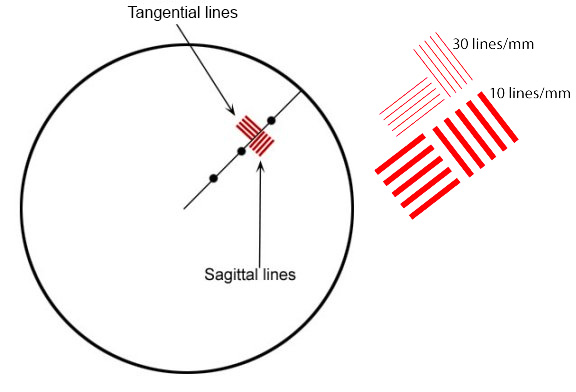
A Quick How to on Reading MTF ChartsIf you’re new here, you’ll see we have a scientific methodology to our approach, and use MTF charts to measure lens resolution and sharpness. All of our MTF charts test ten of the same lenses, and then we average out the results. MTF (or (or Modulation Transfer Function) Charts measure the optical potential of a lens by plotting the contrast and resolution of the lens from the center to the outer corners of the frame. An MTF chart has two axis, the y-axis (vertical) and the x-axis (horizontal). The y-axis (vertical) measures how accurately the lens reproduces the object (sharpness), where 1.0 would be the theoretical “perfect lens.” The x-axis (horizontal) measures the distance from the center of a lens to the edges (measured in millimeters where 0mm represents the center, and 20mm represents the corner point). Generally, a lens has the greatest theoretical sharpness in the center, with the sharpness being reduced in the corners. Tangential & Sagittal LinesThe graph then plots two sets of five different ranges. These sets are broken down into Tangential lines (solid lines on our graphs) and Sagittal (dotted lines on our graphs). Sagittal lines are a pattern where the lines are oriented parallel to a line through the center of the image. Tangential (or Meridonial) lines are tested where the lines are aligned perpendicular to a line through the center of the image.
From there, the Sagittal and Tangential tests are done in 5 sets, started at 10 lines per millimeter (lp/mm), all the way up to 50 lines per millimeter (lp/mm). To put this in layman’s terms, the higher lp/mm measure how well the lens resolves fine detail. So, higher MTF is better than lower, and less separation of the sagittal and tangential lines are better than a lot of separation. Please keep in mind this is a simple introduction to MTF charts, for a more scientific explanation, feel free to read this article. |
Canon 70-200mm f/2.8
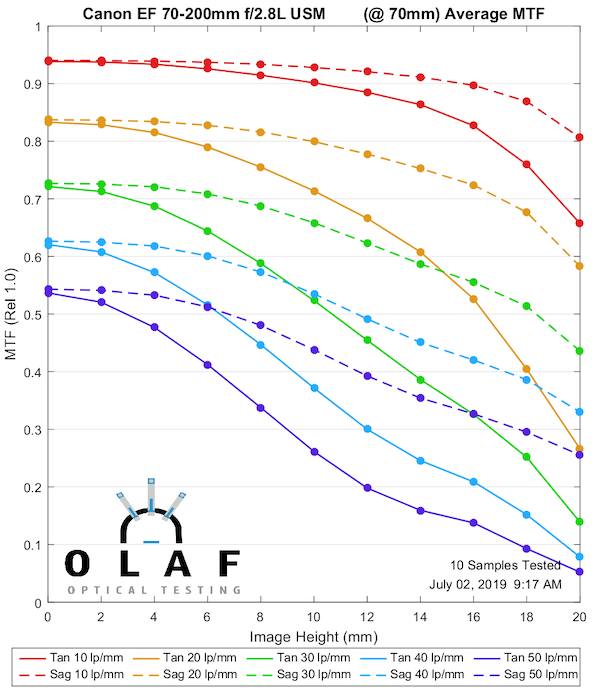
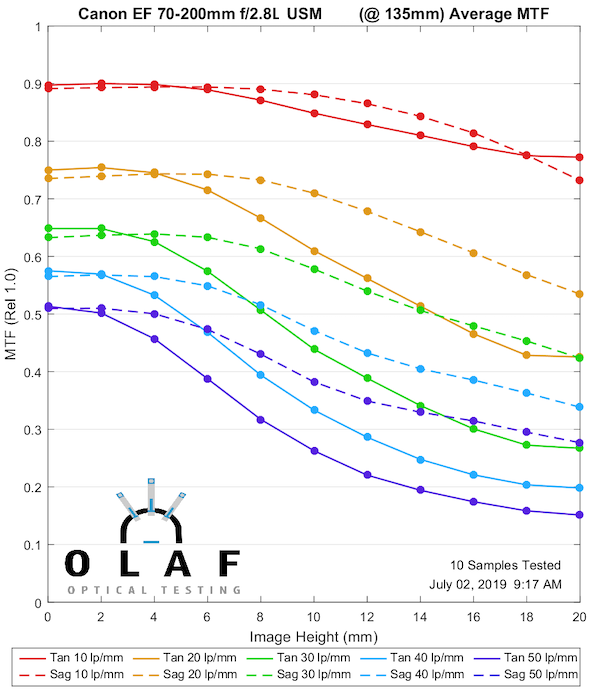
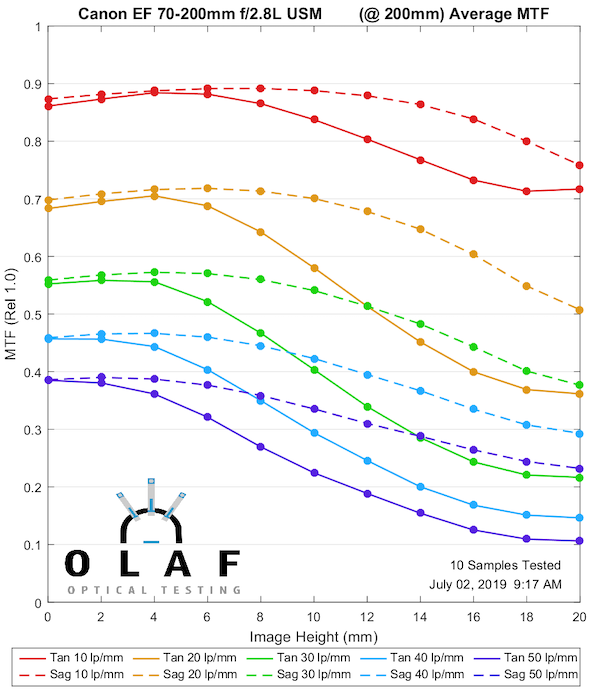
We’ll start with by far the oldest design of currently produced zooms in this range. It’s a classic lens, considered good by all who have used it, but a decade or more away from being ‘best in class’. We expect the newer designs should be better, although that’s not always the case.
It also kind of sets the trends for all 70-200mm f/2.8 zooms (with a few exceptions): it’s sharper at 70mm than 200mm, gives a very good image in the center 1/2 of the field, but not so great an image in the corners. This isn’t a big deal for most photographers. Since these lenses are so commonly used for sports or portraits; the edges of the image are often not critical (and in fact, the photographer often loves that they are blurry).
At 70mm
At 135mm
At 200mm
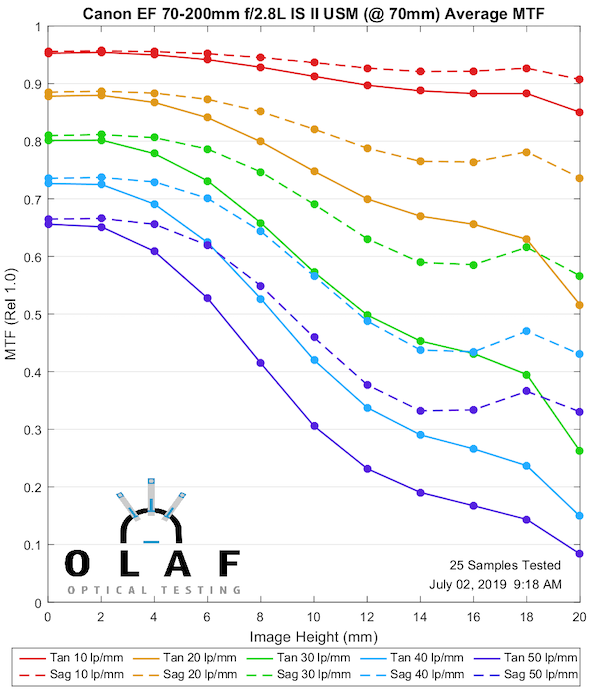
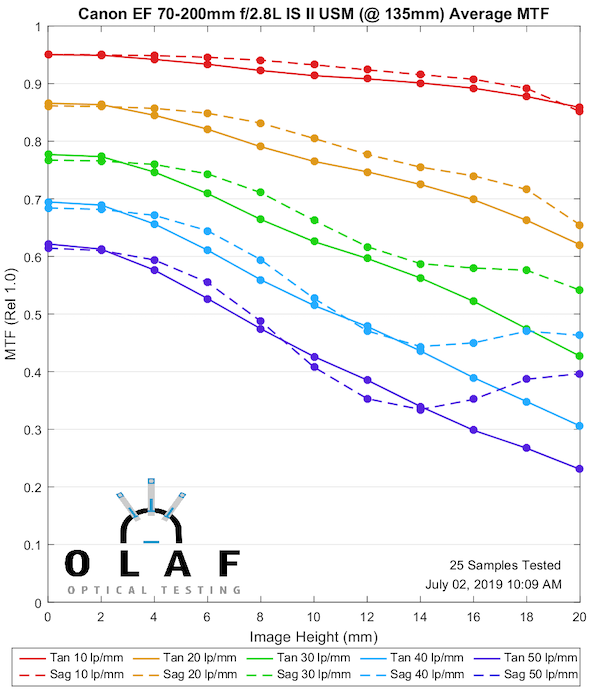
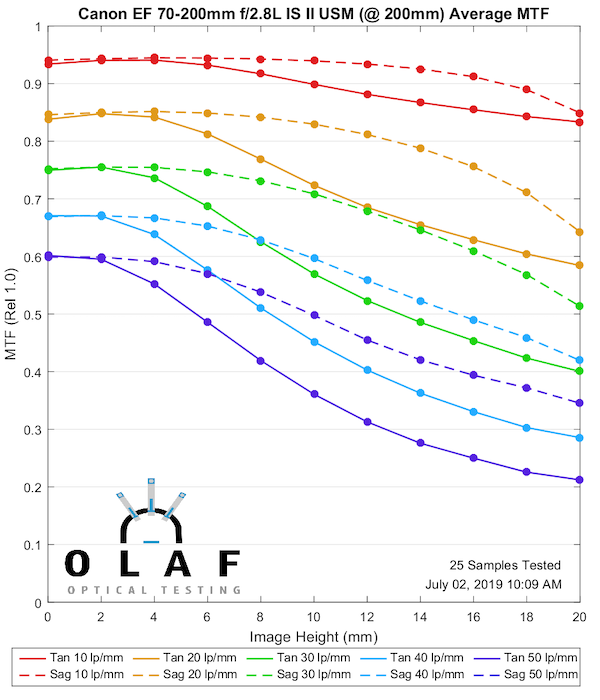
Canon 70-200mm f2.8 IS II (and III, they’re the same optically)
The IS II version is much better than the NON-IS both in the center and off-axis. It’s still relatively weaker at 200mm, but not as much of a drop-off as the NON-IS. Notice also there is less sagittal-tangential separation now; this indicates improvements of lateral color and/or astigmatism.
One thing to remember, the original version above still makes nice pictures. If you compare them side by side, you’ll notice the difference (better fine detail resolution and off-axis softness isn’t as dramatic), but you would never say the original version’s images suck. I started with these two because a lot of people are familiar with both, and it gives you some perspective to compare the MTF charts with your real-life experience.
At 70mm
At 135mm
At 200mm
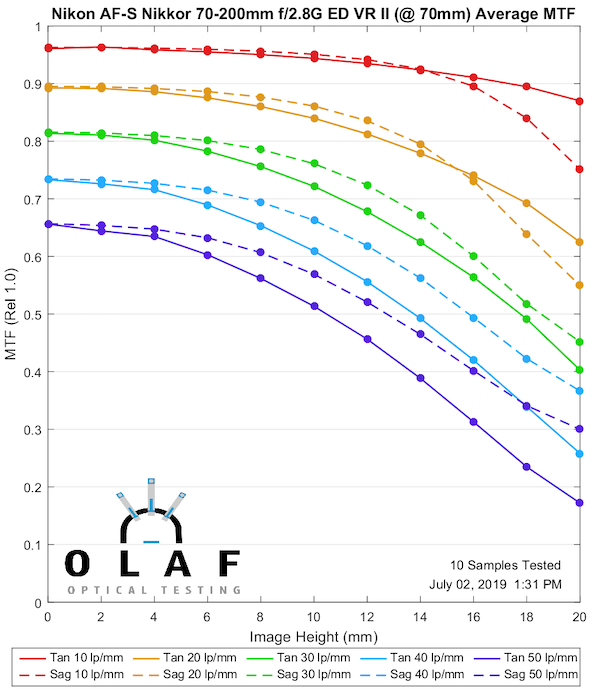
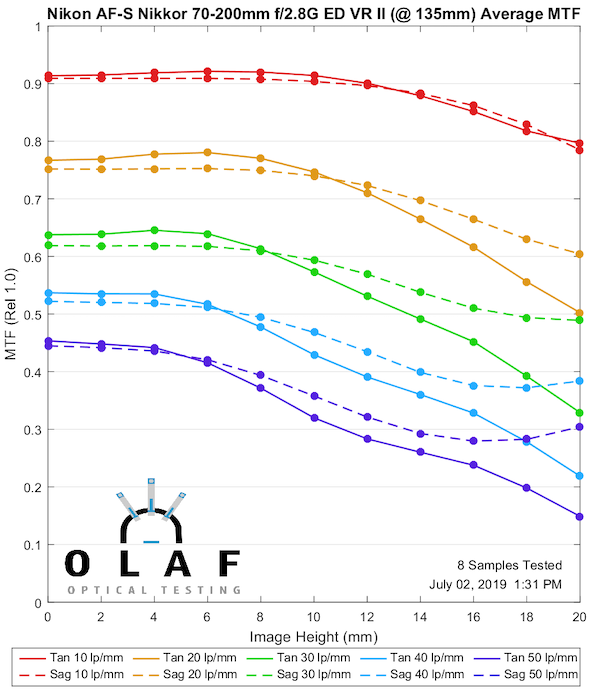
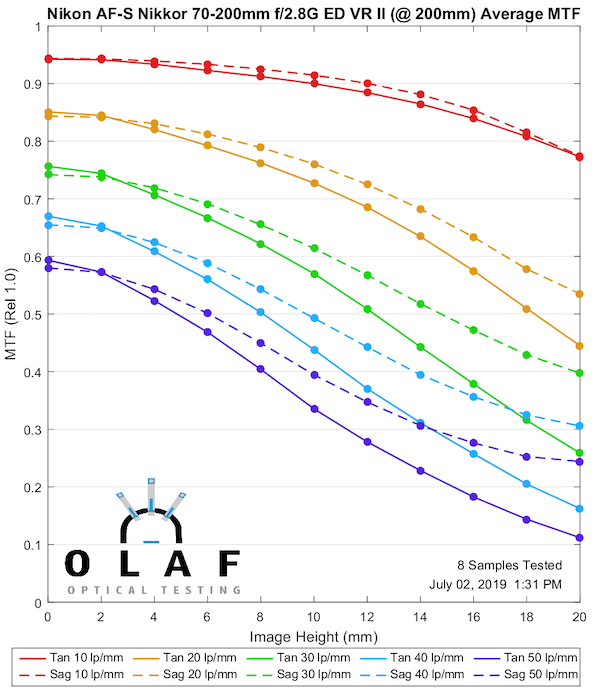
Nikon 70-200mm f/2.8 VR II
The Nikon VR II is a bit different than most 70-200 zooms; the weakest area (in most copies) is in the middle of the zoom range, but the performance at 200mm is pretty strong.
At 70mm
At 135mm
At 200mm
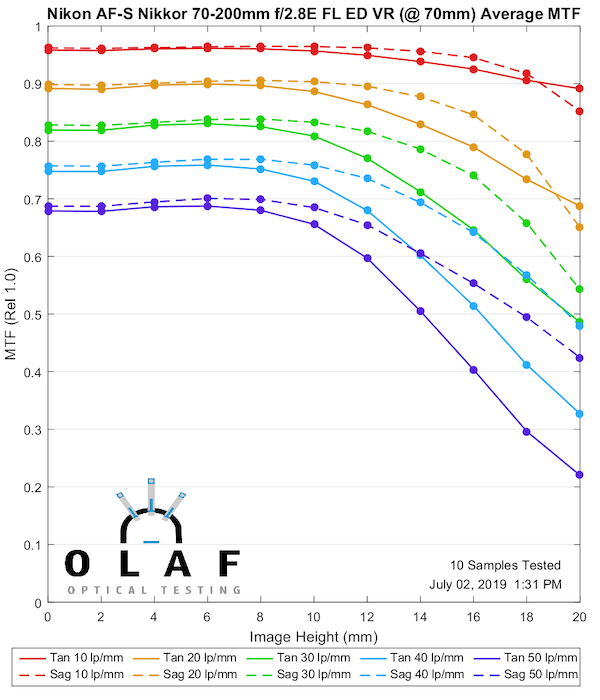
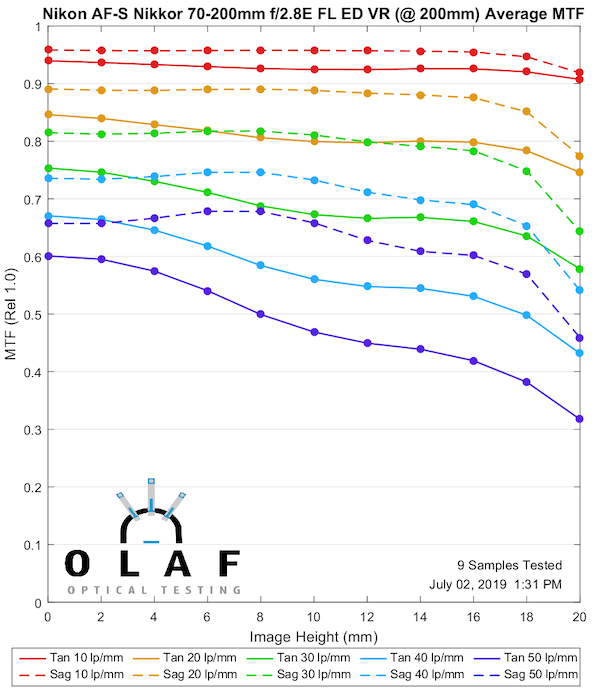
Nikon 70-200mm f/2.8E FL ED VR
I like to make fun of lenses with half-a-dozen initials in their name, but this Nikon set the standard for all 70-200mm lenses when it was released a few years ago, and is still the best of all of them. So no funs will be made.
At 70mm
At 135mm

At 200mm
Sony FE 70-200mm f/2.8 GM OSS
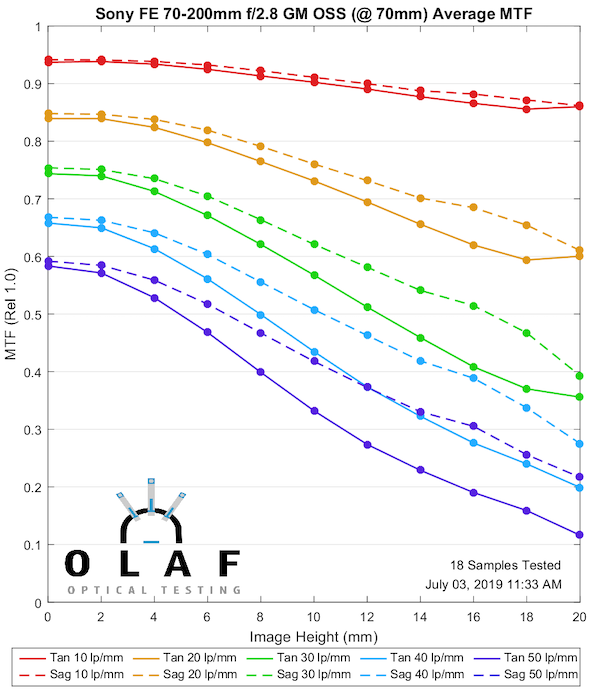
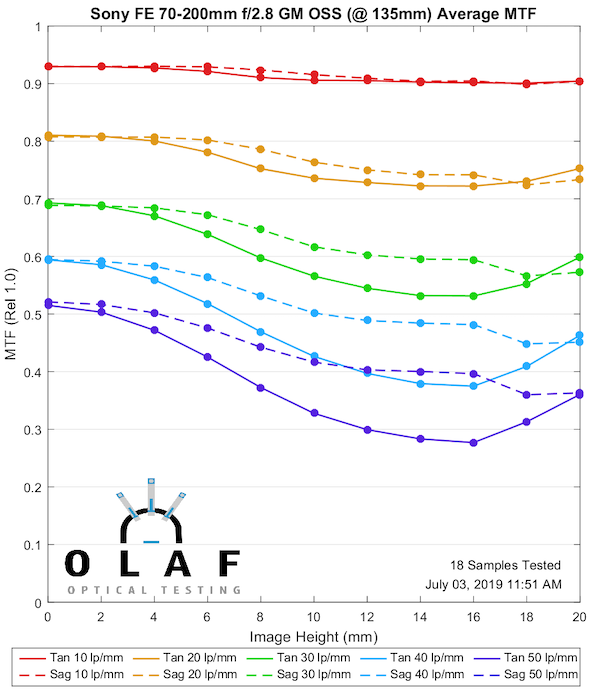
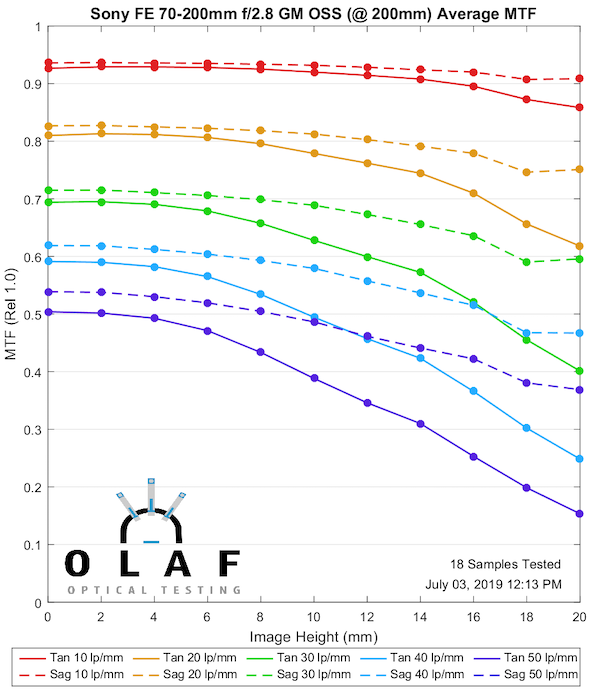
Welcome to the MTF of the most tested lens in our history. Why did we test so many copies? Because Sony fanboys (and employees) were absolutely, positively, certain this lens was the best 70-200mm EVER. It’s not. It’s a decent lens with a LOT of sample variation. A good copy of it is as good as a Canon 70-200mm f/2.8 IS II, which is an excellent lens. A lot of copies aren’t that good, though. Because I see so many stupid things posted about how this lens has been ‘fixed’ and new copies are better, here are a batch of recently tested ones. They are no different than all the other batches we’ve tested.
Full disclosure: I work with Sony. I like Sony. But I despise this lens in case you can’t tell; if you gave me one, I’d sell it the next day. I try to be impartial, but with this lens, I’m not, and I know it. The optical bench, however, is unbiased.
At 70mm
At 135mm
At 200mm
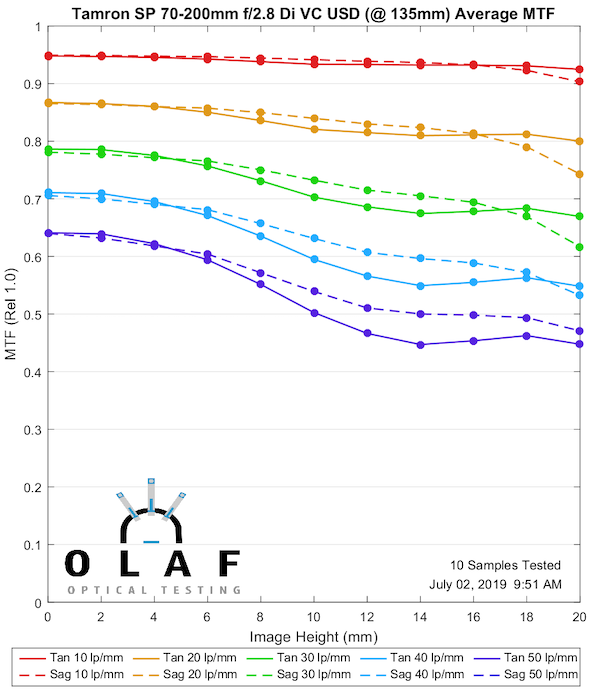
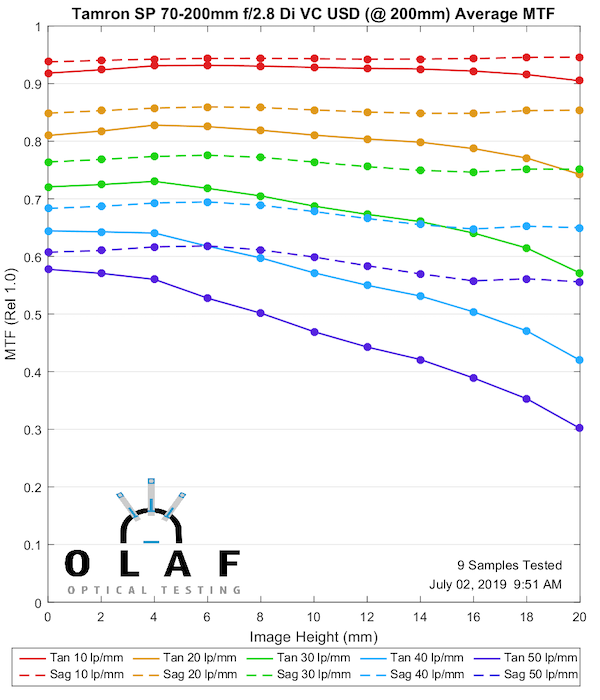
Tamron SP 70-200mm f/2.8 Di VC USD
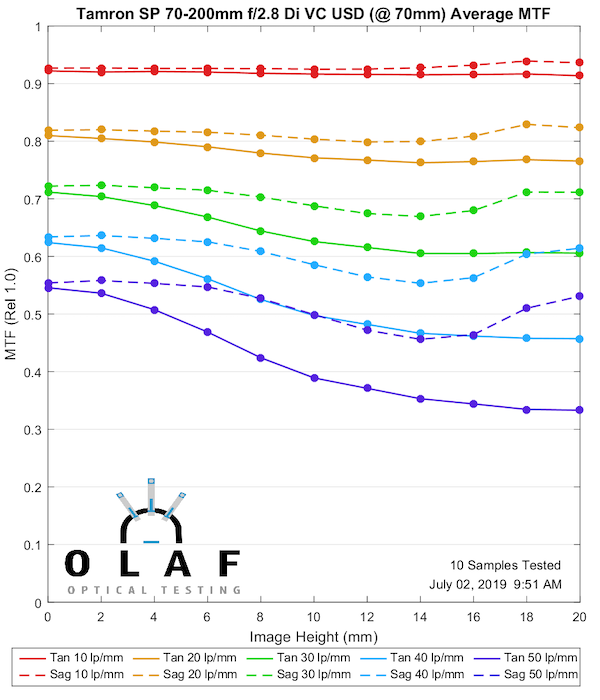
Another lens with too damn many initials in its name; and this time it’s not good enough to avoid me mocking it. So I mock you, Divcusd. But while it isn’t too spectacular to mock, optically it’s quite good, very similar to the Canon 70-200mm f/2.8 IS II overall, but with a bit more emphasis on the edges staying strong at the wider end.
At 70mm
At 135mm
At 200mm
Sigma 70-200mm f/2.8 Sport
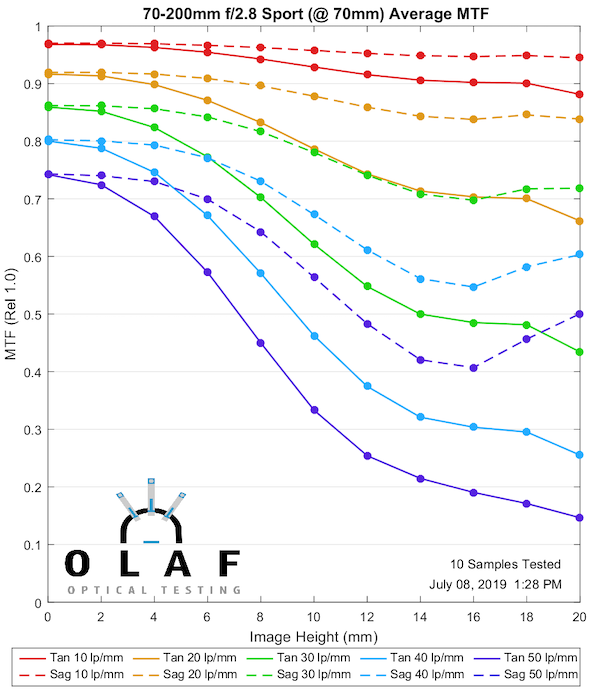
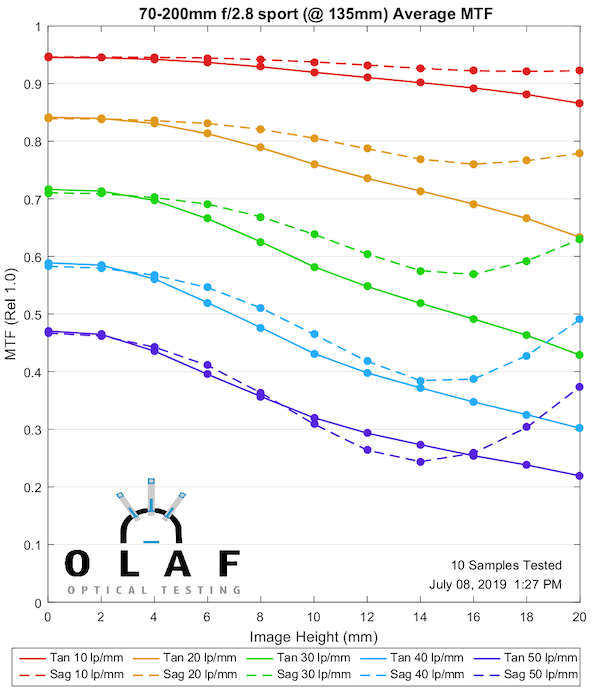
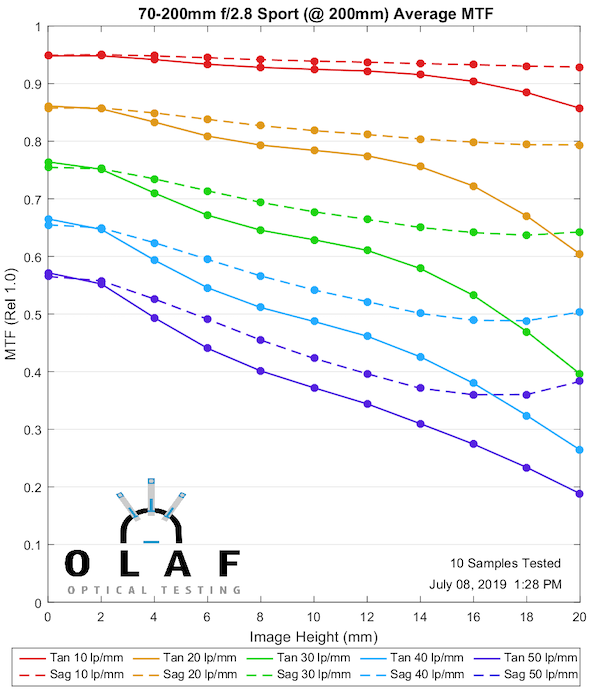
The Sigma has a pattern much like the Nikon VR II; it’s the sharpest of any of these in the center (but not the edges) at 70mm, gets a bit mediocre in the middle of the zoom range, and sharpens up at 200mm.
I’m going to use it as an example of why many people will rave about a 70-200mm lens that I’m critical about. Notice even at 135mm, the lens weakest point, it’s still excellent in the red and orange (lower frequency) curves. It will show reasonably large objects as very sharp and contrasty. It’s only in the higher frequencies (fine detail) that it’s not as good. Fine detail is often not as important as good contrast when using a 70-200mm lens.
At 70mm
At 135mm
At 200mm
Just for Fun
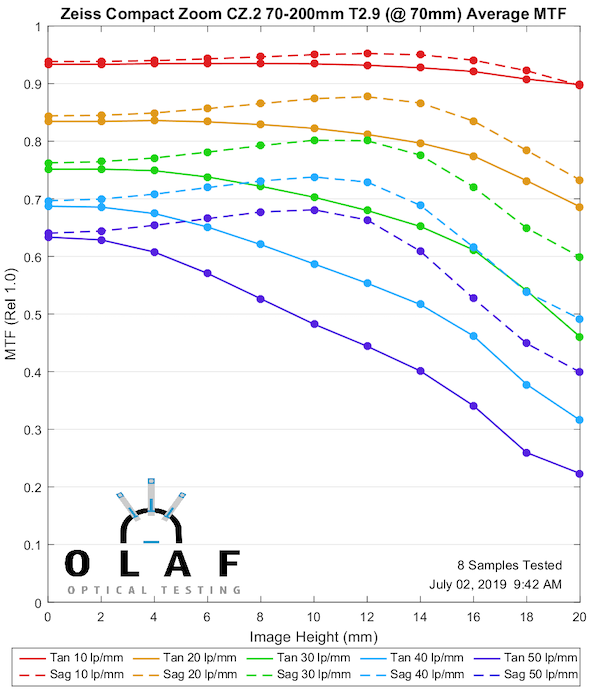
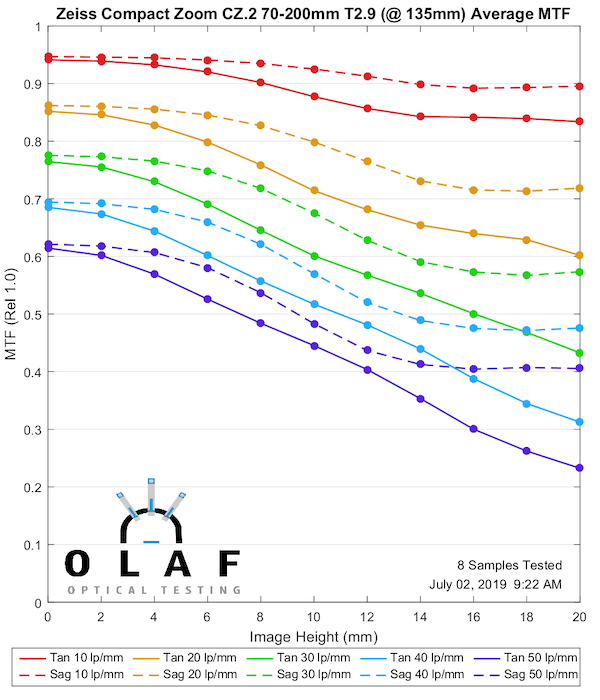
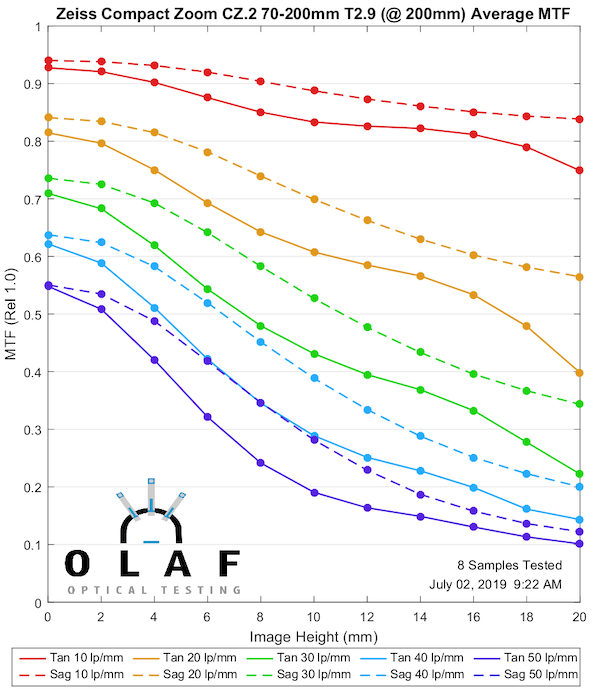
I’m going to do Cinema lenses separately, but I thought some of you, at least would be interested to see how these relatively expensive photo lenses compare with a $21,000 Cinema 70-200mm T2.9 zoom.
Zeiss 70-200mm T2.9 Compact Zoom
If you are expecting that extra $18,000 buys you higher resolution, well, nope. What it buys is consistency, lack of focus breathing, a true parfocal image, and accurate focusing scale. In general cinema lenses don’t resolve detail as well as photo lenses; there’s no reason they should and really quite good reasons why they shouldn’t.
70mm
135mm
200mm
Summary
The summary is simple. If you shoot Nikon, treat yourself to the FL ED VR if you can afford it. If you shoot anything else, make your choice based on price, how the lens handles and focuses, etc. The MTF curves say they’re all pretty good.
Roger Cicala and Aaron Closz
Lensrentals.com
July, 2019
79 Comments
Carleton Foxx ·
My triumphant sense of self worth comes from just owning any camera at all. I’m particularly proud of the excellent photos I can coax from my Brownie Hawkeye. I’m like a low-rent Vivian Maier.
Michael Jin ·
It’ll be interesting to see how things pan out when all of the MILC 70-200mm offerings are released.
Vladimir Gorbunov ·
The first batch of graphs bears the same captions as the second one: L IS USM II. Also which Tamron lens you tested, – G2 or original?
Athanasius Kirchner ·
I second Vladimir on both accounts.
SlvrScoobie ·
came here to ask this. IS II USM vs… IS II USM…? but the first is a classic?
Roger Cicala ·
Tamron is the original version, the G2 was optically identical except coatings and MTF (we did spot check) was unchanged. The first Canon is the original NON-IS with mislabeled graph. I’ll get that changed.
Roger Cicala ·
The Canon labels are corrected now. Sorry for the delay, I was moving Monday and Tuesday and had no interwebs
Vladimir Gorbunov ·
Thank you!
Now waiting for 10x zooms shootout, after Canon finally releases RF24-240. 🙂
Roger Cicala ·
Vladimir, life is too, too short for me to test 10X zooms. NEVER!!!
Michael Clark ·
Apart from optics, the Tamron G2 is compatible with their ‘TAP-in Console” USB dock and software that allows the end user to update lens firmware and do highly detailed micro-adjustment without sending the lens back to a service center. The original version is not compatible with the TAP-in system.
Andreas Werle ·
Thanks Roger for sharing your Data with us!
May I have a question about the MTF-Chart of the Zeiss Cinema-Zoom. As I understand it, MTF-curves cannot distinguish such a lens from a usual Canon- or Nikon-Zoom. Can OLAF deliver any data, which are unique to Cine-Lenses, show specifically their quality and would it not be interesting to make those measurements?
Greetings Andy
Roger Cicala ·
Andreas, MTF can show their MTF; the resolution and sharpness. In a deeper dig than I do here, it can show the field curvatures and how it transitions from in-to-out of focus. It can also show that there is less sample variation in those parameters.
However, many of the parameters cinematographers value; everything from focus breathing, flare characteristics, ‘rendering’ in all it’s meanings, etc. are not indicated by MTF. Remember also cinema is less about resolution in most cases, and more about those other things, hence less emphasis on MTF in the cine world.
JordanViray ·
The performance of the Tamron is impressive. I’ll have to add it to my shortlist.
Baconator ·
The Nikon looks impressive. Thanks for testing and publishing!
Mike ·
I’m just curious why a lens would perform differently for Sagittal and Tangential lines. IE: why would it resolve one type of line better than another given the same line thickness/spacing and distance from center?
Astro Landscapes ·
Because lenses are made up of circles of glass, and depending on how the elements are actually constructed, they may have issues resolving detail one way or the other. (It’s not just vertical detail versus horizontal detail anywhere in the frame; it’s actually measured along lines emanating from the center of the frame. So horizontal/vertical is all relative.)
(I did a terrible job of explaining that.)
Mike ·
If it’s “one way or the other” then one would think that in the MFT the dotted lines would sometimes be higher and the solid would be higher in other lenses. In almost all cases though, the dotted lines are higher than their respective solid line. I don’t really understand why.
Athanasius Kirchner ·
I’m no optical designer, but that would probably suggest that sagittal resolution is more important to lens designers than tangential, and that could be for good reasons – if nothing else, it’ll aid AF, since most systems search for vertical contrast (and sometimes horizontal too), and both axes fall under sagittal resolution.
Brandon Dube ·
There are more tangential aberrations than sagittal. It is nothing done by intention.
Athanasius Kirchner ·
That’s very interesting. Thanks for the correction.
Brandon Dube ·
Imagine you have a sphere that you’re looking at. If you’re dead nuts lined up to it, it’s completely symmetric and things should look the same no matter how your eye gazes. Now move your head up, say, 2/3 the diameter of the sphere. In the horizontal direction, it’s the same sphere it ever was. In the vertical axis, now you can’t see the bottom of it because the middle is in the way, and the profile looks different. This difference is the source of why the T and S performance can differ.
A snowglobe makes a good play piece for this.
Mike ·
That explains why you can’t see the bottom if you move up (which is obvious) but doesn’t explain why lines in one direction have higher values than lines in the opposite direction.
Brandon Dube ·
Being unable to see the bottom is an expression of the fact that the sphere doesn’t have symmetry anymore once you move away from its axis. In optical design, you would never use a sphere of such curvature so far off-axis for the belly blocking the bottom problem to appear. However, optics is extremely sensitive, and the sphere appearing different in the two axes by even a couple of nanometers is significant.
As you begin to move away from the axis, the sphere appears flatter on one side then the other. This creates an aberration called Coma. There is also an appearance that the “average tilt” of the surface is changing, in one axis, as you move away from the center. This creates an aberration called Astigmatism.
With regard to S and T, T is the axis that is normal to this off-axis geometry, so it does not have these aberrations (in a simplified understanding…), while S does. Since S has more aberrations, and aberrations blur the image, the MTF (a measure of contrast, where “1” is unblurred and “0” is completely blurred) tends to be lower in that axis.
If you want to peel away the simplification, my inbox is a better place than the LR comment section – brandon at retrorefractions dot com
Mike ·
Thanks, it’s starting to make more sense 🙂 I’ll ping you if I have more questions.
Ilya Zakharevich ·
Brandon, this is a very beautiful explanation. And it is also is complete BS.
Because a sphere is (gasp!) spherically symmetric, it looks exactly the same from any direction. Your explanation cannot work without involving the words “optical axis”.
The other parts of the explanation do not make a lot of sense either… (But, of course, the spirit of your explanation is great!)
?????????????????????????? I would rework what you say like this:
Put a point light source off optical axis, and observe its image on the sensor (through a lens); this is the “spot of confusion” (SoC; it is going to be circular?—?CoC?—?for the source on-axis). This spot is symmetrical (with the mirror going “radially”: from the center of the image). The geometry of the SoC is determined by aberrations.
Due to symmetry, “odd order aberrations” in the direction “across the mirror line” disappear AUTOMATICALLY. On the other hand, optical design needs to do special effort to achieve similar cancellations in the other direction. (And since lens design is about balancing-the-compromizes, such effort cannot be done ideally!)
Because of this it is much easier to decrease blurring in tangential direction than blurring in the radial direction. Finally: tangential blurring affects RADIAL LINES, and vice versa.
Ilya Zakharevich ·
Moreover, I suspect that your explanation is not only BS, but also it may be wrong (did not try to think about it deep enough!). I suspect that the MAIN COMPONENT of these aberrations comes from curvature of field?—?so one needs to explain why the surface of “tangential best focus” is more curved than the surface of “radial best focus”?—?and AFAIU the symmetry does not say much about these two curvatures.
The explanation I know involves “exact optics”?—?but I do not remember whether it explains this effect, or the opposite one! 😉
Brandon Dube ·
I encourage you to write a book, since you seem to know something Conrady, Hopkins, Welford, and Sasian all missed. Be careful using the phrase “spot of confusion,” though; nobody with any background in optics, much less aberration theory, would use that expression. It’s either a point spread function, or a “spot” casually. And CoC is a fabrication of people working on DoF, not aberrations.
Your “across the mirror line” symmetry is the same thing I described, perhaps you were confused about which axis I meant, and if you were I’m sorry I was not more clear. If you weren’t, please stop writing and provide a page # reference to a well-regarded book on aberration theory. The authors at the top of this comment are a good start.
Ilya Zakharevich ·
Brandon, be a good sport and do not try to shift responsibility for what you wrote to other people. If you cannot see the problems with what you wrote, I recommend looking again in a week or so. (It takes A LOT of training to see goofs in YOUR OWN writing quicker than this!)
> Be careful using the phrase “spot of confusion,”
Sorry to say this, but after what you wrote, you are not in a good bargaining position to recommend how to explain things to novices…
> a page # reference to a well-regarded book
If you can provide such?—?explaining how the curvature of surface-of-focus-for-tangential-lines is related to one for radial lines, I’m willing to reshuffle my TODO list (full for the next 25–30 years) to have a look at this, and compare this with my “exact optics” calculations.
Brandon Dube ·
A sphere does not look the same from any direction, if it did my snowglobe analogy would not hold water. It looks the same along any axis normal to its center of curvature, which is hardly all directions.
The description I gave is completely correct, up to a misinterpretation of my description of axes, and a consistent typo exchanging T and S. This is what happens when one writes from an airport lounge in the wee hours of the morning.
Regarding your last paragraph, the radial direction is not considered in what I wrote, so I hardly see how I need explain anything about it.
Ilya Zakharevich ·
> The description I gave is completely correct
This is very easy to write down! As I said: let’s put aside our
rapiersquills, and you try to revisit what you wrote in a couple of weeks. Your mind block (about spherical symmetry of a sphere) has a good chance to dissolve then…Brandon Dube ·
Do not put words in my mouth. I _specifically_ discussed a Cartesian frame of reference _and_ explicitly stated that the spherical frame of symmetry is irrelevant. Good day.
Arlington Brian ·
Heya Roger, I know that no-good can come from asking this. I have a Sony 70-200 f 2.8, I love the real world images, everything is great with the world. So let’s assume I read this and was obsessed with knowing if that is a good or a bad copy, is there some reasonable test I can perform to compare it to a ‘known good’ copy?
Can I see anything meaninfly if I print off a test sheet, and adapt my Canon 70-200 f2.8II and zoom them both in at 11:1, or is that too amatuer a test?
I know I should just look at my real life images and be happy, but you created a monster (me) 🙂
Astro Landscapes ·
Easy: Test it on an A7R2 or A7R3, with all factors of potential shake eliminated, and perfect focus on a highly textured flat subject. (Brick walls are popular, but I’m a hedge guy myself.) If it “looks good” to you, then test complete. (Chances are, if you haven’t noticed any softness yet, you won’t notice softness under a perfectly controlled static test…)
Roger Cicala ·
I am Roger Cicala and I support Astro Landscapes message. A good days shooting with an A7R3 is all the test you’ll need, and I could make a strong argument in some ways is a better test than what I can do in the lab. Shooting is 3-D, the lab is 2-D.
Astro Landscapes ·
Oh, good, I’m not a crazy person who tries to balance clinical standards of measurement and diagnosis with real-world shooting conditions… 😛
DrJon ·
He did write this….
blog/2010/11/how-to-test-a-lens/
Which may or may not escape the Spam filter…
Arlington Brian ·
@disqus_JqeE7F3maD:disqus that is perfect, thank you sir 🙂
Roger Cicala ·
Arlington, assuming you have a good copy of the Sony, I suspect you’ll find they are pretty indistinguishable, or perhaps, ‘this one is seems a little better here and that one there’. If you see a ‘this one totally kicks the other one’ I would bet you have a truly bad copy of the other one.
DrJon ·
There’s also this:
blog dot kasson dot com slash lens-screening-testing
Which is quite a bit of work…
Anatoly Shapiro ·
I wish you had the old canon 80-200 2.8L on that comparison, its magic for a reason
Astro Landscapes ·
Not as good as the old Nikon 80-200 2.8. That thing is legendary. 😛
Anatoly Shapiro ·
Well then i would like to see both those lenses on this comparison. Given the age of the canon drainpipe and the legendary status it holds among internet comments, mostly pointing out that it was optically superior to the modern versions, it would be interesting.
While I’m sure Nikon has their own legendary lenses I am just not familiar with them, but of course would love to look into that as well(girlfriend shoots Nikon), could you be more specific than Old 80-200?
Christopher J. May ·
I think both the Canon and Nikon 80-200mm f2.8s would fall apart compared to everything listed here. A lot of their ascribed “magic” qualities were first postulated in places like the the DPReview lens fora when megapixels counts were 12 or less. I own the AF Nikkor 80-200mm f2.8D and it was serviceable when I was shooting a D600. When I switched to a D800, I started being a little more critical with how I used it and when I tried it on a Z7, I was a lot more critical. Honestly, it’s still fairly impressive when stopped down a bit, especially when one considers that it was designed in the 1990s. But when used wide open on a high resolution body, it’s well behind anything listed above. I would guess that the Canon 80-200mm would probably test similarly.
Astro Landscapes ·
I strongly suspect this is exactly the case. The old 80-200’s were merely a touch sharper than the 1st-gen 70-200’s that they were replaced by, probably because the 1st-gen 70-200’s were an optical compromise for new autofocus technology, the slightly wider end, and/or the addition of stabilization optics. They’d fall apart (wide open) compared to the Nikon 70-200 E.
Having said that, those older lenses are still WICKED sharp when stopped down. I keep randomly testing old lenses on the D850 and Z7 and they’re just bonkers by f/5.6. Even my old series E 50mm that is just fuzz at f/1.8 is totally handling 45 megapixels at f/5.6… I’ve got some old manual focus slow-aperture 80-200mm’s that are decent, too, at f/8 though never in the corners of course.
Anatoly Shapiro ·
For the canon side of old vs new I can say that the 80-200 is 16 elements, the 70-200 mk1 is 18 and the 70-200 mk2 is 23 elements, so all 3 use different optical designs, aside from the focus motors and added IS in the 70-200’s.
That aside, i cant remember where i read it, but iirc the canon 80-200 was removed from production due to some green-manufacturing initiative canon joined in the 90’s as the process for making the fluorine elements was using too much lead, hence there was no real market related reason to stop using this optical design.
Anatoly Shapiro ·
There is some youtube video with a british accent testing out the canon 80-200 2.8 on a sony A7RII body and according to that one, the lens still resolves quite well on a 42mp sensor, except for wide open on 200mm where it needs to be stopped down a bit.
Alec Kinnear ·
I own both the Canon EF 80-200mm f2.8 Magic Drainpipe and the Nikon F 70-200mm f2.8E FL (I’m slowly switching systems from Canon to Nikon, due to the again crippled video in the EOS R and the excellent video in the Nikon Z line: plus of course ergonomics, I don’t like touchbars and I do like joysticks, like I enjoyed in my 5D series cameras).
The Canon EF 80-200mm f2.8 on which I’ve shot sport on a 5D, 5DIII and a 5DSR is very sharp – from f3.2. At f2.8 it’s great on the the 12MP 5D, acceptable on the 5DIII and a bit rough around the edges on the 5DSR. The Nikon f2.8E FL is very sharp from f2.8 on both a Z6 (24MP) and a D4 (just 16MP). Focusing of course is faster on the newer Nikon lens which is an advantage for sport action and servo focus.
Honestly though, a good photographer could get his or her images with either one. The lens is not the weakest link here from f3.2. Keep in mind the Canon Magic Drainpipe has old school focusing with a bit of buzz. Not a problem for sport but definitely an issue for live music/theatre (where I ended up shooting the EF 85mm f1.8 as it was quiet).
Astro Landscapes ·
Can’t wait to see how the Nikon Z and Canon RF 70-200’s perform! Considering the eye-popping acuity I’ve seen from the existing RF L’s, I’m expecting a lot from the Canon at least, and of course the Nikon has quite some shoulders to stand on too.
Renaud Saada ·
Roger, I remember you writing that the 200 L II was one of your favourite lenses until you saw the results of the 70-200 L IS II. The centre performance of the zoom is higher, but these results seem to demonstrate the prime is better if you consider the whole field, no ?
Roger Cicala ·
Exactly Renaud!
Renaud Saada ·
With the wide field covered by the EOS R autofocus, the performance in the whole field becomes more important as we tend to put the subject anywhere in this field. And moreover, the prime is much cheaper and has less weight than the zoom.
Thanks for all these tests, data and comments shared here
GulliNL ·
@rogercicala why didn’t you include both the Wunderbar and the Ultraboy charts? You sold them pretty well to me but how can I boast their quality if I can’t slap people with charts? (How do they compare in real life? I heard the Wunderbar has had some issues with bad copies in the past but the new batch should be spectacular!)
Roger Cicala ·
Obviously because Wunderbar is paying me big bucks to not make that direct comparison.
Ludwig Eder ·
sorry for reading as wunderbra…
Gosh1 ·
Very interesting. Thank you for sharing all this hard work at the bench.
Nikon have set high standards for anything in this guild of optics it puts out in the future…. not least the forthcoming 70-200 S-Nikkor for the Z System!
And so we see the meaty data that explains the conclusions of Thom Hogan in his review of the current Nikkor 70-200:
“somehow this new 70-200mm f/2.8E tests a lot like a prime. Let me put it a different way. If I were to test a 70mm f/2.8 prime and get the results I got from this zoom, I’d be happy. If I were to test a 135mm f/2.8 prime and get the results I got from this zoom, I’d be happy. If I were to test a 200mm f/2.8 prime and get the results I got from this zoom, I’d be more than happy. Indeed, at every focal length this lens is up in the “pretty darned good prime” territory. Enough so that I had to update my Rationalizing Lenses article. ….the only three primes I know of that perform better than the 70-200mm f/2.8E at the same focal length are the 200mm f/2, the recent Nikkor 105mm f/1.4E, and the 85mm f/1.4 Zeiss Otus. That’s saying a lot.”
Ashley Pomeroy ·
I don’t want to sound bitchy, but that could be condensed to “at the equivalent focal lengths this zoom performs as well as the best primes, with few exceptions“.
I mean, yes, technically it is saying a lot, but there must have been a better way. It’s like those YouTube videos that are 10:06 long because they can have two adverts instead of one.
On-topic, I have a 70-200mm f/2.8 IS, the original. It must have been a popular rental back in the day, and it’s a relative bargain on the used market. It would be nice to see what it’s like. From what I’ve read it’s similar to the original 70-200mm f/2.8 but not quite as good in the corners, presumably because of the IS unit.
Roger Cicala ·
Ashley, I think the original IS was actually a bit better than the NON-IS, but they were very close.
Chik Sum ·
they are all impressive, but after comparing and looking back at the classic F4 IS lens which I owned for 11 years, I’d say I’d be nicer to my bank account (and neck). current lens tbh is quite far above what we needed/wanted. maybe the premium lens are more of a weather sealing and constant aperture thing to most.
as canon shooter I feel like I’d be more on the L lens, but the sigma is also interesting to me
YS ·
they are all impressive, but after comparing and looking back at the classic F4 IS lens which I owned for 11 years, I'd say I'd be nicer to my bank account (and neck). current lens tbh is quite far above what we needed/wanted. maybe the premium lens are more of a weather sealing and constant aperture thing to most.
as canon shooter I feel like I'd be more on the L lens, but the sigma is also interesting to me
TwoMetreBill ·
Photographers get great photos from any lens. Imagers want to count the eyebrows on a gnat.
Aside: lens breathing is just plain incompetent design, the designer(s) should be fired. Nikon 70-200 f/2.8 with 30% loss of focal length at close focus, their macros are even worse. The 70-200 f/4 gains 2% at 200, that team should be in charge of lens design.
Brandon Dube ·
I’d bet the designers of the lenses that breath so heavily are better at their jobs than you are at yours.
Antonio Sánchez ·
I am curious, would this charts change much whether the lens is focusing at infinity or at close range?
DrJon ·
Excellent question…
Roger Cicala ·
Antonio, the answer is sometimes significantly but usually just a bit. Unfortunately, MTF benches work at infinity or at macro distances, but not in between. In general, newer lenses and cinema zooms with compensating elements change very little, older designs without them may change more significantly close up.
Antonio Sánchez ·
Thanks!
Jeff Allen ·
Interesting set of results. In cinematography we do have sophisticated MTF machines but by far we rely on company made projectors that are set-up by a dedicated teams in our offices to strict standards. Our staff are consistently trained on how to read the results and in our larger offices we encourage clients to test if they want too.
All that said we have also experienced high levels of “older imperfect” lenses being used to create a “look”, not everyone wants razor sharp, high resolution images.
Vladimir Gorbunov ·
> It’s a decent lens with a LOT of sample variation.
Dear Roger, may I ask you about how you evaluate the sample variation – is it “raw” data, or it includes possible fixing in service?
For example if you test a lens, it appears soft, then you get it fixed in service, and it becomes OK – will you count this case against the sample variation of this lens model? My own copy of said Sony FE24-240 was soft on one side, but Sony service was able to fix it quite well (but it took about one month), and now I consider my copy as quite a good lens.
Roger Cicala ·
Vladimir,
A pertinent question that’s a bit complicated to answer. In general, this graph (an older one using Imatest, rather than MTF) is a good answer:
https://uploads.disquscdn.com/images/c32e1b7568b0ce1d5905595565cdc66bedf671e5e32c6247ae8aaa490e9584b2.jpg
Simple population statistics generally identify the difference between an outlier and variation once we’ve done even 4-5 lenses. Additionally, as you point out, it’s pretty easy to identify gross tilts of decentering on simpler tests.
A couple of articles from when were working the process out:
https://www.lensrentals.com/blog/2011/10/notes-on-lens-and-camera-variation/
https://www.lensrentals.com/blog/2015/08/mtf-and-variation-an-example/
https://www.lensrentals.com/blog/2015/06/measuring-lens-variance/
Arun Raj ·
Roger,
Thank you!
Could you please let us know whether you have plans to test Pentax 70-200 F2.8? I know that in the past you have mentioned about the difficulty in testing Pentax lenses, has that situation changed? Many Pentaxians vouch that the Pentax 70-200 F2.8 is the best in terms of optical qualities (not about focusing speed)…
Roger Cicala ·
Arun, I still haven’t got a Pentax mount and not certain when I will.
Cliff LeSergent ·
Isn’t the Pentax 70-200mm f2.8 just a re-badged Tamron, like most of the current Pentax f2.8 zooms?
Nicholas Bedworth ·
Roger… Thanks for the detailed comparison and thoughtful comments. We can more fully appreciate the reasons for your lack of enthusiasm for the Sony glass in this category.
That being said, so far, my search on Lensrentals for MTF or reviews of the Sony 100-400 GM zoom isn’t coming up with anything. Perhaps I’m not using the right search terms?
Given your admonitions regarding the 70-200, and my interests in wildlife photography in Sri Lanka and Nepal (my home), it seemed to me that the longer lens would be better suited. Any comments? Body is an A7Riii.
Thanks so much!
Roger Cicala ·
Nicholas, I haven’t tested the 100-400 yet; at first we couldn’t keep it in stock, later some other things took precedence. I have it lined up for testing in early August. Everything I see from reports on our rental stock, though, is the 100-400 is a damned good lens, both optically and from a reliability standpoint. That seems the trend for all the more recent Sony lenses. My own opinion is there was a learning curve the first couple of years, but the learning was fast and furious and the new stuff is really good.
Nicholas Bedworth ·
Thank you, Roger!
Early August is coming up very soon, so this is good news. Quite a few readers should be looking forward to the testing results and analysis. My background is scientific image processing, so it’s really encouraging to see MTF, etc., being used to better inform consumers and professional photographers regarding their “Which lens to choose?” decisions.
All these lenses are impressive objects to behold, with incredible features and capabilities compared to even 5 years ago, but at the end of the day, MTF is an ineluctable criteria, and your blogs present this somewhat complicated topic in an understandable format.
Reliability, which in my case means surviving high humidity and terrible dust, sometimes on the same day, is a real issue, as we’ve discussed offline before. It will be interesting to see how my A7Riii does in Sri Lanka next week…
WestEndFoto ·
Very interesting. I almost wanted to throw out my 85 1.4G when I bought the 70-200 2.8E. Then I bought the 105 1.4E and the world was right again.
Stanley Kubrick ·
You despise the Sony 70 to 200 but you don’t say specifically why? And I don’t want to have to read all your charts. Can you just say why?
Roger Cicala ·
Sure, I say it all the time. It’s poorly designed mechanically making it fragile, the sample variance is high, and repairs are breathtakingly expensive, averaging over half the cost of a new lens.
Stan Chung ·
Nikon 70-200 vr2 repairs for me is coming to almost halfway mark. First it the AF focus plane if off, then the VR unit is replaced. YMMV.
Reggie ·
Hard to believe that Sony, Nikon, and Canon all have new 70-200s since this was posted. Be interesting to see them added here.